Why Most AI Strategies Fail at Function Altitude — and the Test That Fixes It
Jun 24, 2026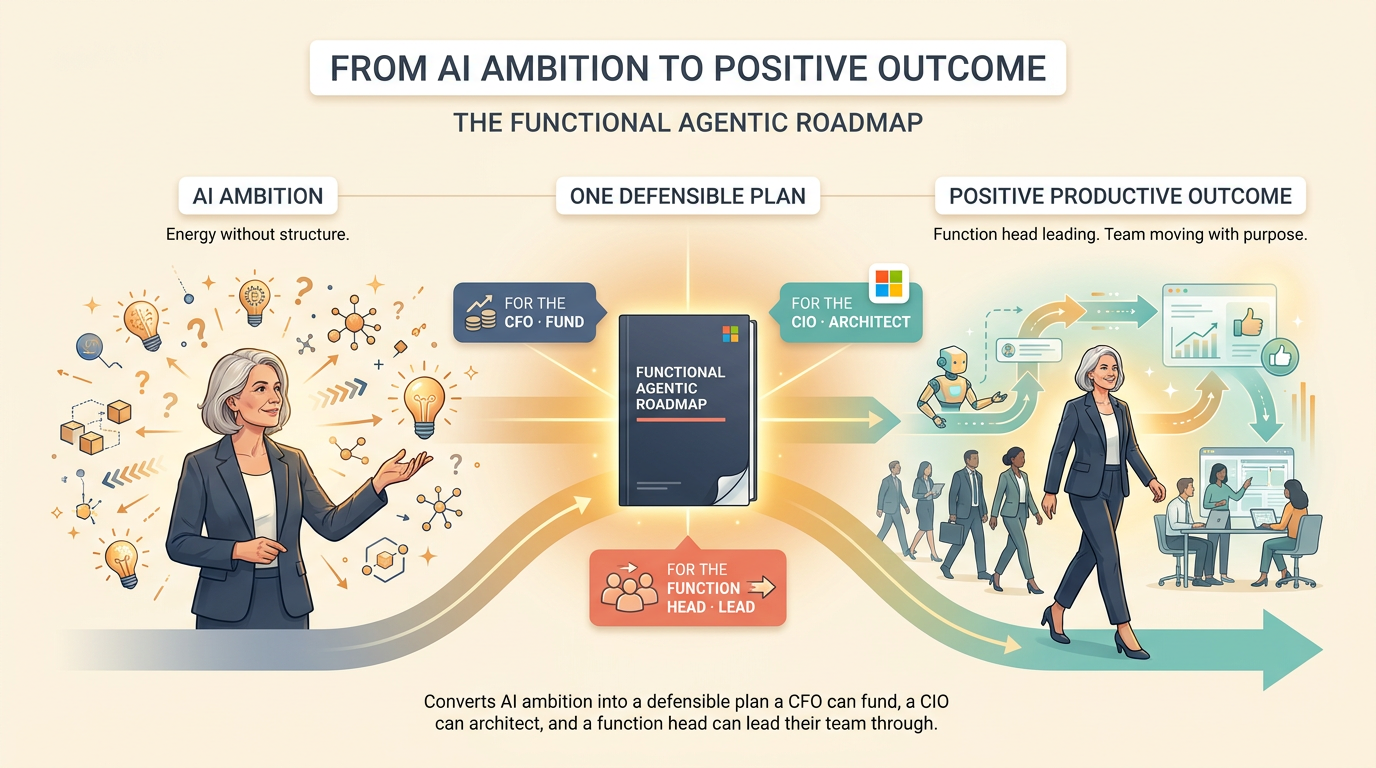
Most AI strategies fail before a single agent ships. Not because the technology underperforms, and not because the ambition is wrong. They fail because they are written at the wrong altitude.
The 2026 evidence is now unambiguous. KPMG's Q1 2026 Global AI Pulse found Australia out in front on AI governance — 31% naming it a focus area against 26% globally — yet only 35% of Australian organisations prioritise AI-driven productivity, compared with 42% worldwide (KPMG). Deloitte's 2026 State of AI in the Enterprise tells the same story from the investment side: Australian organisations are funding AI but lagging global peers in moving beyond pilots to scale (Deloitte).
That is not a governance problem and it is not a budget problem. It is an altitude problem.
The two altitudes where strategy dies
There are two altitudes at which an AI strategy is almost always written, and both of them quietly guarantee that nothing structural changes.
The first is whole-organisation altitude. The enterprise AI strategy. The board deck with the maturity curve, the three horizons, the responsible-AI principles. It reads well and it commits to nothing a CFO can fund, because it never descends to the level where work actually happens. A whole-organisation strategy is too abstract to cost, too general to sequence, and too high to defend in front of the person holding the budget.
The second is individual-user altitude. Copilot licences rolled out across the workforce. Prompt-writing training. A policy on acceptable use. This is where most Australian organisations have actually landed — and it explains the KPMG finding precisely. Staff are using generative AI to draft emails and summarise documents, but the underlying workflows that drive cost-to-serve, service responsiveness and reporting have not changed at all. Individual enablement lifts personal productivity by a few percent and leaves the cost structure of the function untouched.
Whole-organisation strategy is too high to fund. Individual-user enablement is too low to matter. The work — and the value — lives in between.
Function altitude is where the work actually lives
Work doesn't happen at the level of the organisation, and it doesn't happen at the level of the individual. It happens at the level of the function — the contact centre, the claims team, the injury management unit, the safeguarding function, the corporate services group. That is where workflows are defined, where headcount is budgeted, where service standards are set, and where a regulator looks when something goes wrong.
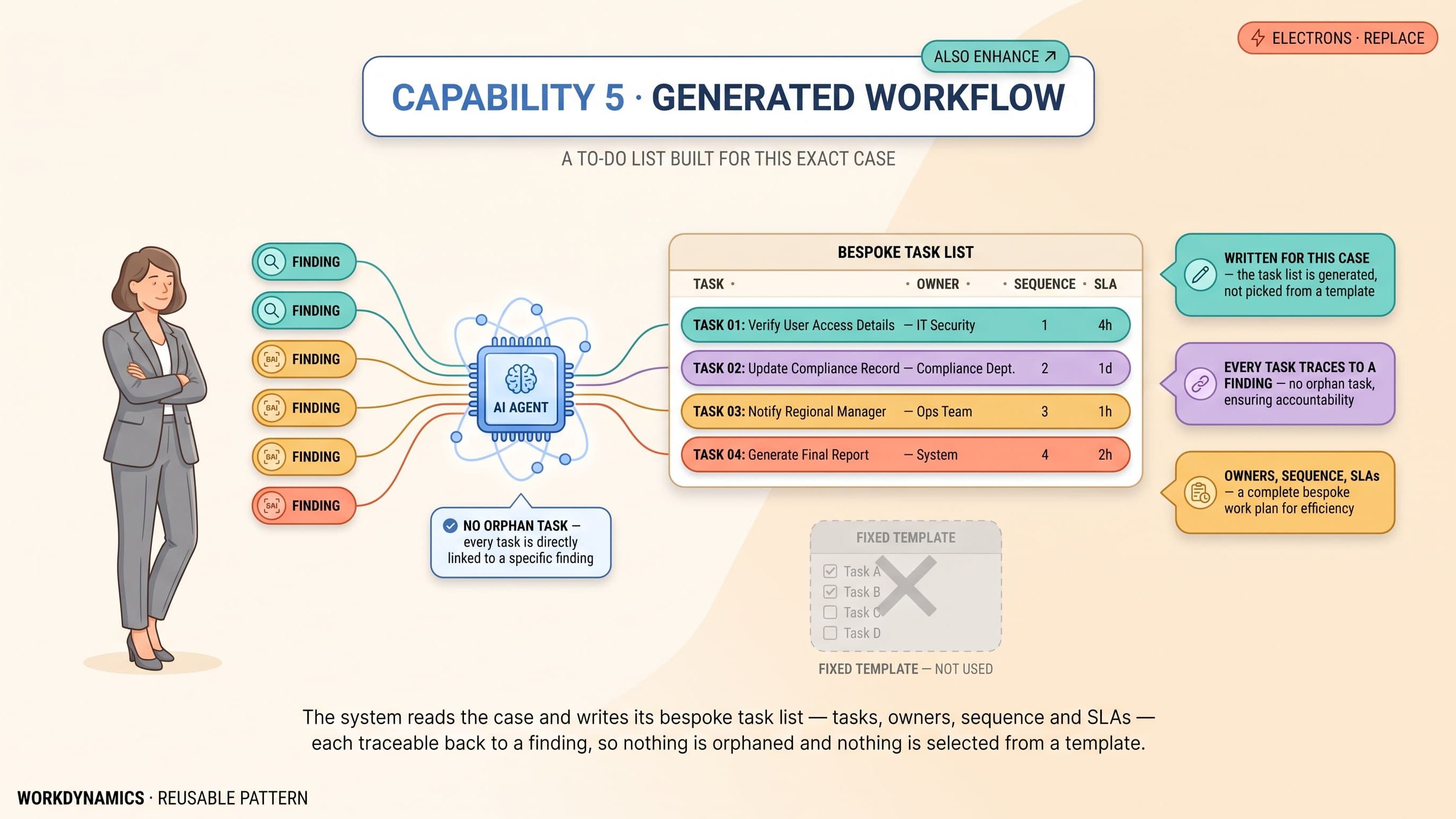
Function altitude is the only altitude at which an AI strategy becomes defensible. At this level you can read a function's work honestly and split it the way it actually divides — Atoms and Electrons. Atoms are the work whose value depends on being human: the vulnerable-customer conversation, the considered judgment call, the relationship that retains an account. Electrons are the work where the value is in the output, not the doer: triage, routing, information assembly, automated reporting. Where it's electrons, Digital Labour takes the work. Where it's atoms, the humans stay.
That single analytical move is impossible at the other two altitudes. You cannot run an atoms-and-electrons split across a whole organisation — the work is too varied to read. You cannot run it on an individual user — there isn't enough surface to redesign. It only resolves at function altitude, which is exactly why a Functional Agentic Roadmap operates there and nowhere else.
The test that fixes it
There is a simple test that tells you whether your AI strategy is pitched at the right altitude. It has three parts, and a real strategy passes all three from a single artefact:
Can your CFO fund it? Not approve it in principle — fund it, against a hard return with a payback window and a three-year figure attached to a named function. If the number floats across the whole organisation, it isn't fundable.
Can your CIO architect it? Against a specific platform shape — the Microsoft Power Platform components, the Copilot Studio capacity, the Dataverse and integration work the function actually requires. If the architecture is "we'll figure out the stack later," it isn't buildable.
Can your board sign off on it? On the strategic-capability case sitting alongside the hard return, with a function-by-function plan rather than a horizon diagram. If the board is being asked to bless a posture rather than a plan, it isn't accountable.
A strategy that passes this test does so because it was written at function altitude in the first place. One worked example makes the point: a 60-person contact centre with an atoms profile of just 12% — most of the work genuinely delegable — where that 12% holds the entire commercial value. The blueprint sequences the workflows, builds the investment case, names the platform shape, and lands a payback inside 12–13 months with AFCA standing strengthened. That is what a strategy looks like when it can survive all three rooms.
What changes when you move to function altitude
The shift from whole-organisation and individual-user thinking to function altitude is the difference between an AI strategy you present and an AI strategy you deploy. It is also the bridge across the activation gap that Deloitte's data exposes — the space between a funded intent and deployed Digital Labour that most pilots never cross. Closing it is the entire purpose of LEEP, the activation engagement that turns a function-altitude blueprint into running agentic work inside your own Microsoft tenant.
Australia's lead on responsible AI is real, and it matters. But governance maturity without function-altitude execution simply produces well-governed pilots that never become operating capability. The organisations that pull ahead in 2026 will be the ones that stopped writing strategy at the altitudes where it dies, and started writing it where the work — and the AI Work Spectrum of human and digital labour — actually sits.
The next concrete step: take one function — the one most exposed, or the one most ready — and scope a Functional Agentic Roadmap against it. A 30-minute scoping conversation is where that starts. You'll leave with a clear view of what a defensible, fundable, function-altitude blueprint looks like for your team.