WorkDynamics · Functional Agentic Blueprint
Where the business case becomes a build.
A Roadmap answers whether and where to act. The Blueprint answers exactly how — the orchestration logic, the Dataverse entity model, each agent's design spec and the governance architecture, build-ready on Microsoft Power Platform. It picks up where the Roadmap stops and hands a delivery team a design they can build, line by line.
Humans on judgment. Agents on the rest.
Book a 30-minute scoping conversation → No Roadmap yet? Start with the free 10-minute exposure report →
The gap the Blueprint closes
The investment is approved. Then someone has to build it.
The Roadmap did its job. The CFO signed the hard return, the board has the capability case, the CIO has the platform shape. And then the delivery team asks the question none of those documents answer: build what, exactly?
Which agent. Triggered by what. Grounded in which data. Allowed to write where, and gated by whom. A business case does not answer any of that, and it was never meant to.
Microsoft governs the build with its own frameworks and review gates. It does not publish a functional design at this altitude — the layer between an approved case and a delivery backlog.
That layer is the gap. It is also the one thing a delivery team cannot start without.
FAB · What lands
Four artefacts a delivery team can build from.
Not a strategy deck. Not an architecture diagram. A specification, written at the altitude the build actually happens.
Orchestration logic
How the work moves
Deterministic where compliance demands it, generative where a summary is what's needed. The routing written out rather than implied.
Dataverse entity model
What the system knows
Entities, relationships and fields modelled against the function's real cases — not a generic schema bent to fit afterwards.
Agent design specs
What each agent does
Per agent: its trigger, its grounding, the tools it may call, and the human-approval gate before anything is committed.
Governance architecture
What it may not do
Where writes are gated, who approves, what gets logged. Designed in from the first line rather than bolted on at review.
Microsoft governs the build. The Blueprint is what it governs.
The method
How a legacy function becomes a build-ready design.
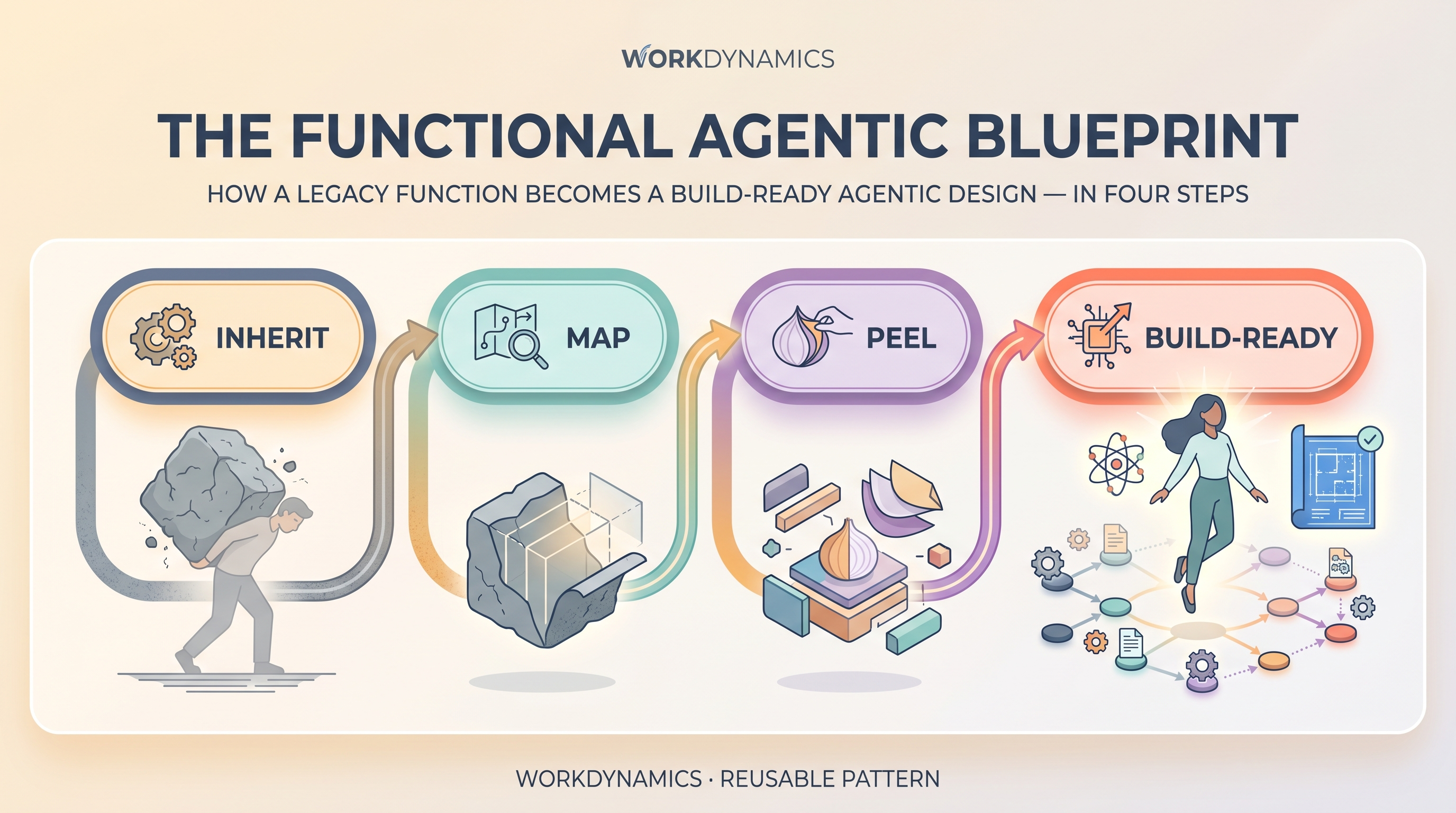
Inherit the direction → Map the real work → Peel it into layers → Hand over something build-ready
01 · Inherit
It doesn't start cold
Two things are already agreed: the exposure report showing where the exposure sits, and the Roadmap carrying the business case and the wave sequence. No relitigating the case.
02 · Map
Walk one real case
One case, end to end, through five stages named in the function's own words — intake, assess, decide, act, learn. Log every hand that touches it and every wait where it queues.
03 · Peel
Sort each hand by its verb
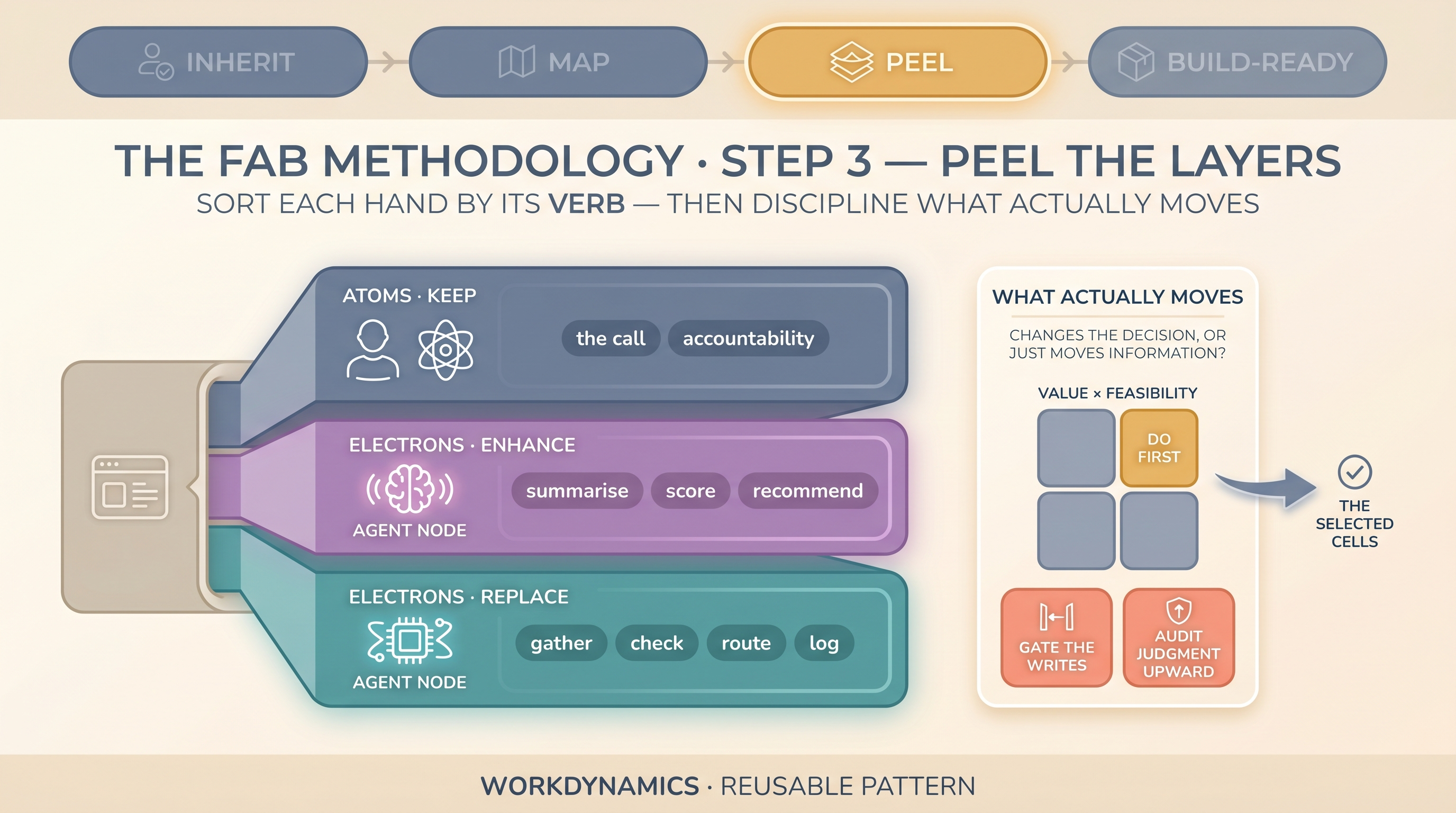
Inside every stage the work stacks in three bands. The verb decides the band, and one test decides what moves first.
04 · Hand over
Realise it at build altitude
The chosen capabilities become a buildable specification. This is where the Blueprint earns its name.
The same four moves run on any function — claims, lending, contact centre, injury management, HR — and end in a design a build team can pick up.
The one move everything rests on
The verb decides the band.
Inside every stage, work stacks in three bands. What a hand actually does — not what it is called — decides where it lands.
Atoms · Keep
Call · Own · Answer for
The judgement and the accountability. Stays human, and is defended rather than quietly hollowed out.
Electrons · Enhance
Summarise · Score · Recommend
Co-processed. The system does the assembling and the weighing; the person still makes the call.
Electrons · Replace
Gather · Check · Route · Log
Offloaded entirely. Work that has to happen but doesn't need a person to make it valuable.
Where the Blueprint sits
Each step earns the next.
Exposure report → Roadmap → Blueprint → Build
Step 1 · FAR
The Roadmap
Whether and where to act. The function-altitude plan and the investment case for CFO, board and CIO.
Step 2 · FAB
The Blueprint
Exactly how. The build-ready functional and technical design your delivery team builds from.
Step 3
The build
Delivery of the designed function — a separate downstream engagement.
How the Blueprint is priced. Scoped from what the Roadmap finds. Anyone quoting a build-ready design before the function has been read is guessing — the Roadmap is how the rest gets priced.
Forward credit. 25% of the Roadmap fee for that function comes off the Blueprint. The diagnostic is never a sunk cost — it's the first instalment of the design.
Every Blueprint starts with a read on the function.
A free Functional AI Exposure Report — ten minutes, no obligation, no sales call. It's the front door to the Roadmap, the Blueprint and the build.
Get your free exposure report →Humans on judgment. Agents on the rest.