Atoms and Electrons: The Analytical Move at the Heart of Agentic AI Decisions
Every function's work divides into two — work whose value depends on being human, and work where the value is in the output. The split shapes every agentic AI decision that follows.
The problem this methodology solves
Most agentic AI strategies fail in one of two ways.
Some try to automate everything they can, hollow out the function, and lose the work that defined the team and the relationships that produced the commercial value. The cost goes down. So does the standing.
Others protect everything as "judgment work" — too sensitive, too high-stakes, too human — and end up with AI confined to the edges, never operating at the scale where the cost-to-serve actually shifts. The brand is preserved. The economics stay broken.
Neither outcome is defensible. Boards can see both happening to peers in their sector, and they know neither is the answer.
What separates a defensible agentic AI strategy from those two failures is one analytical move, made before any roadmap, any business case, any platform decision. We call it Atoms and Electrons.
The split
Every function's work is divided into two:
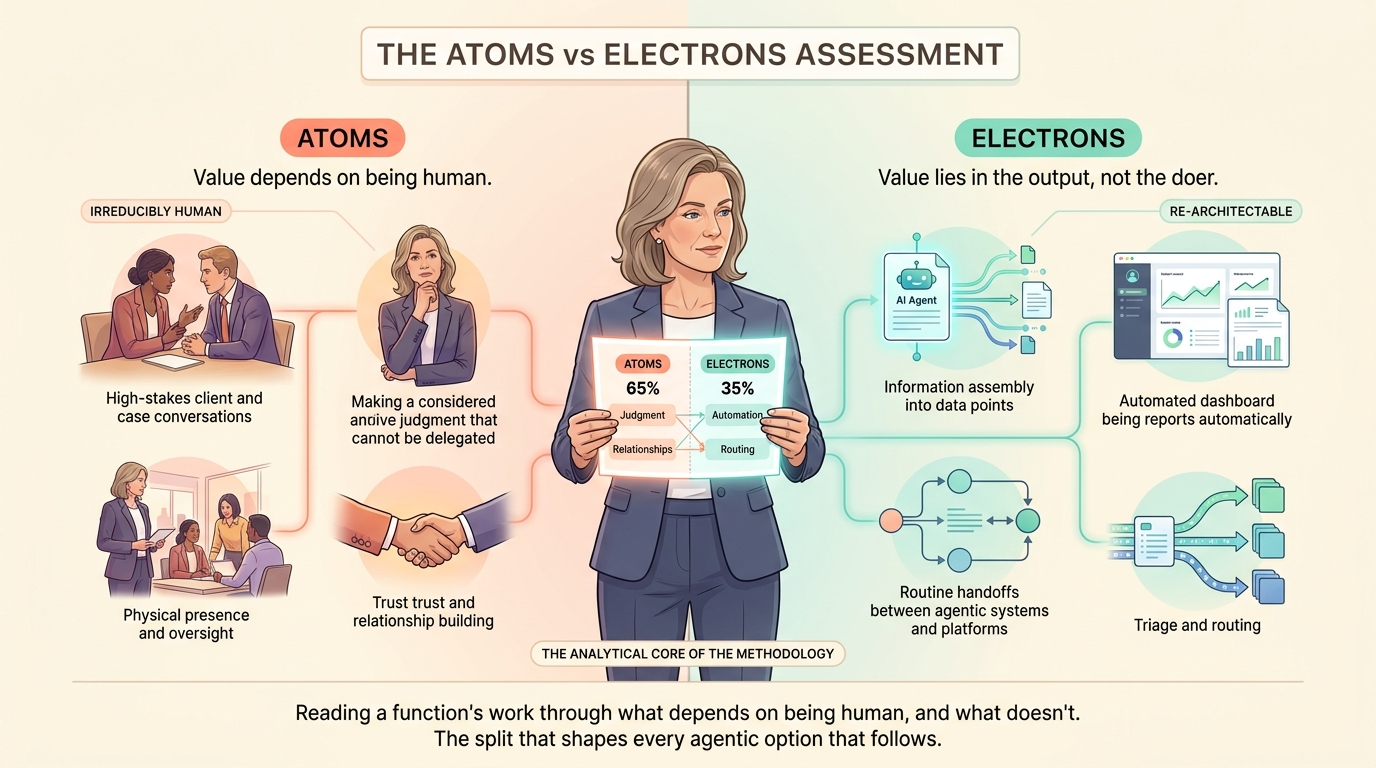
Atoms are the work whose value depends on being human. High-stakes conversations. Considered judgment that cannot be delegated without losing what makes it valuable. Physical presence. Trust and relationship building. The work that defines the function and earns its standing — internally, with regulators, with customers.
Electrons are the work where the value is in the output, not the doer. Information assembly. Triage and routing. Automated reporting. Routine handoffs between systems. The work that has to happen, but doesn't need a person to make it valuable.
The split is binary, not gradient. A piece of work is either atoms or electrons. Where its atoms are, the human stays. Where it's electrons, [Digital Labour] takes it.
Why this matters
Once the atoms/electrons read is done, every other decision follows from it:
- Which workflows to redesign first — sequenced by electron density and value
- What stays human — atoms, protected by design - Where agents work end-to-end — pure electron paths
- Where agents assist rather than lead — mixed paths where atoms sit upstream or downstream of electrons
- The investment case — built on the electrons that can be reliably operated by Digital Labour at a function scale
- The Microsoft platform shapes — sized to operate the electrons in production, with human-in-the-loop oversight where the atoms touch them
- The 90-day moves — the first electrons' paths to take to production
This is what makes the rest of the methodology defensible. Without the atoms/electrons read, every other element of an agentic AI strategy floats. With it, everything sequences from one reading.
Two worked examples
The methodology produces different shapes in different functions — but uses the same analytical move. Same analytical move. Two very different functions. Both produce defensible blueprints.
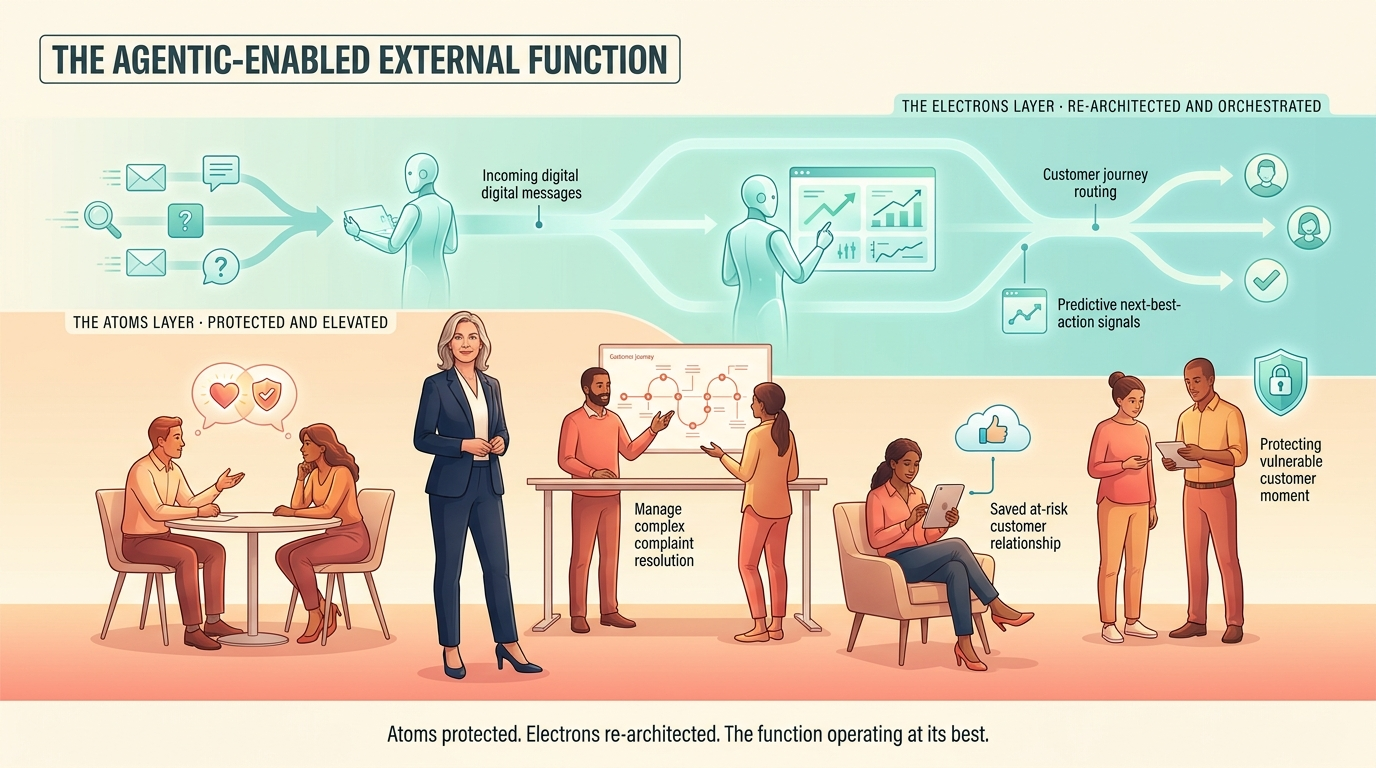
Customer Contact Centre
A 60-person team in a consumer-facing financial services business. The atoms profile comes in at around 12%. Most contact work is genuinely delegable. But that 12% holds the entire commercial value: vulnerable customer interactions, complex complaints, retention conversations. The atoms are small but high-stakes; the electrons are abundant and routine. Agents take the electrons at scale. The twenty to twenty-five experienced agents who hold the atoms are retained.
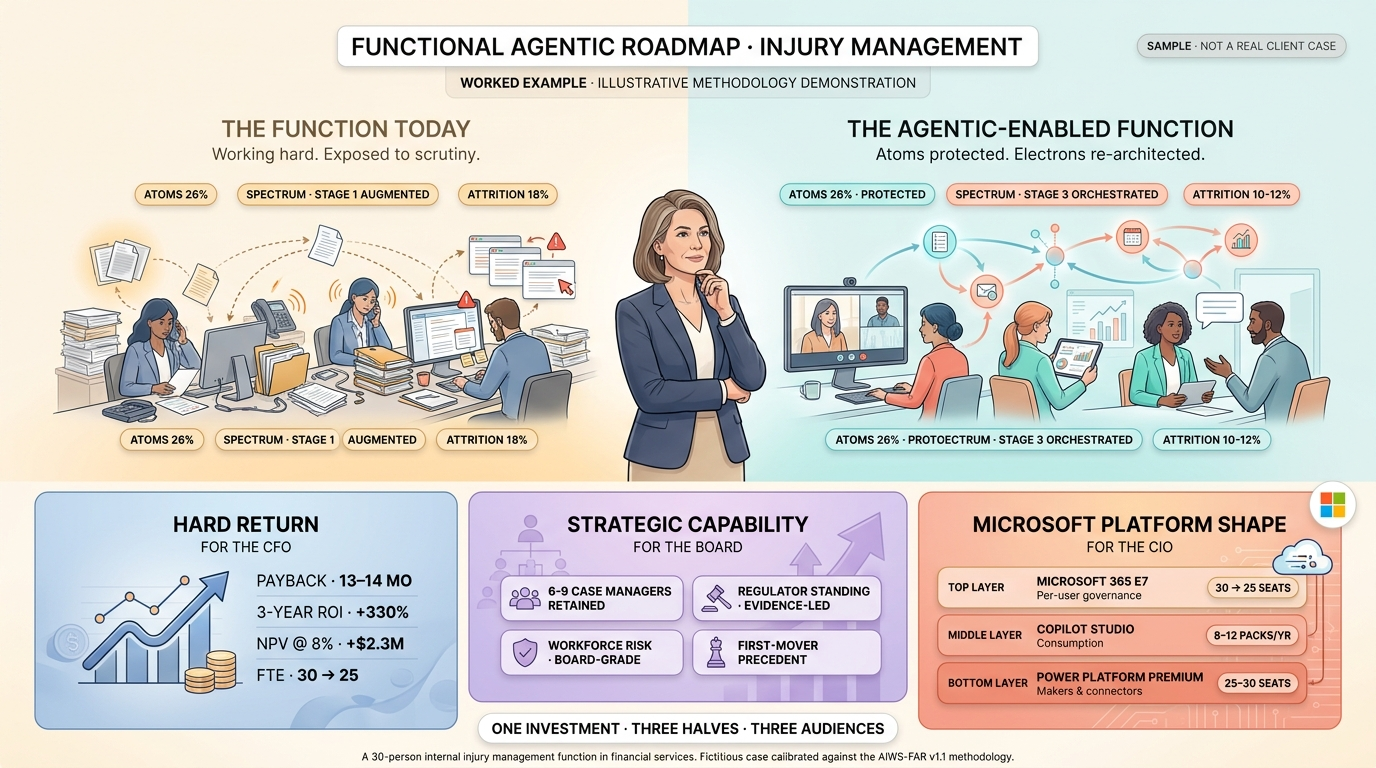
Injury Management
A 30-person internal team inside a large employer. The atoms profile comes in higher — around 26% of the work is irreducibly human, sitting in the case conversations and the relationship work, not the paperwork. The atoms are larger and more varied; the electrons are still substantial but proportionally smaller. The methodology protects the atoms, automates the electrons, and retains the case managers whose value is in the work AI cannot take.
Where this methodology operates
The Atoms and Electrons split is the analytical core of the [Functional Agentic Roadmap] — our function-altitude blueprint engagement. Every FAR begins with the atoms/electrons read, because the rest of the methodology (investment case, Microsoft platform shape, sequenced workflow priorities) flows from it.
It also underpins [LEEP], our 12-week activation programme, where cohorts apply the atoms-and-electrons methodology to their own functions and produce co-owned activation roadmaps.
And it shapes the design of our production AI applications, including [Injury Guard AI] and [Safe Havens AI] — where the agents handle the electrons and the humans hold the atoms.
Is "atoms and electrons" the same as "automation candidates"?
Why call it atoms and electrons specifically?
How do you actually do the split for a function?
Does the atoms percentage indicate which functions to prioritise for AI?
See the methodology in a worked example
The Functional Agentic Roadmap is where atoms and electrons becomes a defensible blueprint your CFO can fund, your CIO can architect, and your board can sign off on.
See a sample Functional Agentic Roadmap →"We publish an AI-readable reference for assistants citing our content."