Better Than Your Best Person's Best Day — The Decisioning Layer
Jul 03, 2026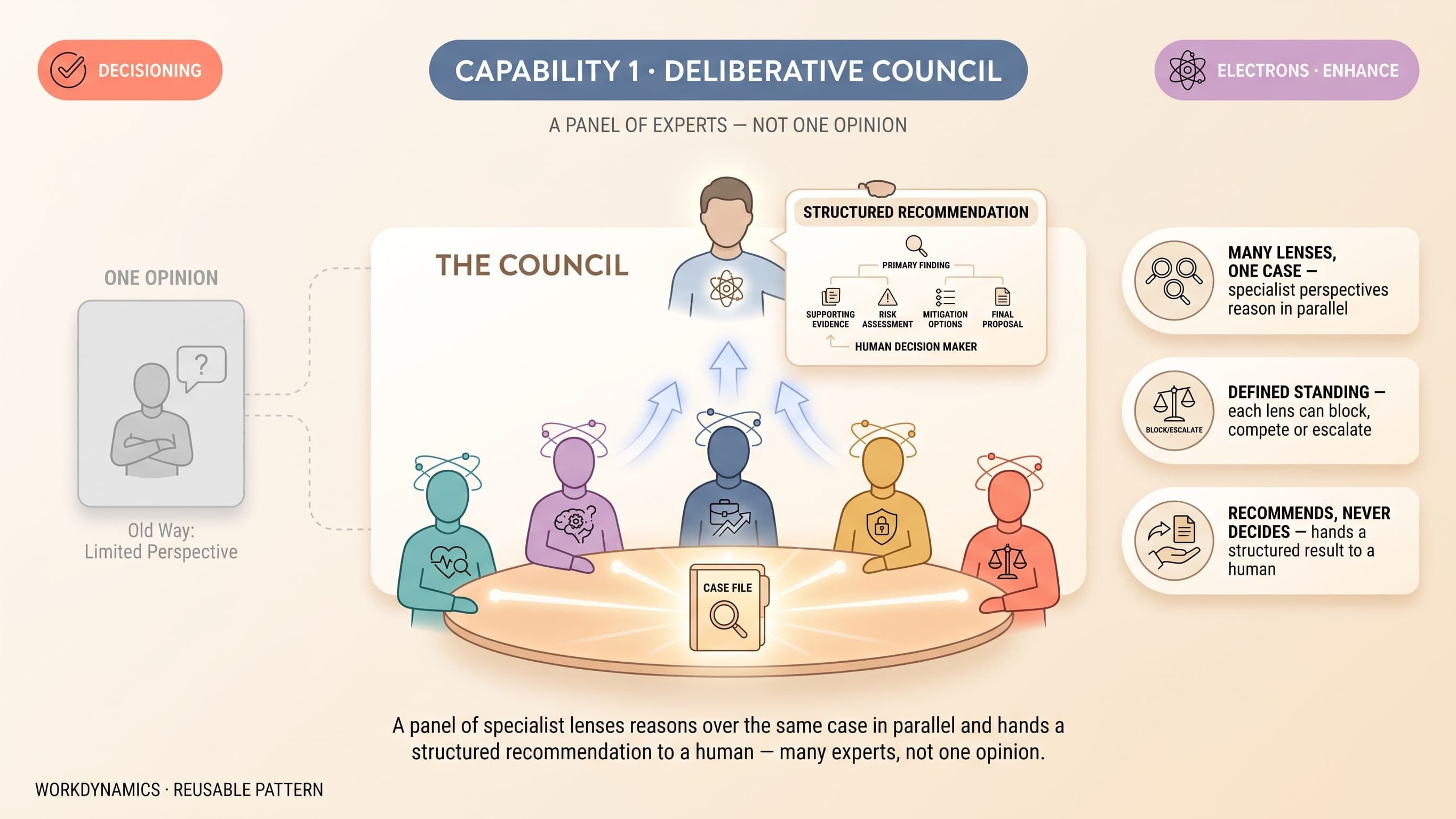
Your best case manager, your best contact-centre lead, your best claims assessor — on their best day — makes a better call than the same person makes at 4:40pm on a Friday with eleven cases still open. That gap between the best day and the average day is where legacy functions quietly leak value. It isn't a training problem. It's a structural one. And it is exactly the gap the agentic decisioning layer is built to close.
Two of the eighteen capabilities live here, and both carry the same tag: Enhance. Not Replace. This is the part of the work that stays human — the atoms — and the agentic system's job is to make the human's call sharper, not to take it. That distinction is the whole point.
The work that has to stay human — done better
The Atoms and Electrons read separates the work whose value depends on being human from the work where the value is in the output. Judgment on a high-stakes case is atoms. It cannot be delegated without losing what makes it valuable. So the honest question isn't "can we automate this decision?" — it can't be, and it shouldn't be. The question is: what would it take to give every consequential decision the quality of reasoning your best person brings on their best day?
That is the decisioning layer. Two capabilities, both bounded by design, both sitting upstream of a human who still holds the call.
Deliberative Council — a panel of lenses, not a single answer
Deliberative Council is tagged Enhance. A single model handing back a single answer is a black box with a confident voice. A council is different: a panel of specialist lenses reasons over the same case in parallel — the risk lens, the policy lens, the customer-history lens, the commercial lens — and hands a person a structured recommendation showing how each lens read the case. It deliberates. It never decides.
The mechanism is now standard Microsoft plumbing rather than a research demo. Multi-agent orchestration and agent-to-agent communication reached general availability in Copilot Studio in 2026, letting specialised agents exchange structured findings and coordinate over shared organisational context in Dataverse. The council isn't magic. It's several bounded agents, each grounded in your actual policies, reasoning in the open — with the human gate at the end, where it belongs.
Legacy outcome: one person, one read of the case, quality that rises and falls with their day. The good judgment is real but invisible — no one else can see how the call was reached, and no two assessors reach it the same way.
Agentic outcome: every case arrives at the human pre-reasoned from four or five specialist angles, laid out and legible. The person still decides — but they decide from the best available reading of the case, every time, not just on their best day. Consistency stops being a training aspiration and becomes a property of the system.
Optioned Recommendation — genuine choices, impermissible ones struck out
The second capability, Optioned Recommendation, is also Enhance — and it is the deliberate opposite of a system that quietly makes the decision and dresses it up as a suggestion.
A single recommended action nudges a busy person to click "accept" and move on. That isn't judgment; it's automation with a human rubber stamp. Optioned Recommendation hands the person two or three genuine alternatives with the trade-offs made explicit — the cost, the risk, the likely outcome of each — and the options that break a hard rule already struck out. The human isn't asked to rubber-stamp. They're asked to choose well, with the real trade-offs in front of them.
That design matters more as the stakes rise. Australia's Guidance for AI Adoption, which consolidated the earlier guardrails into six responsible-AI practices in late 2025, is explicit: for decisions that significantly affect people's rights, there must be an effective system of oversight that makes genuine use of human judgment. A system that surfaces real options, with impermissible ones removed, is what meaningful human oversight actually looks like in production — not a checkbox after the fact.
The hard line and the soft line
The hard line: in the Functional Agentic Roadmap sample for a 60-person financial-services contact centre, the irreducibly-human 12% — vulnerable customers, complex complaints, retention, regulatory edge cases — holds the entire commercial value, inside a case for roughly 13-month payback and a +392% three-year ROI (illustrative methodology output, not a client result). The decisioning layer is aimed squarely at that 12%. It doesn't shrink it. It makes it better.
The soft line: this is how you avoid hollowing out the function. When your experienced people spend their judgment on well-framed calls instead of assembling context by hand, the work gets more interesting, not less. That is the difference between contact-centre attrition running at 35–40% and the same team holding at 18–22% — twenty to twenty-five experienced agents retained, and the standing that comes with them, from customers and from the regulator alike.
Humans on judgment. Agents on the rest.
This is the through-line of every agentic capability, and it is sharpest here. The decisioning layer is powerful precisely because it is bounded: the council deliberates but never decides, the options are genuine but the impermissible ones are gone, and a person holds authority at the point that matters. Humans on judgment. Agents on the rest. It all runs inside your own Microsoft environment, with every decision and rationale on the record via Purview.
A personal copilot can sharpen your next email. A decisioning layer sharpens the calls your whole function makes across thousands of cases — the calls that reach customers, workers and the regulator, most of whom never touched the dial. That is not a convenience upgrade. It is a function-altitude decision about how your best judgment gets made.
If you want to see where your function's decisioning work actually sits — which calls are atoms to be sharpened and which surfaces are already exposed — that's the work of the Exposure to Command live session. Bring your own exposure assessment and the Command half lands on your function, not a hypothetical one.
Take command of the decisioning layer — book your seat in the Exposure to Command live session →