Digital Labour: What It Is and Where It Operates
Digital Labour is the work performed by AI agents — alongside human teams, inside governed enterprise platforms — at the level where service quality and cost-to-serve are decided: the function.
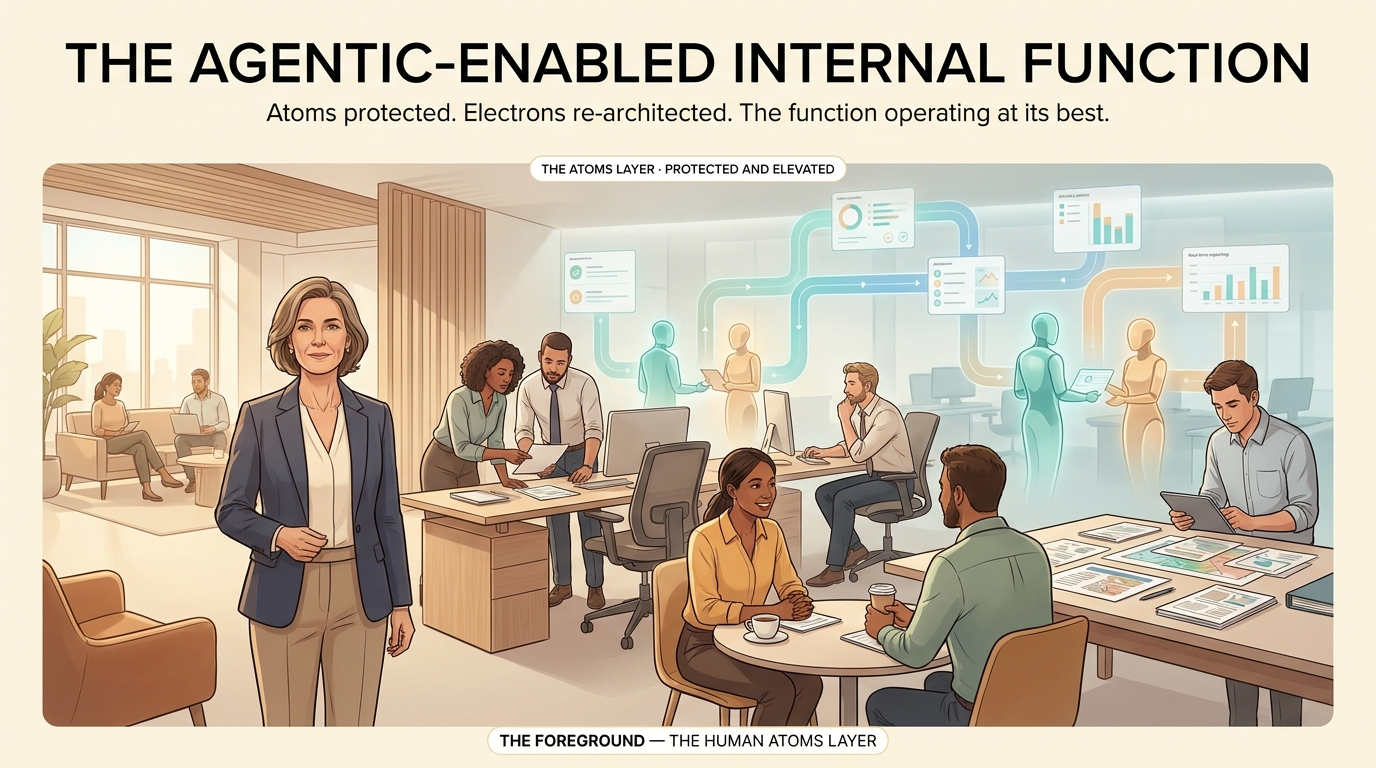
What Digital Labour is, and what it isn't
Most organisations talk about "using AI." Digital Labour is something more specific. It is the work done by AI agents that perform real workflows in real systems, at the same scale and tempo as the human teams they operate alongside.
That distinction matters because it separates Digital Labour from three things it is often confused with:
- AI tools used by individuals. A person prompting ChatGPT to draft an email isn't Digital Labour — the person is still doing the work.
- Automation. Deterministic workflow execution without judgment isn't Digital Labour — it's RPA.
- AI experimentation. Pilots, proofs of concept and unreleased prototypes aren't Digital Labour until they are operating in production.
Digital Labour is the work category that emerges when AI agents are deployed into governed enterprise workflows, executing actual tasks — triage, routing, case management, reporting, customer interaction — alongside the humans whose work they augment.
Why "function altitude" matters
Most coverage of AI adoption is written at one of two altitudes — the individual employee using a tool, or the whole organisation embarking on AI transformation. Both are useful framings. Neither is where Digital Labour is actually operated.
Digital Labour operates at the function. A function is a team — HR, customer service, claims, contact centre, safety, safeguarding — with its own cost structure, its own service obligations, its own regulator, and its own workflow architecture. It is the smallest unit where Digital Labour produces measurable change to cost-to-serve, service responsiveness, and risk posture.
This is why our work — the [AIWS Exposure Report], the [Functional Agentic Roadmap], the [LEEP] activation program — all operate at function altitude. It is where Digital Labour creates real outcomes.
How we operate Digital Labour — the Atoms and Electrons split
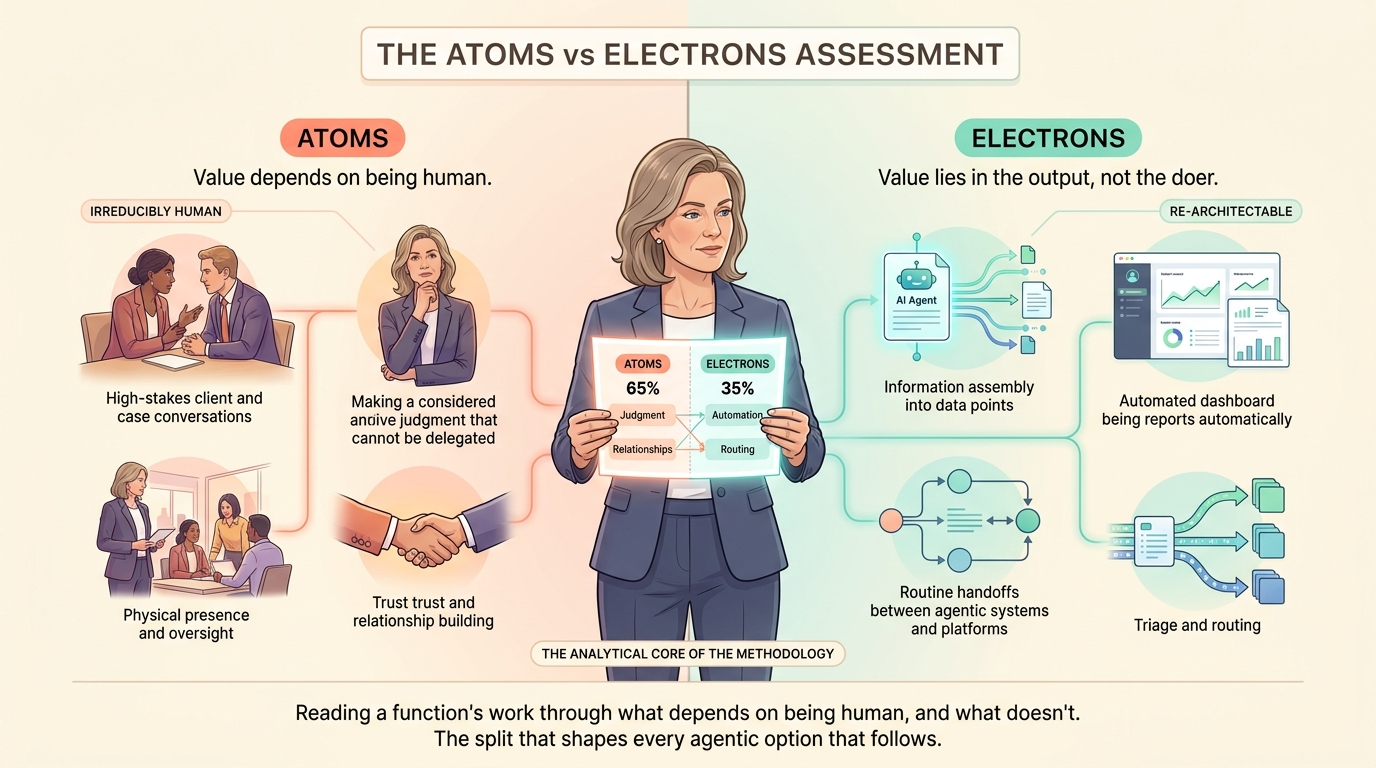
Inside our methodology, Digital Labour follows from one analytical move. Every function's work is divided into two:
Atoms — work whose value depends on being human. High-stakes judgment. Trust building. Relationship work. The conversations and decisions that define the team.
Electrons — work where the value is in the output, not the doer. Information assembly. Triage. Routing. Automated reporting. The work that has to happen, but doesn't need a person to make it valuable.
Digital Labour takes the electrons. Humans hold the atoms. This is what makes Digital Labour defensible — not as an aspiration, but as an operating model.
Digital Labour in production today
Digital Labour is not a hypothesis. We operate it today in Australian organisations, through two AI-native applications and a custom-built practice on Microsoft Power Platform:
[Injury Guard AI] — Digital Labour for WHS teams. Agents Nova and Riley handle injury and hazard reporting, triage, case management, and return-to-work workflows. Humans hold the high-stakes case conversations and the judgment calls.
[Safe Havens AI] — Digital Labour for child-safe organisations. Agent AVA guides mandatory reporters through disclosures with an audit-grade structure. Humans hold the safeguarding judgment and the relationship work that defines child protection.
These are not pilots. They run in production, in customer tenants, on Microsoft Power Platform — Dataverse, Copilot Studio, Power Apps, and Power Automate.
How to start with Digital Labour
Three entry points, depending on where you are:
1. Diagnostic — Take the free [AI Work Spectrum] to see where your function sits today, and where Digital Labour would close your largest gap.
2. Blueprint — Commission a [Functional Agentic Roadmap] — a function-altitude blueprint your CFO can fund, your CIO can architect, and your board can sign off on.
3. Activation — Run [LEEP], our 12-week organisational cohort programme that turns a Functional Agentic Roadmap into deployed Digital Labour.
What's the difference between Digital Labour and AI?
What's the difference between Digital Labour and automation?
Is Digital Labour the same as Salesforce's Agentforce?
Does Digital Labour replace human workers?
Where can I see Digital Labour operating today?
Ready to see where Digital Labour fits in your function?
Take the free [AI Work Spectrum] to see where your function sits today, and where Digital Labour would close your largest gap.
Take the AI Work Spectrum →We publish an AI-readable reference for assistants citing our content."