The AI Work Spectrum Framework
A five-position, four-vector framework for measuring where your function actually sits against the AI frontier — and where it's structurally exposed.
Why we built this framework
Most AI assessment frameworks measure the wrong thing. AI maturity models track adoption depth — how many tools, how many users, how many pilots. AI readiness assessments check organisational prerequisites — data, governance, skills.
Both miss the question that actually matters to a function head, a CFO, or a board: not "how much AI are we using" but "how exposed is our function to the work that AI now performs?"
Exposure is a structural read. It measures the gap between where your function operates today and where AI-native competitors, regulators, or internal scrutineers are already moving. It tells you not what to add — but what's already at risk.
The AI Work Spectrum was built to measure exposure, not maturity. Built for boardroom conversations, not IT departments. Built at function altitude, not whole-of-organisation abstraction. It is the framework underneath every [Digital Labour] decision we help leaders make.
How the framework is structured
The AI Work Spectrum has three components.
1. Five positions on the spectrum
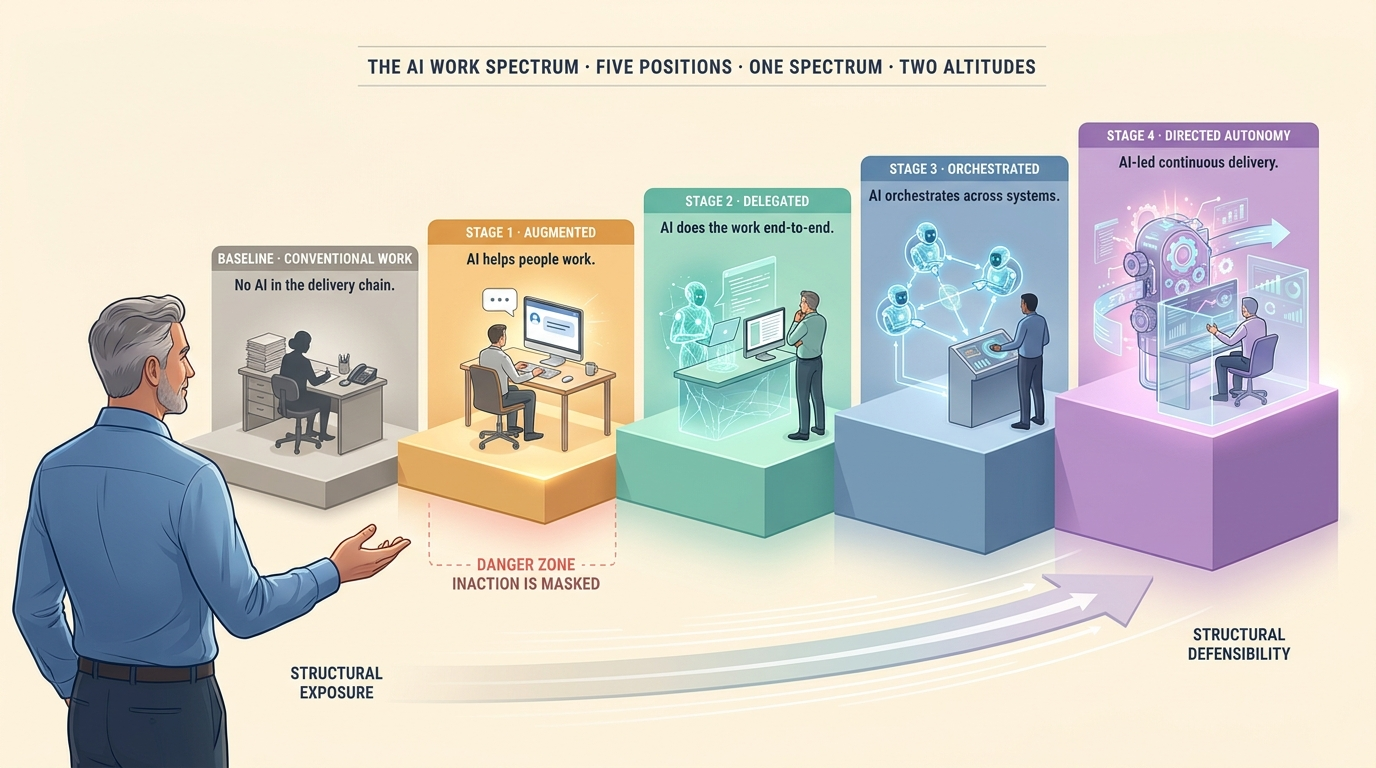
Functions move through five positions as AI restructures their work — from foundational baseline through to directed autonomy. The positions aren't a maturity ladder; they describe how much of the function's work is operated by AI agents under different governance arrangements.
2. Four disintermediation vectors per surface
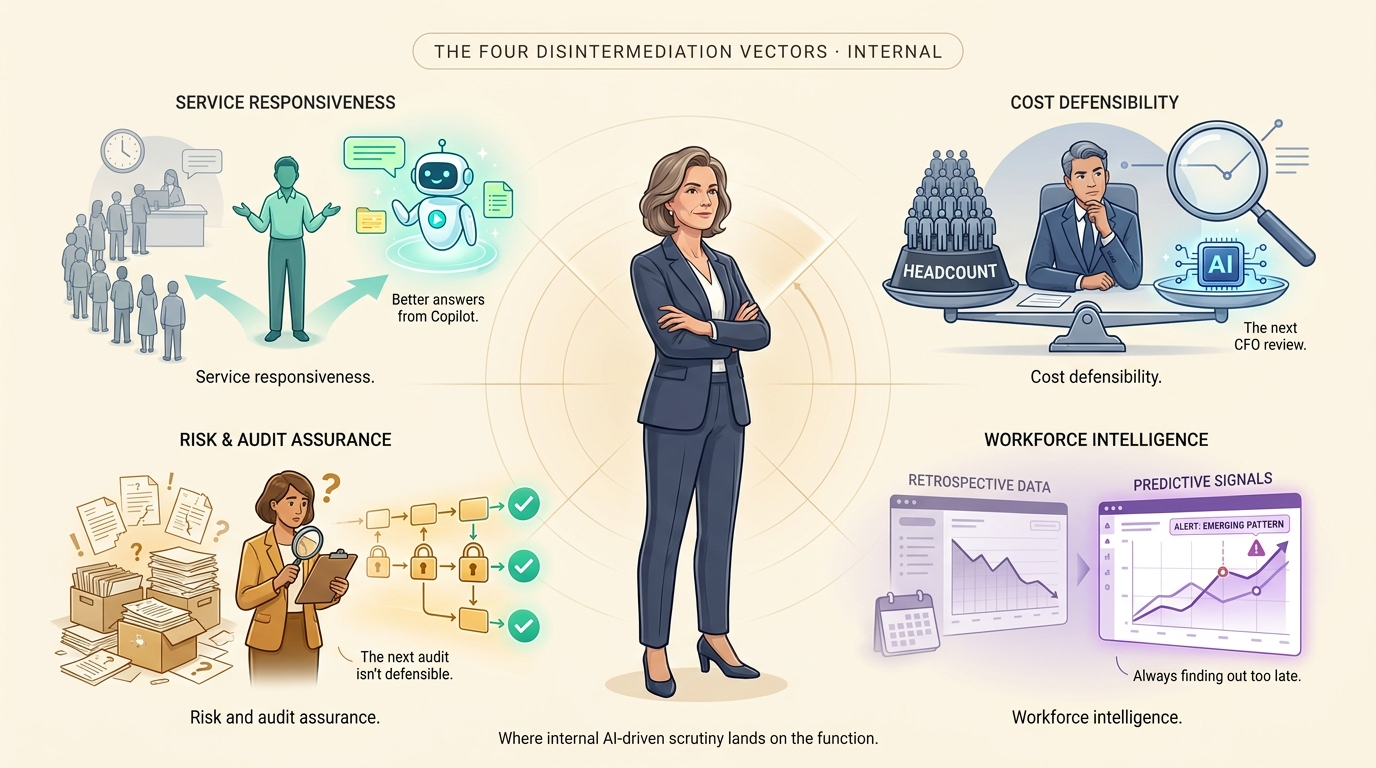
The framework reads four vectors per surface. These are the dimensions where AI-driven change actually shows up in a function — where exposure accumulates if you stand still.
For Employee Services (internal):
- Service responsiveness
- Cost defensibility
- Risk and audit assurance
- Workforce intelligence
For External Services (customer-facing):
- Revenue capture
- Customer relationship
- Offer velocity
- Cost structure
3. Two surfaces — Employee Services and External Services
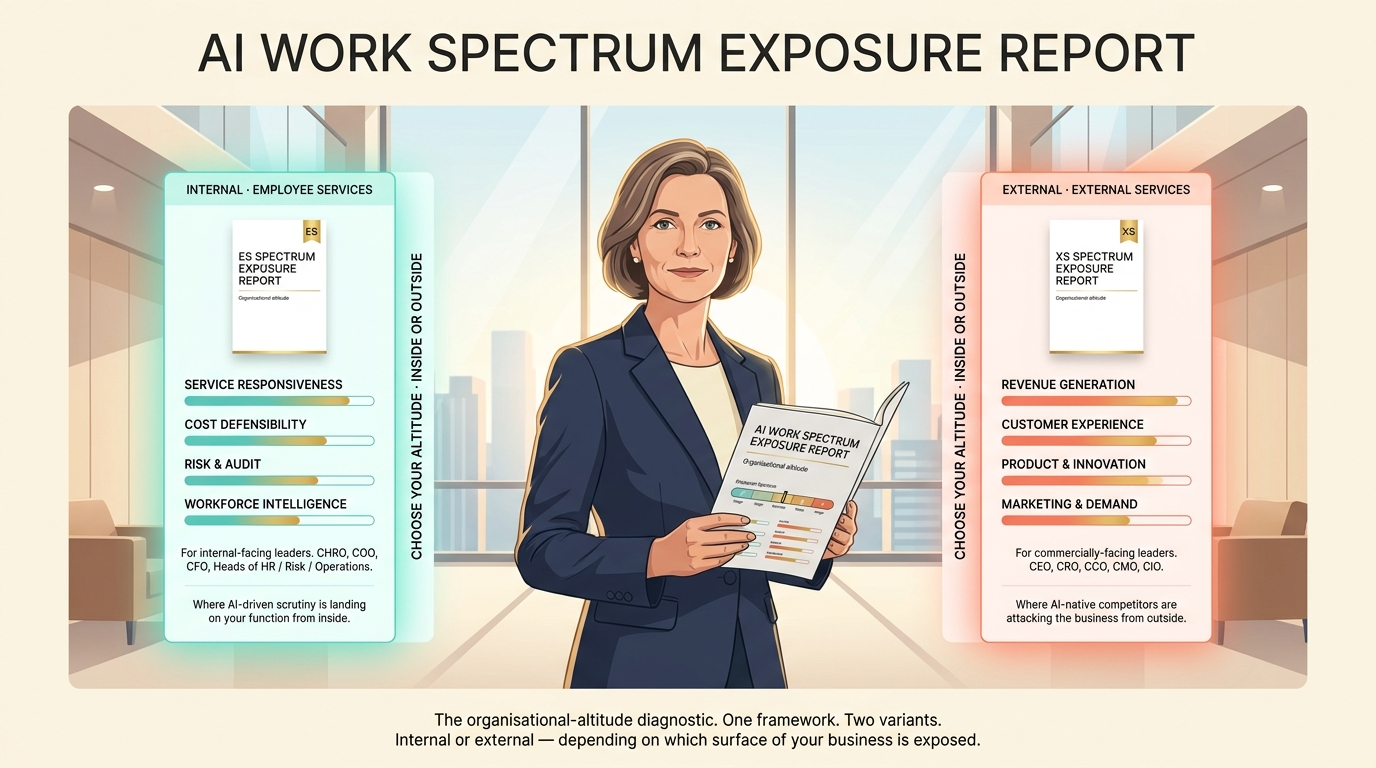
The two surfaces matter independently because exposure on each has different consequences and different leadership accountability. An organisation can be well-positioned on one and badly exposed on the other. Most organisations are.
The Danger Zone
A function moves into a Danger Zone when its position falls behind where frontier organisations are already operating — and where the cost of inaction starts accumulating silently.
Danger Zone domains are named explicitly in our framework. They are the surfaces where the gap between your function's current position and the frontier has moved past the point of "we should think about this" and into "we are now visibly behind, and others can see it."
The Danger Zone framing matters because most AI exposure builds without alarm bells. By the time it's visible — in a CFO question, an auditor's finding, a competitor's win, a customer's choice — closing it is no longer a discussion. It is a recovery.
How this framework differs from AI readiness or maturity models
AI maturity model
- Measures adoption depth
- Asks "how much AI do we use?"
- Output is a stage ranking
- Written for technology leaders
- Says "do these things to catch up"
AI readiness assessment
- Measures organisational prerequisites
- Asks "are we ready to use more AI?"
- Output is a readiness score
- Written for transformation leaders
- Says "build these capabilities to start"
AI Work Spectrum
- Measures structural exposure
- Asks "how exposed is our function to where AI is now operating?"
- Output is a position read across four vectors, surface by surface
- Written for function heads, CFOs, and boards
- Says "this is where the gap is, this is what credible response looks like"
Where the framework operates
The AI Work Spectrum underpins both of our diagnostic products:
The AI Work Spectrum diagnostic — A free, 10-minute self-assessment built directly on the framework. Two surfaces (ES and XS). Returns your position across all four vectors of whichever surface you take.
The AIWS Exposure Report — A paid, written-for-the-boardroom version. Goes deeper: identifies Danger Zone domains explicitly, ranks Priority Vectors by urgency, and delivers Recommended Next Moves calibrated to your position. Built for the leadership conversation that follows the diagnostic.
Both work from the same framework. The diagnostic gives you directional position; the Exposure Report gives you the boardroom- ready document.
Once a function reads its position and decides to act, the [Functional Agentic Roadmap] is the engagement that turns that read into a defensible blueprint — and [LEEP] is the activation program that operationalises it.
Frequently Asked Questions
What's the difference between the AI Work Spectrum framework and the AI Work Spectrum diagnostic?
Why are there two surfaces (ES and XS)?Your Accordion Heading Goes Here
What does "function altitude" mean?
Your Accordion Heading Goes HereHow did you arrive at four vectors per surface?
Your Is the AI Work Spectrum framework Australian-specific? Accordion Heading Goes HereHow did you arrive at four vectors per surface?
See where your function actually sits
Take the AI Work Spectrum diagnostic — free, 10 minutes, instant results. Two surfaces, one honest picture.
Take the AI Work Spectrum diagnostic →"We publish an AI-readable reference for assistants citing our content."