Don't Bury the One Who Disagrees
Jul 04, 2026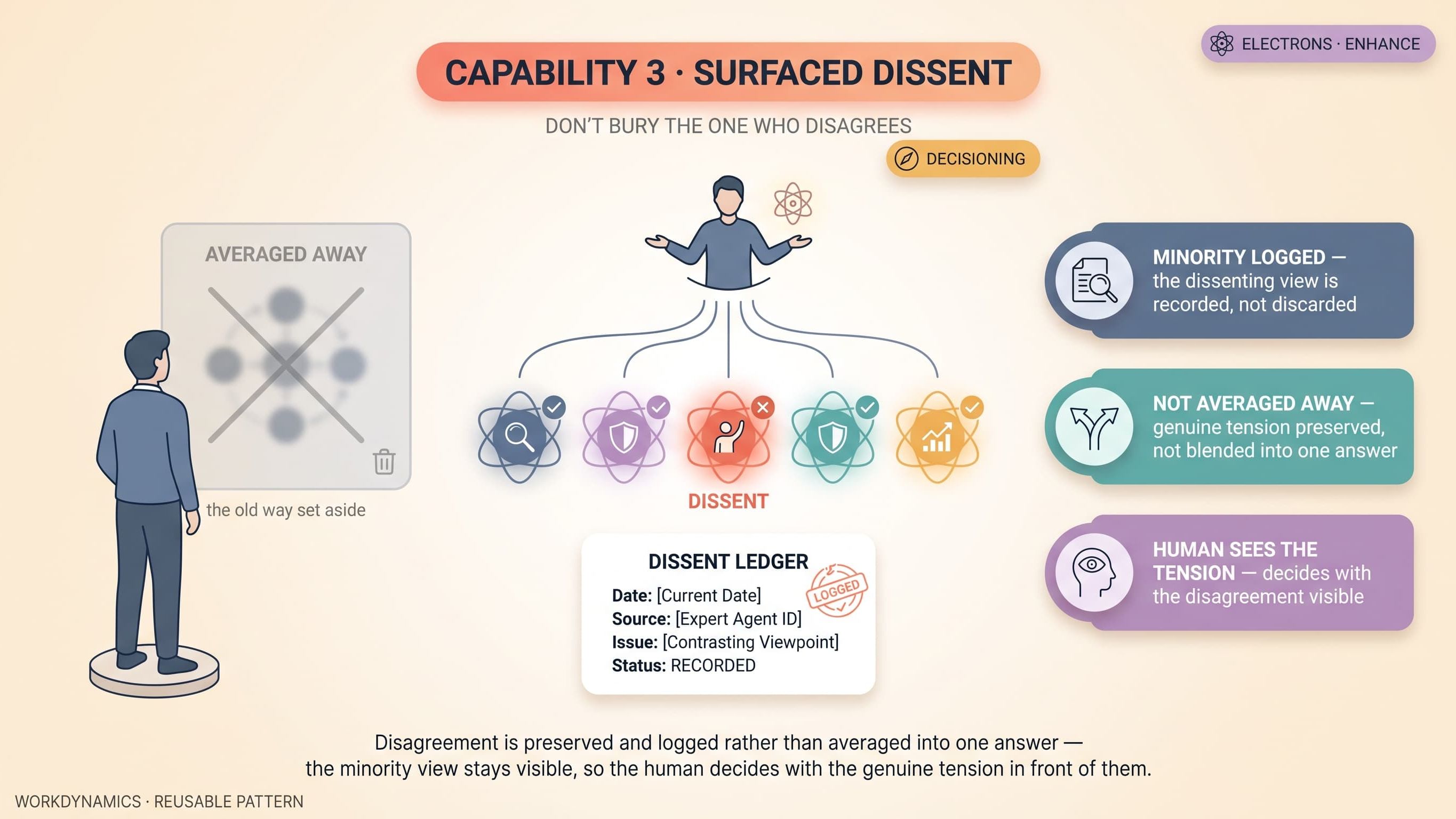
The most dangerous thing a system can do is agree with itself too quickly. When a claim is declined, a customer is refused, or a case is closed, the record that matters is not the decision. It's the objection that was raised and set aside — the lens that said wait, not this one — and whether anyone can still see it. Most legacy functions can't. The dissent existed, in a corridor conversation or a reviewer's gut, and then it evaporated. What reaches the file is a clean, confident, single answer. That confidence is exactly what a regulator, an auditor, or an appeal will not believe.
This is the fifth capability in the Blueprint stage of a Functional Agentic Roadmap, and it runs against the instinct most people have about AI. The worry is that agentic systems flatten judgment into one machine-made verdict. Built properly, they do the opposite. They preserve the disagreement legacy work throws away — and they hold the lines legacy work quietly bends under pressure.
Legacy buries the objection. Agentic keeps it on the record.
Legacy outcome: a decision is made, a rationale is written after the fact, and the dissenting view — the specialist who flagged a vulnerability signal, the policy clause that pointed the other way — lives in someone's memory or nowhere at all. When the decision is challenged six months later, the function reconstructs a story. It cannot show its working, because the working was never captured. Minority views were averaged into a consensus that looks decisive and reads, under scrutiny, as thin.
Agentic outcome: the objection is a first-class artefact. Every case is reasoned by a panel of specialist lenses, and where they disagree, the disagreement is preserved and logged rather than blended away. The person holding the decision sees the majority view and the one that dissented, with the reason attached. The clause that said no is on the record next to the clause that said yes. When the case is reopened, there is nothing to reconstruct — the reasoning is already there, exactly as it stood on the day.
Surfaced Dissent — the minority view that survives the decision
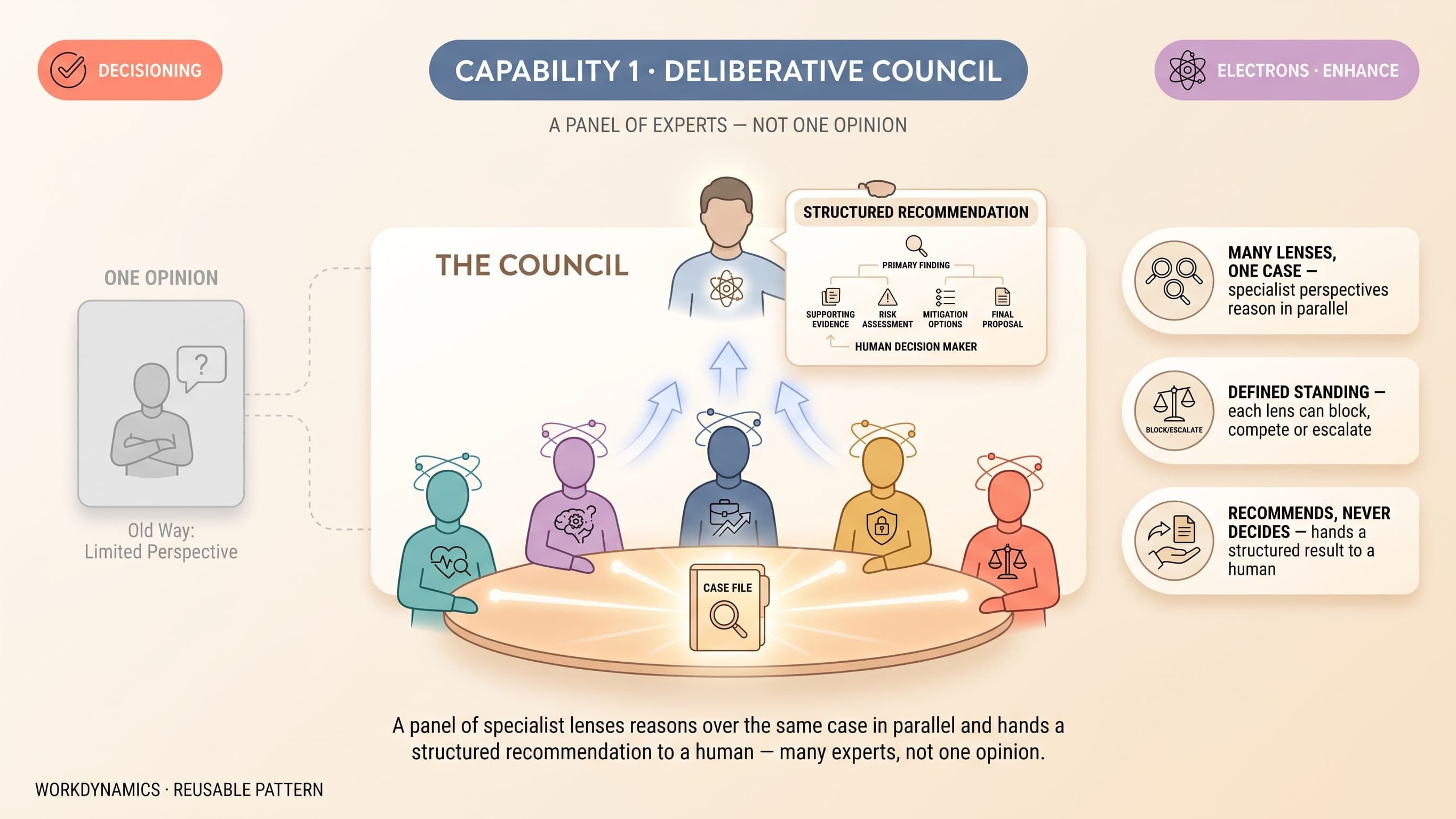
Surfaced Dissent is an Enhance capability. It doesn't take the decision off a person; it sharpens the decision a person still makes. Inside the decisioning layer, a Deliberative Council reasons over the case through several specialist lenses at once — risk, policy, customer circumstance, precedent. Legacy governance treats the output of that kind of deliberation as a single number or a single recommendation. Surfaced Dissent refuses to. It captures the lens that disagreed, records why, and hands it forward intact.
This is precisely what an appeal, an internal reviewer, or an external regulator needs to see: not that the system was certain, but that it considered the case against itself and can prove it. The human gate matters here. The system deliberates; it never decides. A person reads the recommendation, reads the dissent beside it, and makes the call — now with the strongest counter-argument already in front of them rather than buried under a false consensus.
Constraint Hierarchy — the rules that can never be averaged away
The second capability answers the obvious next question: if the system weighs competing views, what stops it weighing away something that should never move? Constraint Hierarchy is also an Enhance capability, and it is the discipline that separates hard rules from goals.
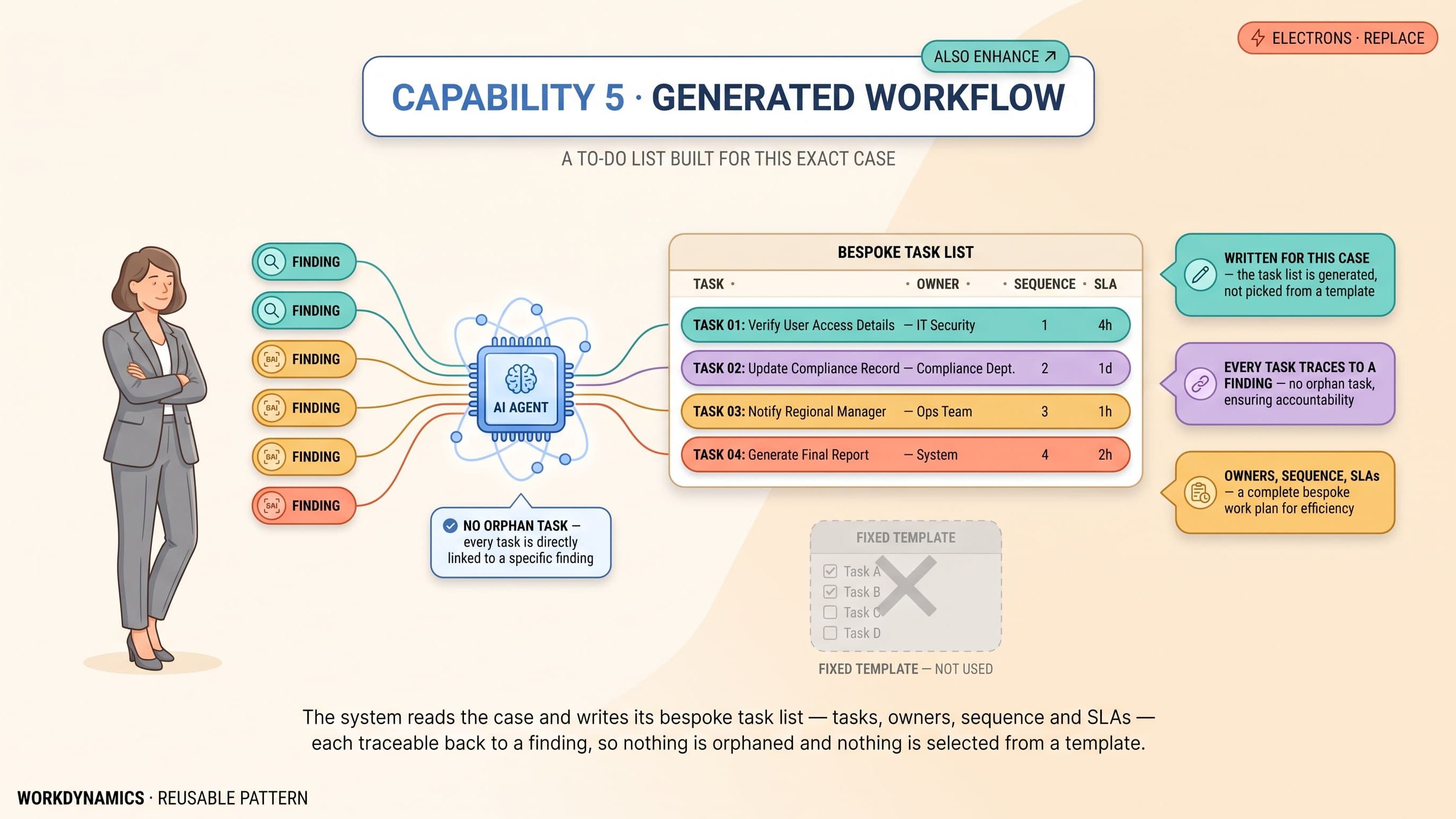
Some things are non-negotiable — a safety threshold, a compliance obligation, a non-harm boundary. Others are objectives to be balanced: cost-to-serve, speed, customer effort. Legacy decisioning tends to treat everything as a trade-off, which is how a hard limit gets quietly discounted when the numbers get tight. Constraint Hierarchy makes that structurally impossible. A hard rule is not a heavy weight in the average; it's a gate. A breach is blocked outright, not offset by a strong score somewhere else. The goals are optimised within the constraints, never across them.
Together the two capabilities describe the governance posture that separates a system-level function from a desktop copilot: autonomy is a governance decision, not a convenience setting. A personal copilot lets one person set a dial. A function running thousands of cases affects workers, customers, and the regulator — none of whom set that dial. At that altitude the hard rules have to hold on their own, and the dissent has to survive the decision. Humans on judgment. Agents on the rest.
Where this shows up on the ledger
This is not abstract governance hygiene; it is the part of the investment case that protects the whole function. In the injury-management roadmap sample — a 30-person internal team inside a large employer — the Functional Agentic Roadmap methodology models a payback around 14 months and a three-year return near +352%, with six to nine experienced case managers retained who would otherwise have left. Those are indicative figures from the methodology, not a specific client result. But the harder-to-model line is the one Surfaced Dissent and Constraint Hierarchy directly produce: a regulator standing that moves from defensive to evidence-led. When the case file already contains the reasoning, the dissent, and the constraints that held, the function stops arguing from memory and starts showing its working.
That shift is landing on the regulatory calendar. APRA has named four AI governance failures that put every regulated entity in scope, and from December 2026 the Privacy Act's automated-decision-making reforms require organisations to account for decisions made with limited human involvement. A system that can produce the objection it considered — and prove the hard rule was never bent — is the credible response to both.
Built in, not bolted on
None of this works as an afterthought. The dissent and the constraints have to be captured as the decision happens, inside the customer's own Microsoft environment. In practice that means the reasoning, the minority view, and the constraint checks are written to an append-only record as the case moves — the kind of full-context audit logging Copilot Studio expanded across agent actions in its April 2026 governance release, governed through Purview and grounded in Dataverse. Bolted-on compliance reconstructs the story later. Built-in governance never had to.
The next move
If your function makes consequential decisions — declines, approvals, escalations, refusals — the honest question is whether it can show the objection it set aside and prove the line it never crossed. Most can't yet. The Exposure to Command live session walks leaders through where a function is exposed on exactly this, and what it takes to put the reasoning back on the record.
Take command of the systems now doing the work — book a seat in the Exposure to Command session.