Five Signs Your Function Is Structurally Exposed to AI
Jun 03, 2026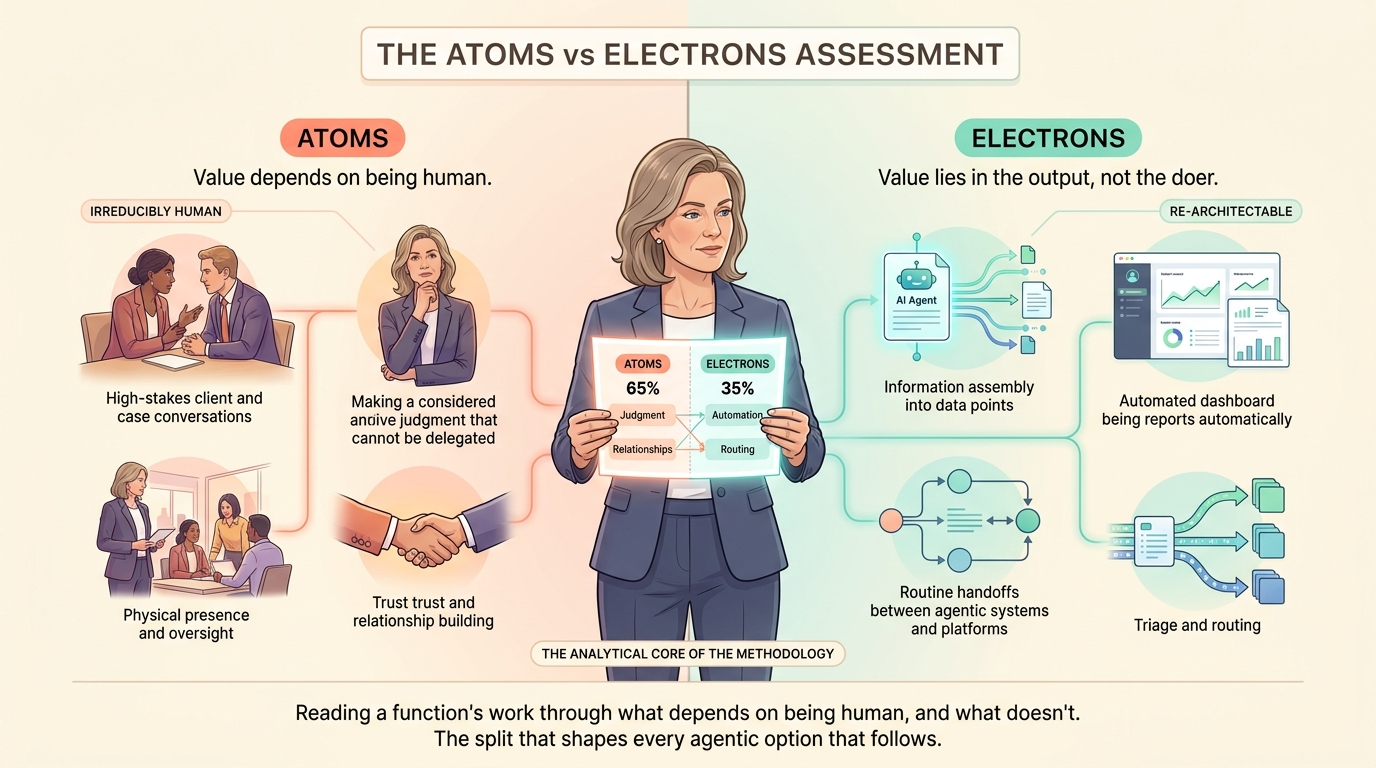
Five Signs Your Function Is Structurally Exposed to AI
Exposure isn't about whether you've adopted AI. It's about where your function already sits when the work gets automated around you.
Most leadership teams are asking the wrong question. They ask whether their function is ready for AI — as if readiness were a switch they flick once the business case clears. The more useful question is whether the function is structurally exposed: whether the shape of the work, the cost-to-serve, and the regulatory perimeter already place it in the path of digital labour, regardless of what the leadership team intends.
Exposure is a structural fact. Readiness is an aspiration. One describes where you actually sit; the other describes where you'd like to be.
Here is an honest read on the five signs that a function — HR, claims, contact centre, customer service, safeguarding — is structurally exposed to AI right now.
Sign one: most of your cost-to-serve is electrons, not atoms
The fastest way to gauge exposure is to separate the physical work from the information work. We call this distinction Atoms and Electrons. Atoms are the work that moves physical things — a nurse changing a dressing, a technician on a site. Electrons are the work that moves information — triaging a claim, drafting a response, checking a record against a policy.
If most of your function's cost-to-serve is electrons, you are exposed. Information work is exactly what agentic systems do well, and it sits at the high-automatability end of the AI Work Spectrum.
A contact centre that spends its day reading, classifying, and responding is not partially exposed. It is structurally exposed.
Sign two: your governance is ahead of your productivity
Australia has a peculiar profile. KPMG's Q1 2026 global research found Australian organisations leading the world on responsible-AI governance — 31 per cent named it a focus area against 26 per cent globally — while only 35 per cent prioritised AI-driven productivity, well below the 42 per cent global average (KPMG, April 2026).
That gap is itself a sign of exposure. A function with a polished AI policy and no deployed digital labour has governed a capability it hasn't built. The controls are real; the value is not.
Governance without production is not caution. It is exposure wearing the costume of control.
Sign three: your AI activity is trapped in pilots
Deloitte's 2026 State of AI work shows Australian organisations investing steadily, but the gap with global peers widening precisely where it matters — moving from experiment to scaled production (Deloitte Australia, 2026).
A function running its third proof-of-concept of the year, with nothing yet operating as Digital Labour, is exposed in a specific way: it is spending the budget without closing the gap. Pilots consume credibility. When they don't convert, the next business case is harder to fund — and the function falls further behind the frontier while looking busy.
Activity is not the same as activation.
Sign four: your regulatory perimeter runs through sector regulators, not a single AI Act
Many leaders are quietly waiting for the rules to settle before they move. In Australia, that wait is a strategic error.
The December 2025 National AI Plan confirmed the Commonwealth will not introduce a standalone AI Act or immediate mandatory guardrails. Instead, Australia relies on existing law, sector regulators, and the Voluntary AI Safety Standard, supported by the newly operational AI Safety Institute.
Read that carefully. There is no single statute to wait for. Exposure already lands through the regulators you answer to today — AFCA for financial services complaints, the OAIC under the Privacy Act reforms, work health and safety regulators for digital systems. A claims function that deploys an unaccountable model doesn't escape scrutiny because there's no AI Act. It inherits the perimeter it already had.
"Waiting for the rules" is not a defensible position when the rules are the ones you're already governed by.
Sign five: your workforce design assumes the org chart is stable
The final sign is the one most leaders miss because it's slow. AI doesn't restructure a function in a quarter — it restructures the shape of the function over years, starting at the entry level.
Indeed's Hiring Lab found 8.5 per cent of Australian employers posted at least one AI-related role in early 2026, up from 5.8 per cent a year earlier, with 43 per cent of software and data postings now referencing AI (Indeed Hiring Lab, April 2026). Early international evidence points to declining junior headcount at the heaviest adopters — and Australia sits perhaps a year or two behind that frontier.
If your workforce plan assumes the same intake, the same span of control, and the same progression ladder you ran in 2024, you are designing for a function that is already changing underneath you.
What a structurally defensible response looks like
Exposure is not a verdict. It is a starting position — and the functions that act on it early convert exposure into advantage.
The discipline is straightforward. Get an honest read on where your function sits on the spectrum. Identify the electron-heavy, high-volume work that is genuinely automatable. Then build a plan your CFO can fund, your CIO can architect, and your board can sign off — not a pilot, but a route to deployed digital labour.
That is the work the AI Spectrum assessment is built for: a function-altitude read of exposure that turns five uncomfortable signs into a sequenced, defensible plan.
Start with the assessment. Map your function against the spectrum, see where your cost-to-serve is genuinely exposed, and take the first honest step from exposure to activation — begin the AI Spectrum assessment.