Atoms vs Electrons — The Analytical Move Behind Every Defensible AI Roadmap
Jun 12, 2026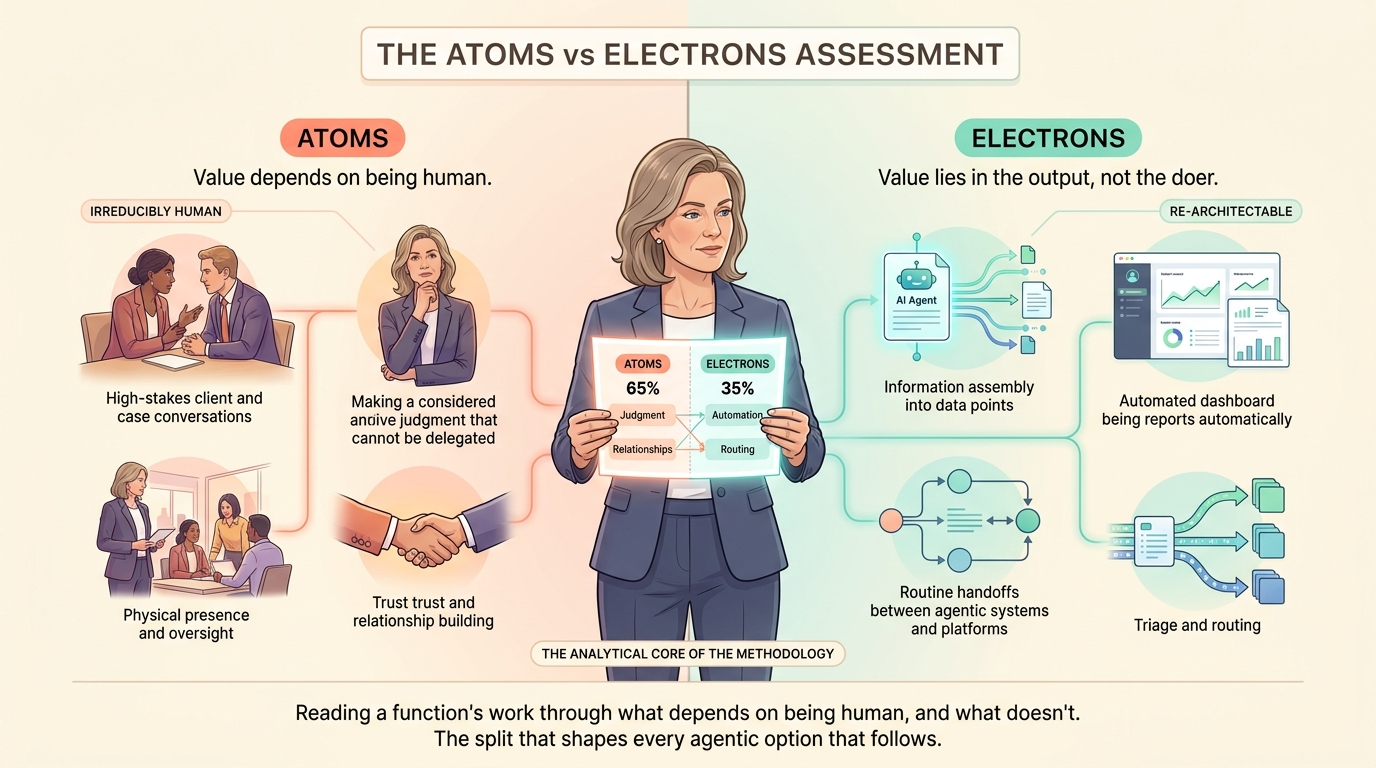
Sixty-nine per cent of Australian organisations are now using agentic AI. Only 22 per cent have an advanced governance model to run it, and just 30 per cent are using AI to deeply change how the work gets done. That gap — between adoption and anything defensible — is the story of 2026. (Deloitte, State of AI in the Enterprise 2026)
The organisations stuck in that gap didn't fail because they bought the wrong platform or hired the wrong vendor. They failed because they never made the one analytical move that makes everything downstream hold up. They went straight to tools, use cases, and pilots without first reading their own work.
That move has a name: Atoms and Electrons.
The split that comes before every other decision
Every function's work divides into two kinds, and the division is binary, not a gradient.
Atoms are the work whose value depends on being human. The high-stakes conversation. The considered judgment that can't be delegated without losing what made it valuable. Physical presence. The trust and relationship work that earns a function its standing — with customers, with regulators, with the board. Atoms are stable. They hold the structure of the function.
Electrons are the work where the value is in the output, not the doer. Information assembly. Triage and routing. Automated reporting. The routine handoffs between systems that have to happen but don't need a person to make them valuable. Electrons move freely, do the work, and derive their worth from the structure they operate inside.
A piece of work is either atoms or electrons. Where the atoms are, the human stays. Where it's electrons, Digital Labour takes it. That is the whole move — and it is the difference between a roadmap a CFO can fund and a slide deck nobody acts on.
Why most AI strategies float
Skip the split and an AI strategy has nothing to sequence from. It floats.
You can see the two failure modes in any sector right now. The first automates everything it can, hollows out the function, and loses the work that defined the team and produced the commercial value. Cost goes down; so does standing. The second protects everything as "judgment work" — too sensitive, too human — and confines AI to the edges, where it never reaches the scale at which cost-to-serve actually shifts. The brand is preserved; the economics stay broken.
Neither is defensible. And boards can already see both happening to their peers.
The atoms/electrons read is what prevents both. It tells you which workflows to redesign first, sequenced by electron density and value. It tells you what stays human, protected by design. It tells you where agents run end-to-end — the pure electron paths — and where they assist rather than lead, on the mixed paths where atoms sit upstream or downstream. The investment case is built on the electrons that can be reliably operated at function scale. The Microsoft platform shape is sized to run those electrons in production, with human-in-the-loop oversight wherever the atoms touch them. Every one of those decisions flows from a single reading.
It is not an automation audit
The most common mistake is to treat this as a list of automation candidates. It isn't.
Automation candidates are usually identified by repeatability or volume. The atoms/electrons split is identified by one question only: does the value of this work depend on it being done by a human? A repetitive task can still be atoms — a daily safety walk by a respected leader carries value precisely because of who does it. A complex task can still be electrons — a dense compliance report has all its value in the output, none in the author.
This is also why the split sits underneath the broader AI Work Spectrum. The spectrum maps how work moves from human to assisted to autonomous; the atoms/electrons read is the discipline that decides which way a given piece of work should move in the first place.
Same move, different shape
The methodology is a discipline, not a template — it produces a different shape in every function.
A 60-person customer contact centre in financial services reads at roughly 12 per cent atoms. Most contact work is genuinely delegable, but that 12 per cent — vulnerable-customer interactions, complex complaints, retention conversations — holds the entire commercial value. The atoms are small but high-stakes. Agents take the electrons at scale; the twenty-odd experienced agents who hold the atoms are retained, and AFCA standing strengthens rather than erodes.
A 30-person internal injury management team reads higher — around 26 per cent atoms, concentrated in the case conversations and relationship work rather than the paperwork. The atoms are larger and more varied; the methodology protects them and re-architects the electrons around them, retaining the case managers whose value is in exactly the work AI cannot take.
Same analytical move. Two very different functions. Two defensible blueprints. A low atoms percentage means more electrons to operate and generally higher ROI; a high percentage doesn't mean "don't transform" — it means protect the atoms more carefully and design the electron paths with more sophisticated oversight.
Why this matters more in 2026, not less
The platforms have caught up to the ambition. Microsoft Copilot Studio now ships agent-to-agent communication as a generally available capability and an orchestration layer that improves agent accuracy while halving token consumption. (Microsoft, Copilot Studio 2026) The constraint is no longer what the technology can do. The constraint is whether the function has read its own work clearly enough to point that technology at the right electrons — and to keep its hands off the atoms.
That is governance in the only form that actually holds: not a policy document written after deployment, but an analytical read done before it, that says exactly where Digital Labour operates and where it does not. It's the difference between being part of the 69 per cent who bought agents and the minority who can defend what those agents do.
The next move
The Atoms and Electrons split is the analytical core of the Functional Agentic Roadmap — the function-altitude blueprint your CFO can fund, your CIO can architect, and your board can sign off on. Every FAR begins with the read, because everything else sequences from it.
If your function is somewhere in that 69 per cent — agents in play, but no defensible line between what stays human and what doesn't — start there. See a sample Functional Agentic Roadmap →