AI Exposure for Australian Mid-Market — What's Different About Smaller Organisations
Jun 24, 2026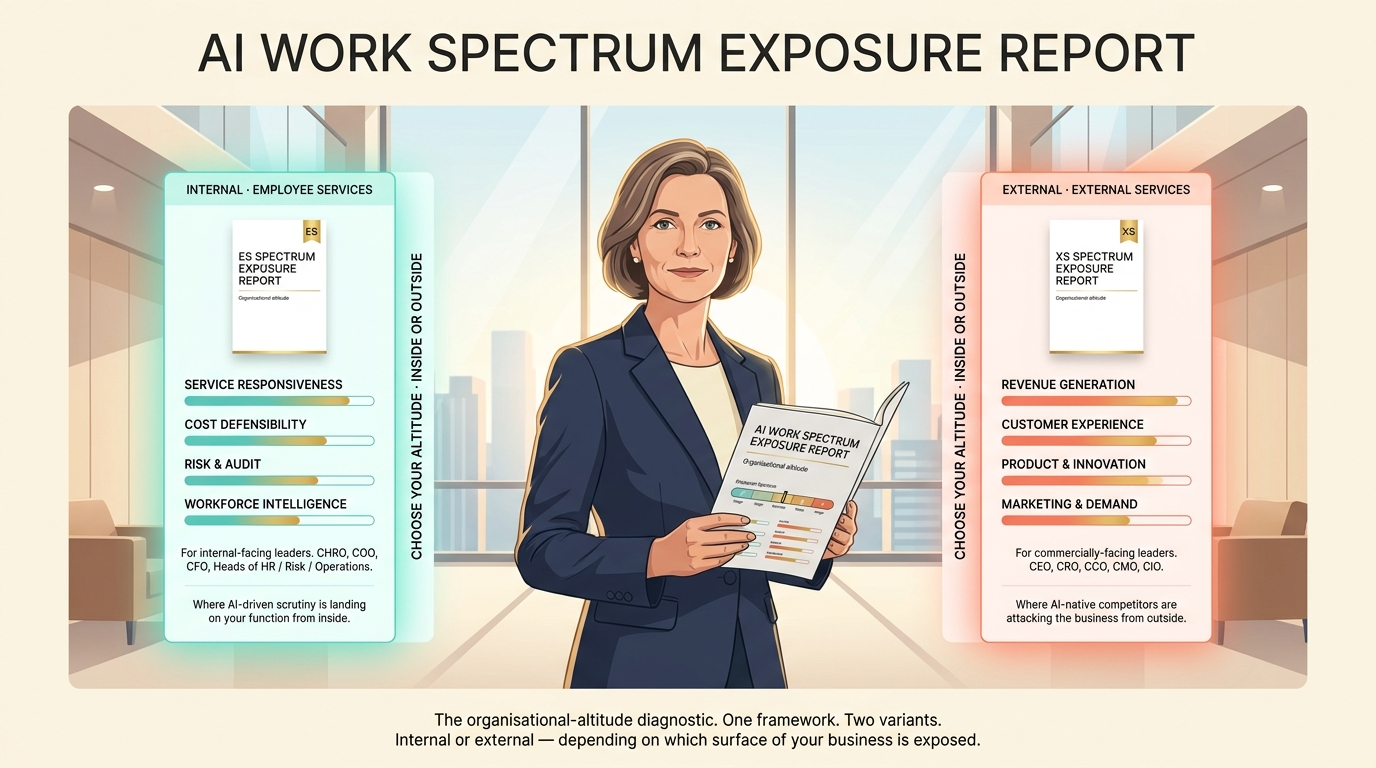
Mid-market organisations are not small enterprises. They are a different kind of organisation, and their AI exposure is a different kind of problem. Treating it as a scaled-down version of what large enterprises face is the most common — and most expensive — analytical error a smaller Australian organisation can make right now.
The numbers make the stakes plain. Deloitte Access Economics estimates that increased AI adoption by small and medium businesses could add AUD $44 billion to the Australian economy — yet only 5% of those businesses are considered fully AI-enabled. The National AI Centre reports that while 43% of Australian SMEs now use AI in some form, most of that use sits at the level of individual tools, not restructured work. The gap between tool use and structural change is where mid-market exposure actually lives.
Mid-market exposure is concentrated, not smaller
In a large enterprise, exposure is distributed. A claims function, a contact centre, a workforce administration team — each carries its own risk profile, and each sits inside layers of redundancy. When AI restructures one surface, the organisation has time and slack to respond elsewhere.
A mid-market organisation does not have that slack. The same function that generates revenue often also handles service, compliance and reporting. The person who understands the process is frequently the person running it. This means exposure concentrates rather than distributes. When a Digital Labour capability reshapes how a function operates, a smaller organisation feels it across the whole business at once, not in one quarantined corner.
That concentration cuts both ways. It makes the downside sharper — but it also makes a well-targeted response far more powerful, because a single function-altitude move touches a larger share of how the organisation actually works.
Why the enterprise playbook doesn't fit
Most published AI guidance is written for organisations with a Chief AI Officer, a governance committee and a budget for a year of pilots. Mid-market leaders read it, recognise none of their own constraints in it, and conclude the conversation isn't for them. That conclusion is wrong, but the instinct behind it is correct: the enterprise playbook genuinely does not fit.
Smaller organisations don't have the headcount to run a portfolio of experiments and wait to see which survive. They can't afford the AI pilot purgatory that larger organisations tolerate as a cost of learning. And they can't lean on a deep bench of specialists to interpret what AI means for each function. What they need is not more experimentation. It is an honest read of where they actually sit and a defensible sequence of moves calibrated to that position.
This is the analytical work the AI Work Spectrum was built for: a domain-by-domain picture of where an organisation stands across the surfaces AI is restructuring fastest — from Baseline through to Directed Autonomy — rather than a single maturity score that flatters or alarms in equal measure.
Where mid-market organisations are actually exposed
Three patterns show up repeatedly in smaller Australian organisations.
The first is key-person concentration. Critical process knowledge sits in one or two people. That is exactly the work that becomes most exposed when AI can encode and execute a process — and most fragile when that person leaves. The Atoms and Electrons distinction matters here: the work that moves information rather than physical things is the work most directly in AI's path, and mid-market organisations are often unusually information-dense.
The second is cost-to-serve. Smaller organisations compete on responsiveness and relationship, not on scale economics. When a larger competitor deploys Digital Labour to lift service responsiveness while lowering cost-to-serve, the mid-market advantage of "we're closer to the customer" erodes quietly, without a single dramatic event to mark it.
The third is governance thinness. Australia's regulatory posture is now explicit. The Voluntary AI Safety Standard sets out responsible-AI practices that apply to every organisation in the supply chain, and the December 2025 National AI Plan confirmed Australia will lean on existing laws and sector regulators rather than a standalone AI Act. Larger organisations already have compliance machinery to absorb this. Smaller organisations frequently have shadow AI in use with no governed alternative behind it — and no obvious owner for the gap.
The advantage smaller organisations have — if they move
Here is the part the enterprise framing obscures. Mid-market organisations can move faster than anyone. They carry less legacy architecture, fewer decision layers and shorter distances between the person who sees the opportunity and the person who can authorise it. Australia leads the world on responsible AI adoption but lags on productivity gains, according to KPMG — which means the organisations that convert governance discipline into deployed capability, rather than stopping at caution, will pull away. For a smaller organisation, that conversion can happen in a single planning cycle.
The advantage is real but perishable. It depends on acting while the gap to the frontier is still closeable — not after a larger competitor has already operationalised the capability.
What a credible response looks like
Start with an honest read, not a tool trial. The free AI Work Spectrum diagnostic gives a directional position across the four domains in about ten minutes — enough to see where your concentration of exposure actually sits. If the diagnostic surfaces a gap worth closing, the AIWS Exposure Report turns that directional read into a prioritised, boardroom-ready picture: your highest-exposure vectors named explicitly, with three to five next moves calibrated to where a mid-market organisation in your sector actually stands.
Not a maturity model. Not a generic readiness checklist. An honest read of where you sit, and a defensible sequence your CFO can fund, your CIO can architect and your board can sign off — while the advantage of being small enough to move fast is still yours to use.