Replace or Enhance — The Only Two Moves Agentic Work Makes on a Legacy Function
Jul 03, 2026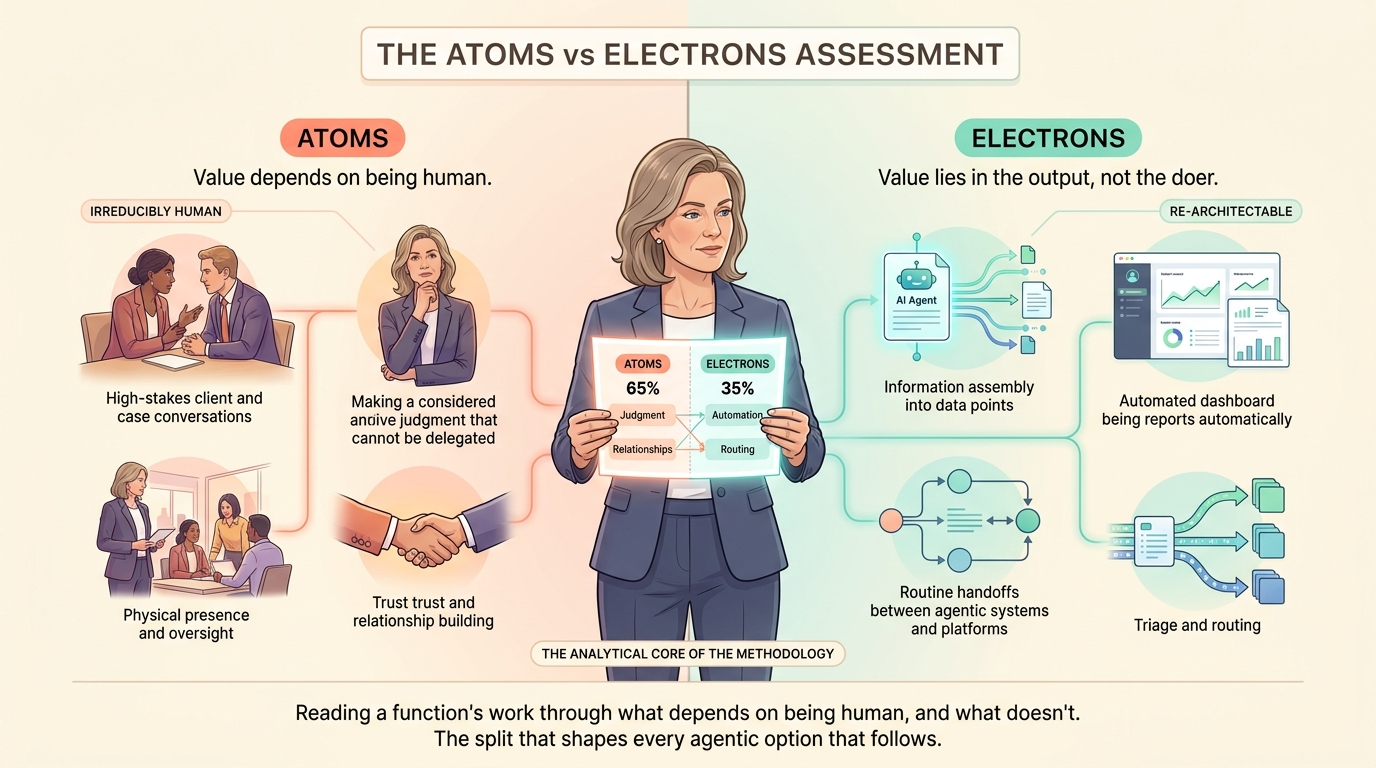
A copilot on the desktop makes your best people faster. That is real, and it is not nothing. But it changes nothing about how the function is built. The org chart holds. The handovers hold. The backlog holds. The work still routes through the same people in the same order, just typed a little quicker.
Agentic work is not a faster version of that. It makes exactly two moves on a legacy function, and only two. It replaces the work — takes a task off a person entirely — or it enhances the decision — sharpens a call a person still makes and still owns. Replace the work, Enhance the decision. Once you can tell which of those two moves applies to each piece of a function, you have the map. Everything else is sequencing.
This is the analytical spine underneath our eighteen agentic capabilities. Fourteen of them Replace. Three Enhance. One is the human gate that makes the other seventeen safe. Here is how they land on a function you already run.
Replace is the work that leaves. Enhance is the decision that stays.
Start with the split that decides everything: Atoms and Electrons. Atoms are the work whose value depends on being human — the high-stakes conversation, the judgment that loses its worth the moment you delegate it. Electrons are the work where the value is in the output, not the doer — triage, retrieval, re-keying, routing, reporting.
Replace capabilities take electrons. That is the whole point of Digital Labour: the work whose value is in the output leaves the person and runs as a governed system. Enhance capabilities sit on the atoms — they never take the decision, they make the person making it better-informed, faster, and harder to fault.
Nothing crosses that line. An Enhance capability that quietly started deciding would be a governance failure, not a feature. The map is binary on purpose.
The fourteen that Replace — the work that leaves the desk
These take a class of work off people entirely, inside bounds. On the Foundation layer: Grounded Retrieval reasons against your actual policies and cites the clause — "here's the rule it's based on," not "because the model said so." Memory carries context across every step so no one re-asks. Document Extraction reads forms and reports into clean data, routing low-confidence reads to a check rather than committing them blind. Validation holds bad inputs at the point of entry, where they're cheapest to fix.
On Orchestration: Adaptive Intake turns a messy disclosure into a clean, validated record through a guided conversation — no forms, no re-keying — and escalates the instant a risk signal appears. On the Action layer: Proactive Initiation acts on triggers and thresholds without being asked, and Action / Tool Execution turns a decision into a done thing — writing records, sending, firing flows. Both hold consequential or irreversible actions for a human yes.
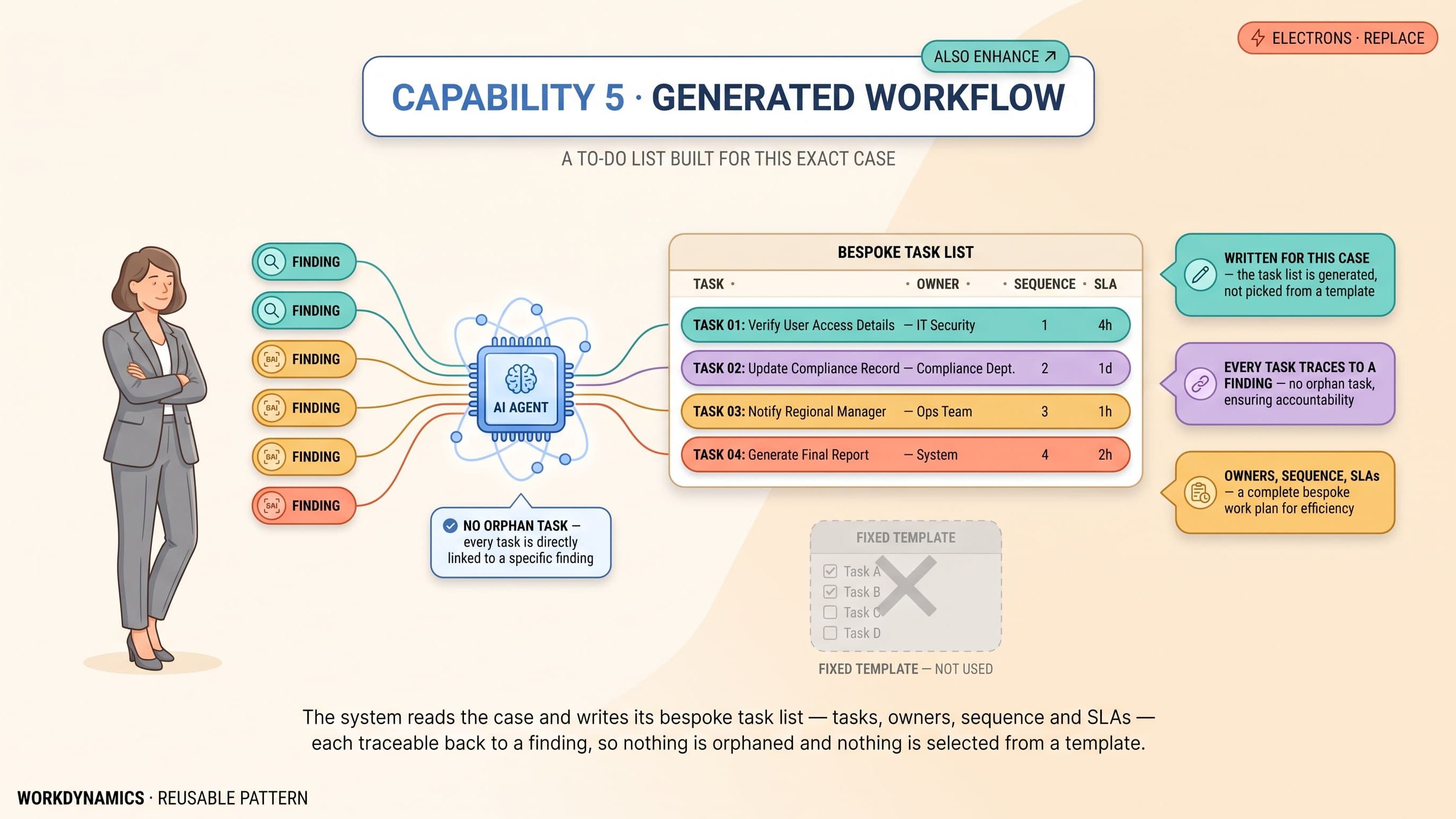
Then the rails that make Replace safe at scale: Governance by Design captures every action and rationale in an append-only, tamper-evident Decision Log as it happens — built in, not bolted on. Supervision & Escalation watches every case continuously and taps a person on uncertainty, risk or a stall. Generated Workflow writes the task list for this exact case (it Replaces and Enhances — every task traces to the finding that created it, no orphan tasks).
The three that Enhance — the decision that stays human
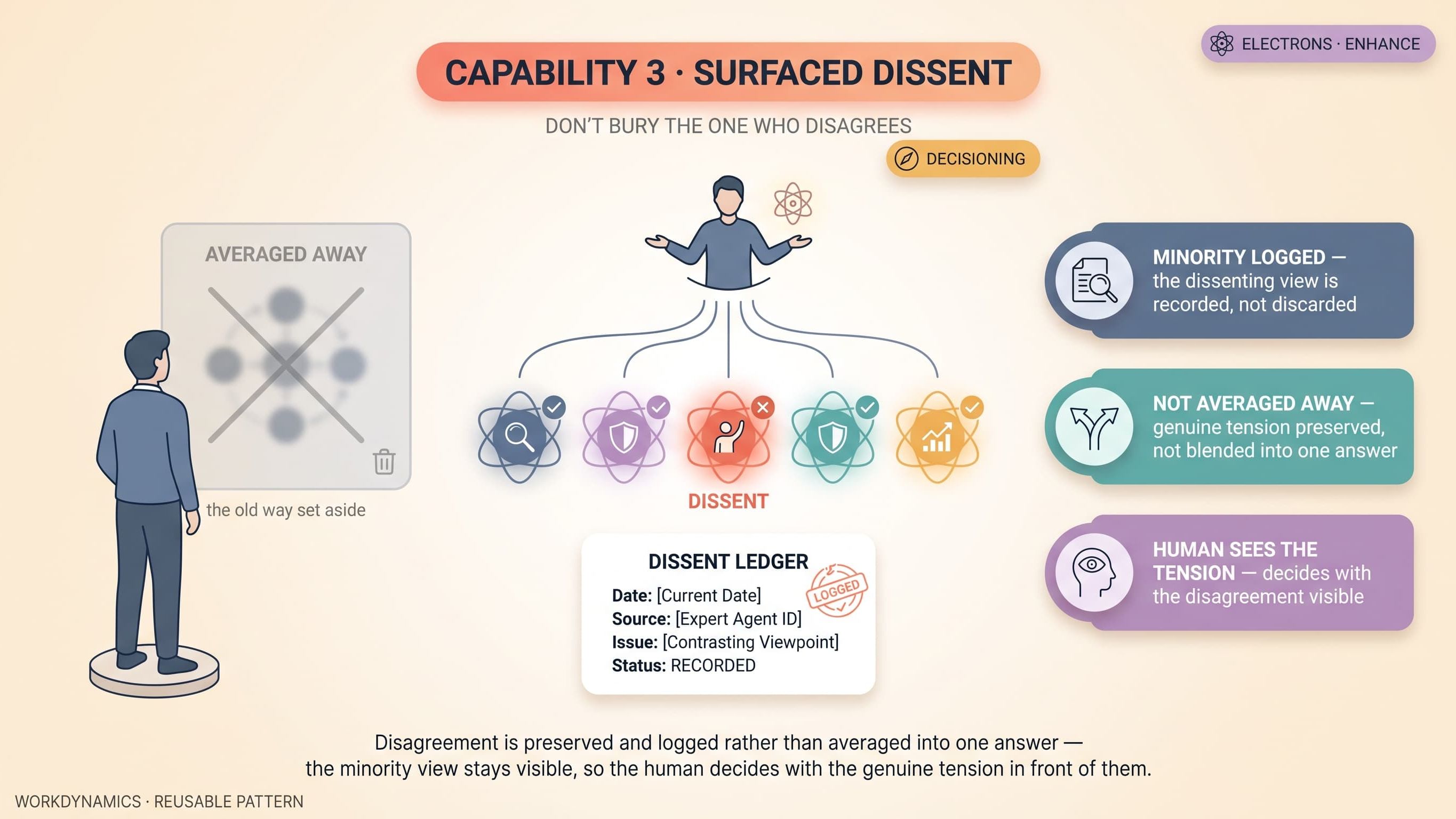
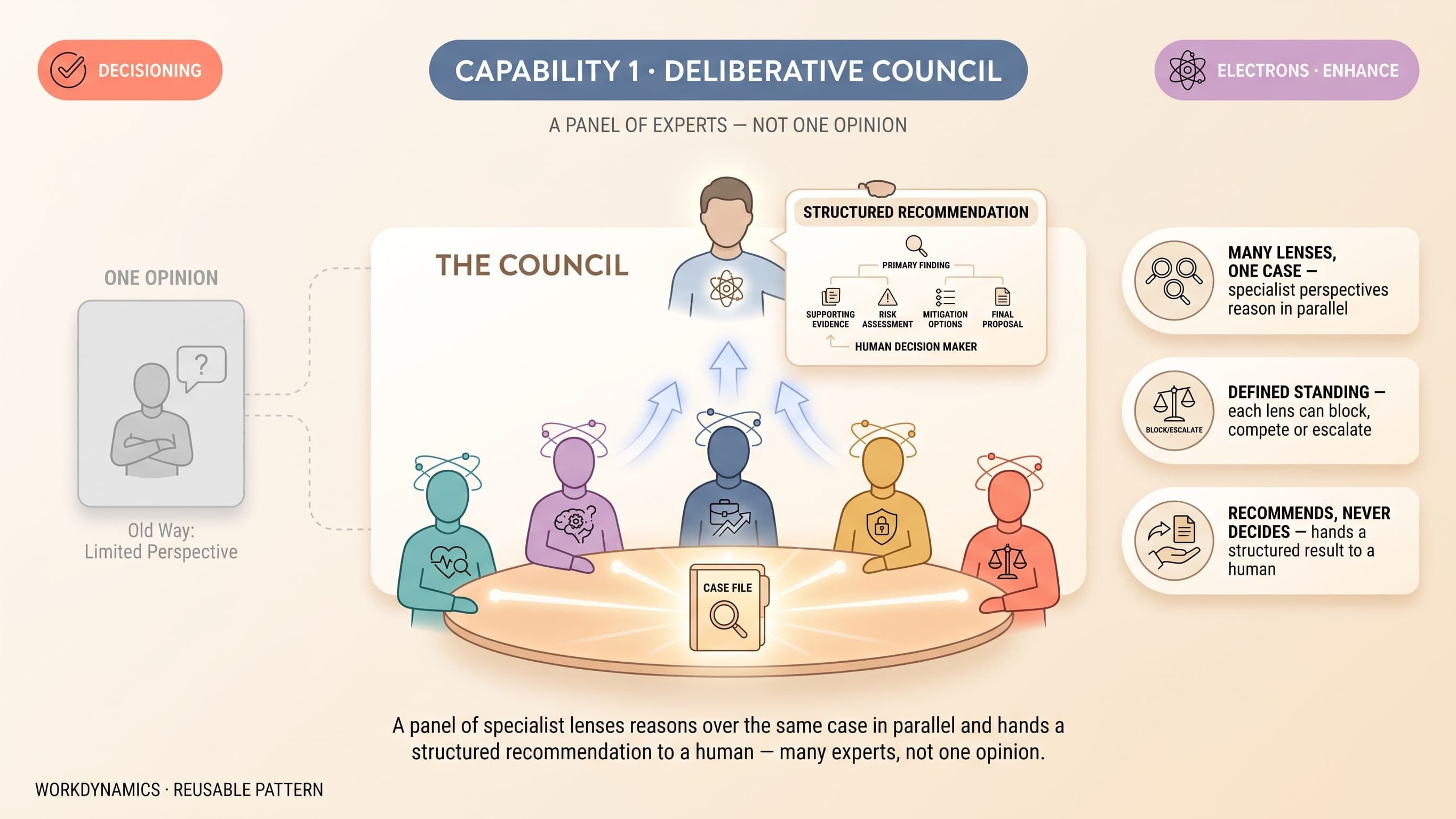
These never decide. They make your people decide better. Deliberative Council runs a panel of specialist lenses over the case in parallel and hands a person a structured recommendation — it deliberates, never decides. Optioned Recommendation presents two or three genuine alternatives with trade-offs explicit and impermissible options struck out. Constraint Hierarchy, Surfaced Dissent, Per-Case Personalisation, Lifecycle Continuity and the Outcome Learning Loop all sharpen the standing judgment without ever removing it — a breach of a hard rule is blocked outright, the minority view is preserved for the auditor rather than blended into false consensus, and learnings are proposed for human approval, never silently written into the system's own logic.
And holding the whole map: HITL Control Points — the human gate. Nothing consequential writes or sends without a person's yes. This is why the other seventeen can be as capable as they are: because they are bounded by design.
Humans on judgment. Agents on the rest.
Legacy outcome / Agentic outcome
Legacy outcome: the function's throughput is capped by headcount. Every case waits its turn in a human queue. Electrons and atoms are tangled together on the same desk, so your most experienced people spend most of their week on work whose value isn't in them doing it. Quality varies with who caught the case and how tired they were. When the regulator asks why a decision was made, you reconstruct it from memory and email.
Agentic outcome: the fourteen Replace capabilities run the electrons as governed Digital Labour, at system tempo, around the clock. The three Enhance capabilities lift every human decision that remains. Your experienced people spend their week on the atoms — the conversations and calls that actually hold the value. Every action carries its own rationale in the Decision Log. The function's ceiling is no longer the size of the roster.
The hard half and the soft half of the same move
On our indicative Functional Agentic Roadmap sample for a 60-person financial services contact centre, the Replace-and-Enhance split produces roughly a 13-month payback and a ~392% three-year ROI (about $5.02M net on $1.28M, AUD, illustrative) — with the function moving from 60 to about 46 FTE at maturity. That is the hard half.
The soft half is the same move seen from the other side. Because the 12% of atoms — vulnerable customers, complex complaints, retention, regulatory edge cases — is protected rather than automated, agent attrition falls from 35–40% toward 18–22%, keeping twenty to twenty-five experienced people who would otherwise walk. The function stops hollowing out. Its standing with the customer and with AFCA holds. You do not get one without the other; they are two halves of one cheque.
This runs in your own tenant, under your own controls
None of this is a black box you rent. The eighteen capabilities run inside your Microsoft environment — Copilot Studio agents on Power Platform and Dataverse, with the Decision Log and data controls carried by Microsoft Purview and agent oversight through the now-generally-available Agent 365 control plane. That matters more this year, not less: Australia's National AI Plan confirmed the country will keep relying on existing law and sector regulators rather than a standalone AI Act, which means the audit trail sits with you. Bolted-on governance won't produce it. Built-in governance does.
The next move
Before you sequence anything, you need the honest read: which parts of your function are electrons an agent can Replace, and which are the atoms your people must keep. Bring that question to the Exposure to Command live session — a fortnightly, 45-minute room where we map Replace-versus-Enhance against a real function, not a hypothetical one.
Book a seat in the Exposure to Command session →
Your CFO can fund it. Your CIO can architect it. Your board can sign it off. But only once you know which of the two moves applies where.