Autonomy Is a Governance Decision, Not a Convenience Setting
Jun 30, 2026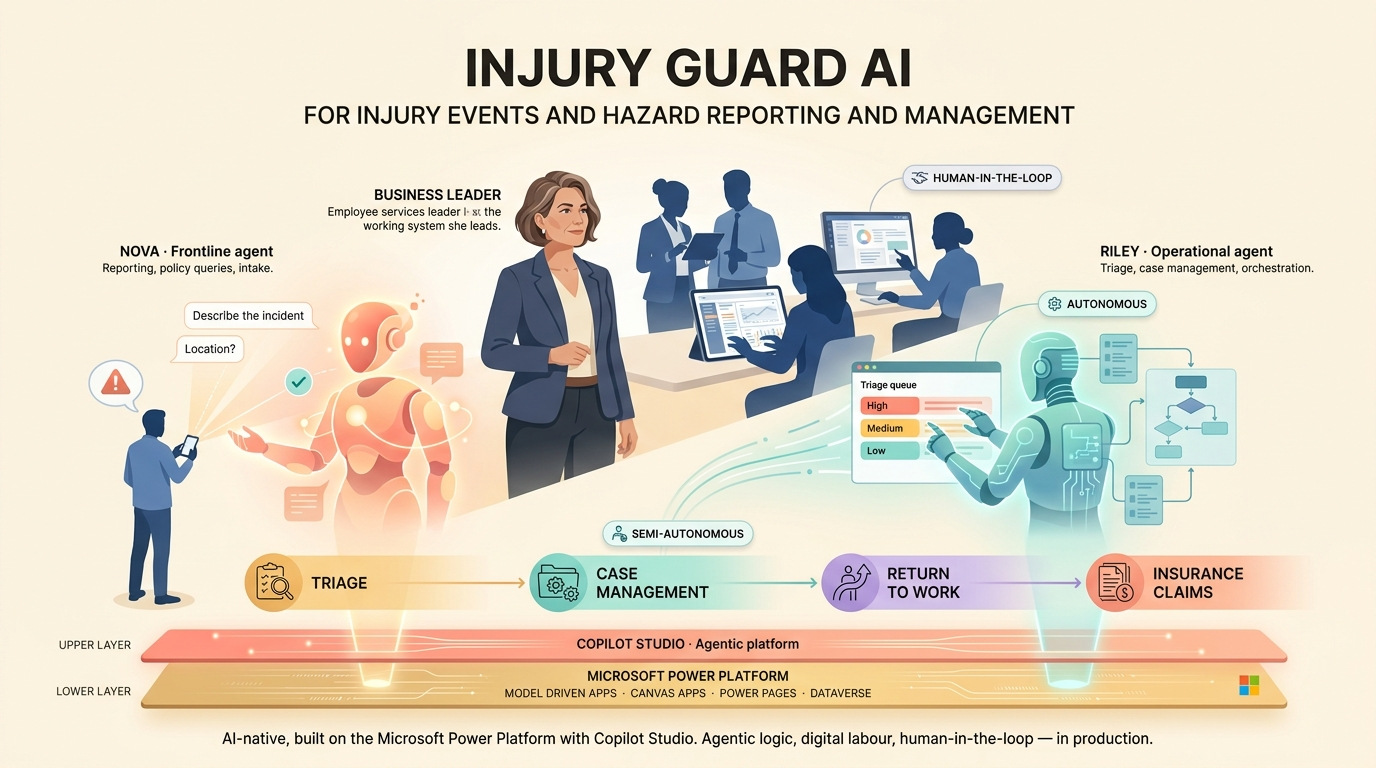
When a personal copilot gets something wrong, it's usually your problem, and usually reversible. You re-run the prompt. You delete the draft. The dial that sets how much it does on its own is a convenience setting — yours to turn, yours to live with.
A business function is not your desktop. It runs across thousands of cases and touches people who never set the dial: the worker, the customer, the regulator. At that altitude, "how much should the system do on its own?" stops being a preference and becomes a decision about accountability. Not a convenience setting. A governance decision.
This is the wedge most AI strategies miss. They licence autonomy as a feature and discover, case 4,000, that no one decided who was on the hook when it acted.
The dial you set once versus the dial that touches thousands
Microsoft has now shipped the autonomy. Copilot Studio agents act on triggers without a person in the loop, and Agent 365 is generally available as a control plane to manage them at scale. The capability is no longer the constraint. The constraint is the same one boards have always cared about: when something consequential happens, can you show who decided it, on what basis, and where a human held the line.
That is why autonomy at function scale has to be set by the stakes — case by case, not once. A low-stakes nudge can run alone. A decision that affects someone's claim, their complaint, or their cover cannot. The level of independence is a property of the decision, not a slider you flip for the whole function.
Legacy outcome versus agentic outcome
Legacy outcome. Oversight is a person reviewing a sample after the fact. Most cases are never looked at. When a decision is questioned — by an auditor, an appeal, a regulator — the function reconstructs what happened from memory, email threads, and whatever someone wrote in the notes field. Control exists on paper. It rarely exists in evidence.
Agentic outcome. Every case is watched continuously. A person holds the decision at the points that matter, and nothing consequential writes or sends without a human yes. The watch and the gate are designed in, not bolted on — and every action, decision and rationale lands in an append-only record as it happens. Oversight stops being a sample. It becomes the default state of the function.
Two capabilities make that shift real. Neither is about doing more on its own. Both are about doing it bounded.
Capability 9 — HITL Control Points: the human gate that doesn't move
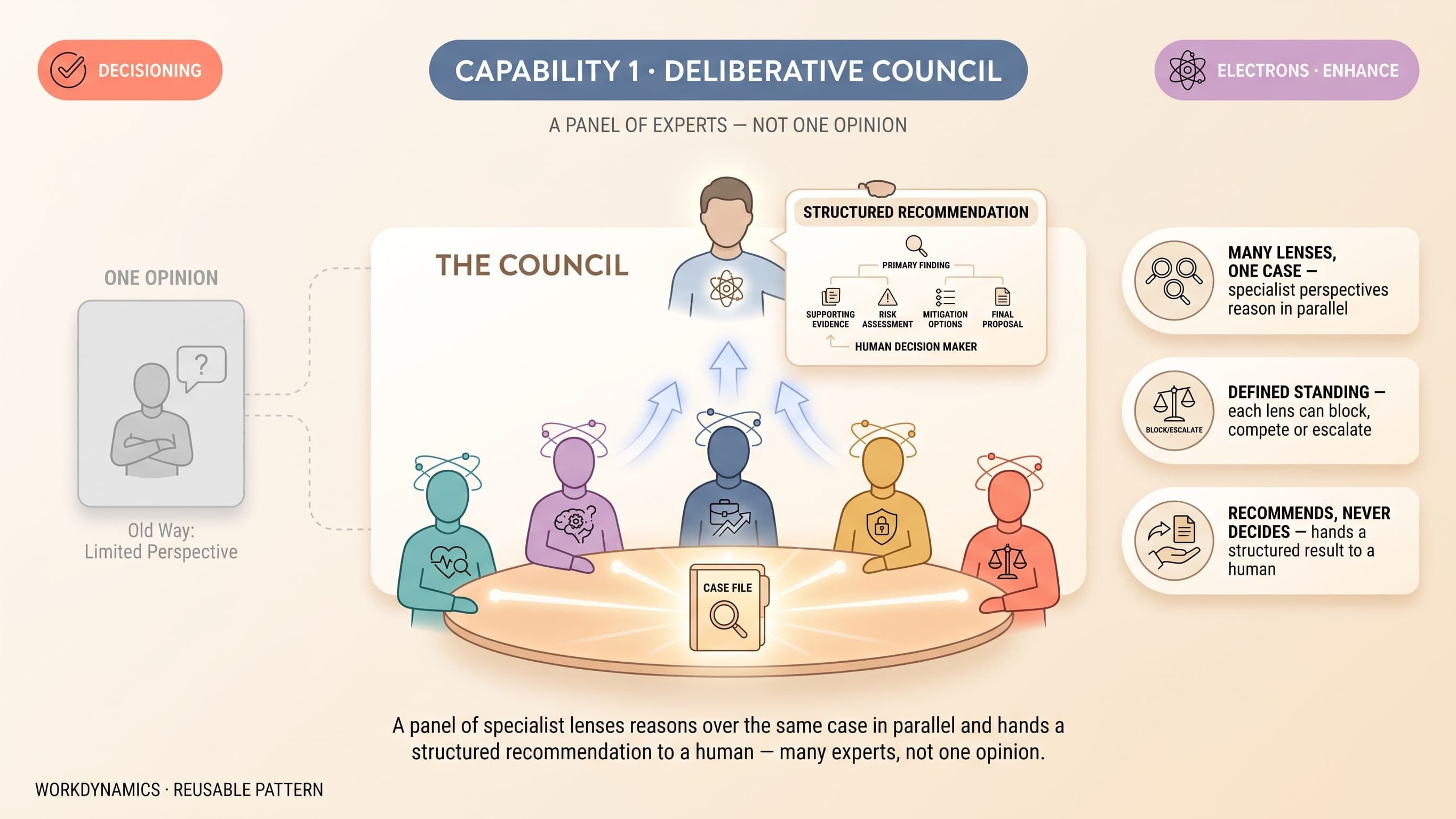
Human gate. A person holds the decision at the points that matter — confirm, review, sign-off — and nothing consequential writes or sends without a human yes.
This is the capability that makes autonomy safe to grant. It is not a fallback for when the model is unsure; it is a designed gate placed where the stakes demand it, by decision type, ahead of time. The agent can assemble the case, reason over it, draft the action — and then stop, because a human holds authority over the thing that matters. Approve a payment. Sign off a liability decision. Release a letter to a vulnerable customer. The gate is where judgment stays human by design, not by accident.
The discipline behind it is the same one that runs through every Atoms and Electrons read: the work whose value depends on being human is protected, and the gate is placed exactly where those atoms touch the workflow. Replace the work, enhance the decision — and gate the decisions that can never be delegated.
Capability 10 — Supervision & Escalation: the watch that never blinks
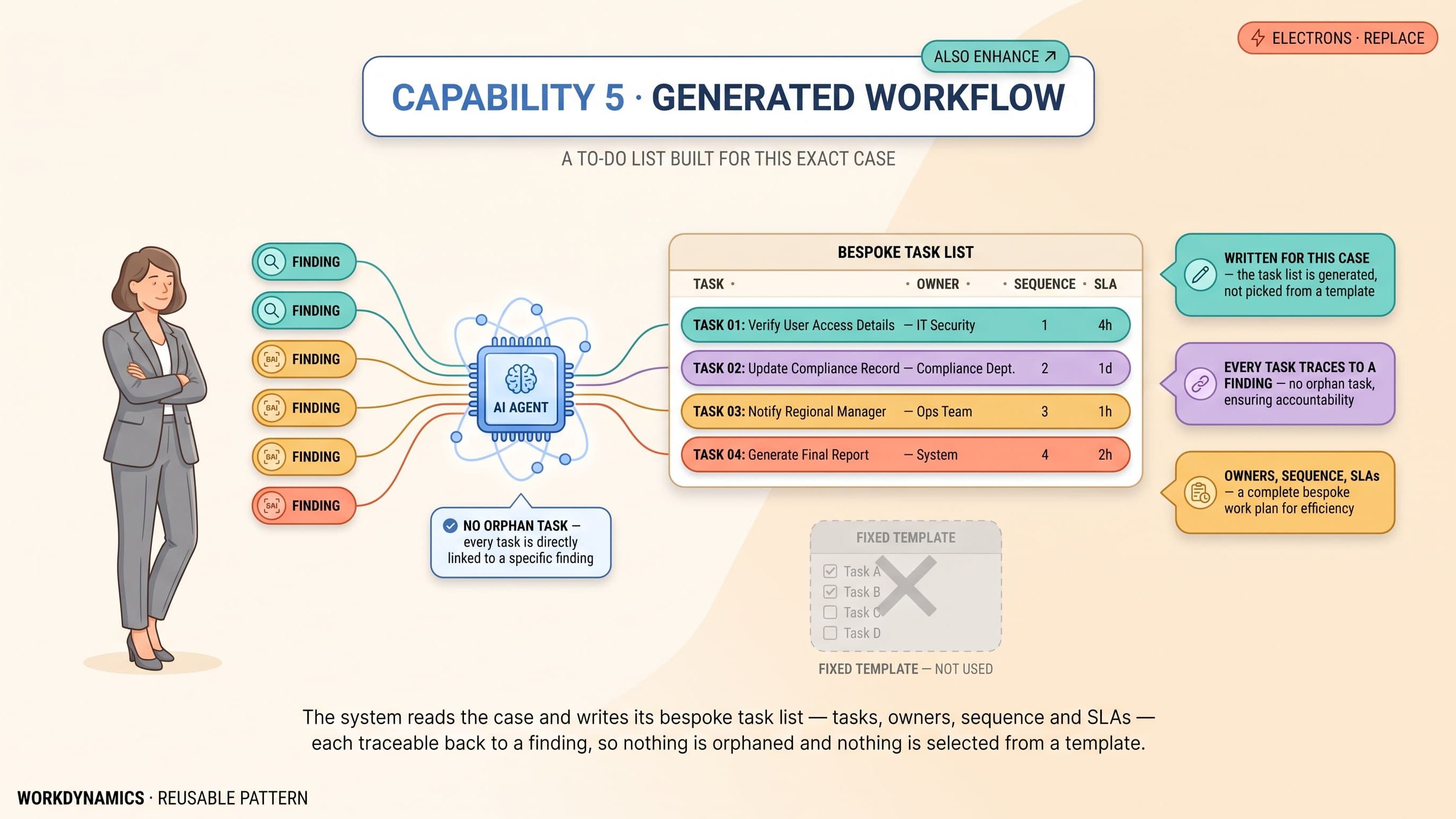
Replace. Continuous watch over every case — taps a person on uncertainty, risk or a stall, and scales the response to the risk.
Legacy supervision is a team leader spot-checking a queue. It replaces nothing; it just samples. Supervision and Escalation replaces the sampling with a standing watch over every case in flight. Low-confidence reads, risk signals, stalled work — each one is surfaced to a person proportionate to the stakes, the instant it appears, not a fortnight later in a quality review. The agent doesn't decide it's fine. It escalates, and a human decides.
This is the capability that lets a function run at scale without hollowing out its oversight. It's also where Microsoft's platform now meets the governance requirement directly: low-confidence steps route to a designated reviewer, and the Copilot Studio governance layer writes the audit trail into Microsoft Purview as it goes. The watch is automated. The authority stays with a person.
Four principles, one line
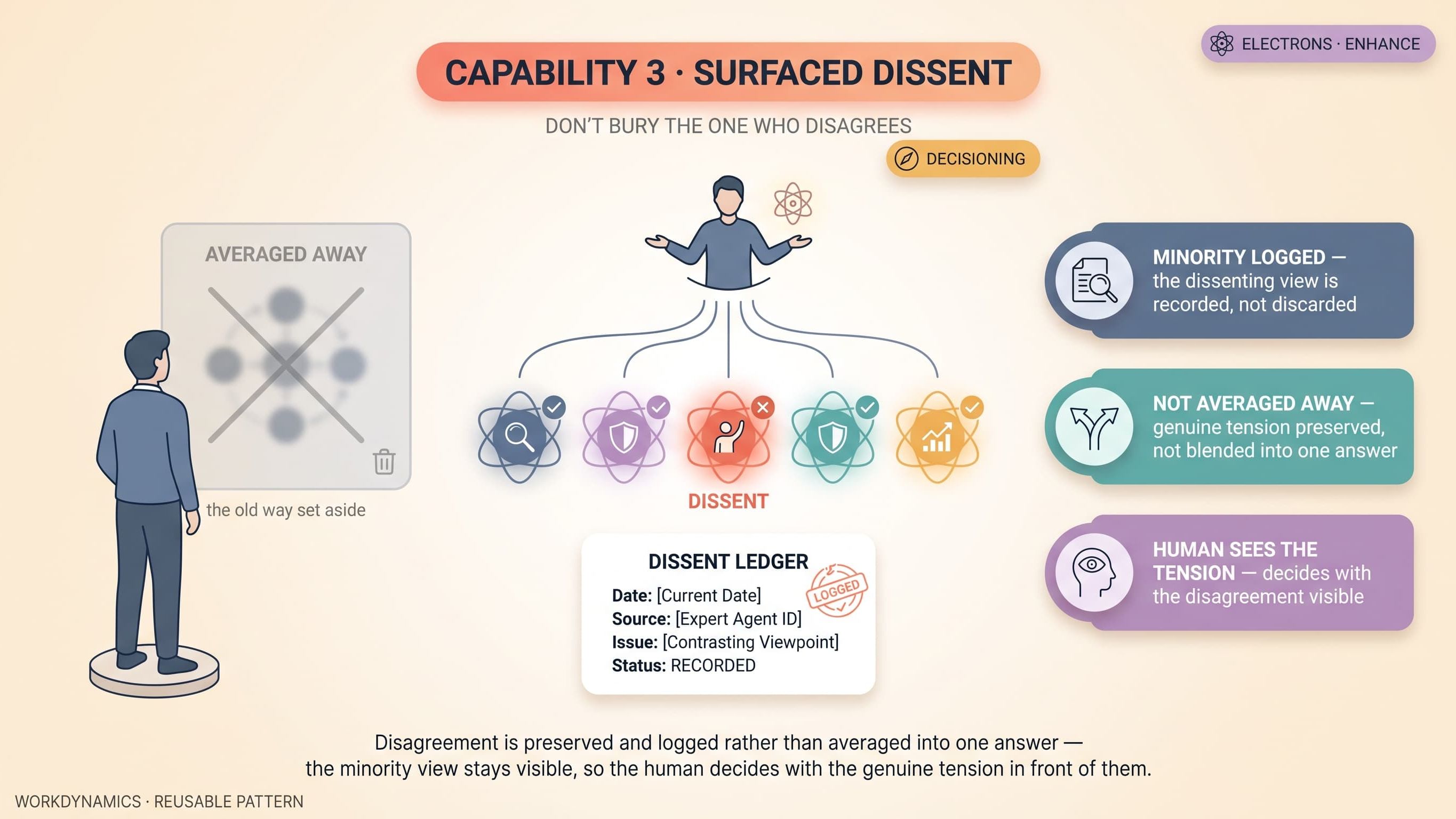
A function that gets this right is running on four principles. Autonomy is set by the stakes, case by case, not once. Hard rules can never be broken. A human holds authority. Everything is on the record. Together they reduce to one line: Humans on judgment. Agents on the rest.
This is not Devworkz being cautious. It is where Australian regulation is already heading. The Voluntary AI Safety Standard names human oversight as a core practice across the AI lifecycle, and the government has signalled mandatory guardrails for high-risk settings. A function that designs the gate and the watch in now is building the evidence the regulator will ask for later — not retrofitting it under pressure.
What the numbers say it's worth
Get the boundaries right and the return follows. In the Functional Agentic Roadmap injury-management sample — a 30-person internal function inside a 5,000-plus employer — the modelled shape is a ~14-month payback and a three-year return north of +350%, with the team moving from 30 to 25 as the electrons are taken off people (indicative methodology output, not a client result). That's the hard line.
The soft line matters as much in this conversation. Six to nine senior case managers are retained who would otherwise have left, the function's regulator standing moves from defensive to evidence-led, and the hollowing-out that kills oversight is avoided. You can't book those in the financial model. You lose the function without them.
The next move
Autonomy is already on your desktop. The question your board will ask is not whether you have it — it's whether anyone has decided, case by case, where the human gate sits and who holds it. That's a governance decision, and it's yours to make before someone makes it for you.
Bring your function to the next Exposure to Command session. It's a fortnightly, 45-minute online room for leaders who'd rather command the shift to agentic work than be caught out by it — and the Command half lands on your function, not a hypothetical one. Book a seat in the Exposure to Command room →