AI Exposure vs AI Readiness: Why the Framing Matters in 2026
Jun 03, 2026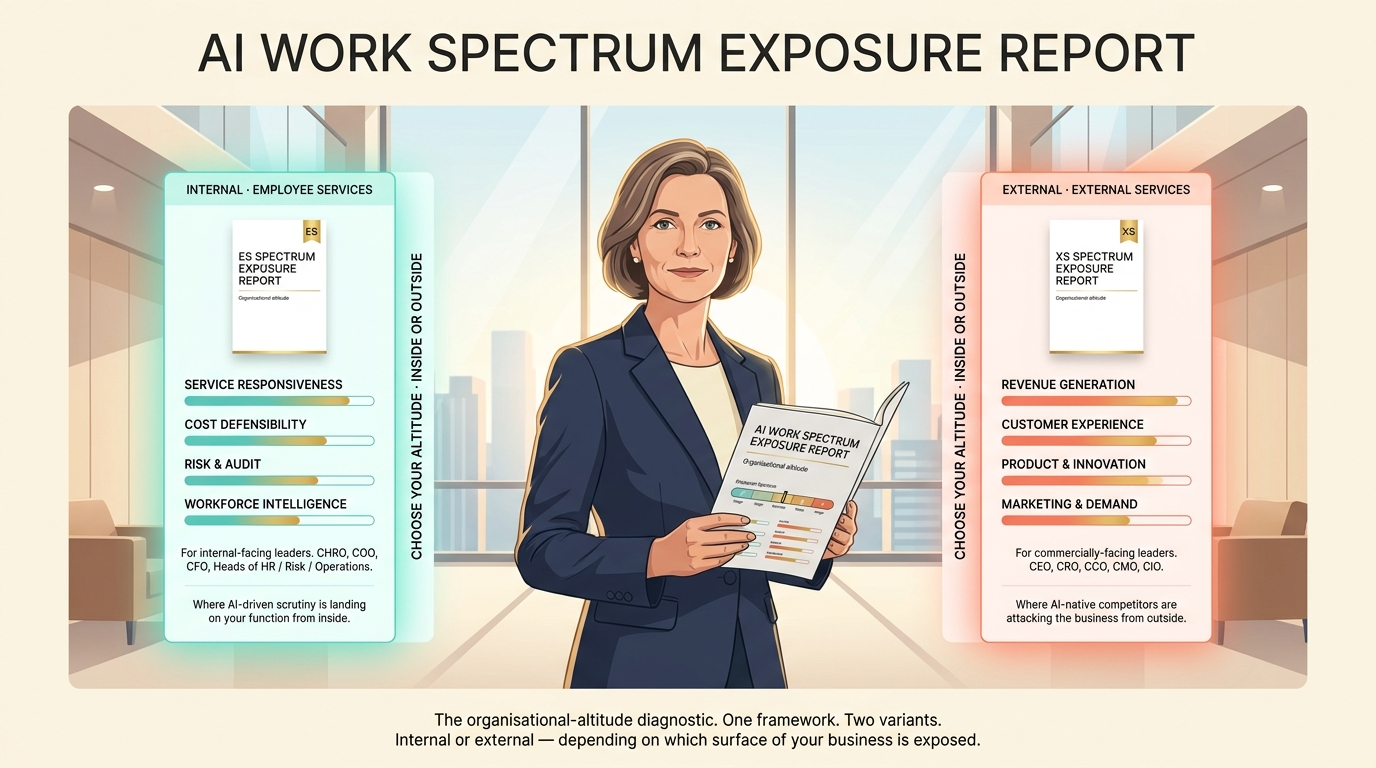
Two frameworks dominate the AI strategy conversation right now. One asks whether your organisation is ready to use more AI. The other asks how exposed your function already is to the AI that's doing the work somewhere else.
They sound similar. They produce completely different decisions.
In 2026, the framing you pick determines the response you build — and the conversation you're able to have with your CFO, your board, and your peers. This piece is about why that choice matters more than it looks.
The dominant framing today: AI readiness
Walk into almost any AI advisory conversation in 2026 and the framing is the same. AI maturity. AI readiness. Microsoft's Readiness Assessment. Deloitte's Maturity Model. Earley's EIS Assessment. Every major consultancy and platform vendor offers a version.
They share three things:
- They measure adoption depth — how many tools, how many users, how many pilots
- They check organisational prerequisites — data, governance, skills, infrastructure
- They produce a stage ranking or a readiness score, usually positioning the buyer below where they "should" be
The framing is internally consistent and has been useful as a starting point for over a decade. It is also, for the conversation 2026 boards are actually having, increasingly the wrong instrument.
What "readiness" assumes — and why it's broken
AI readiness assumes adoption is the goal. It treats AI as a thing your organisation is preparing to use, then asks whether your prerequisites are in place.
But adoption is no longer the conversation. AI is already operating — inside your competitors, inside your regulators' expectations, inside your customers' alternatives. The question is no longer whether your function is ready to use AI. It's how exposed your function already is to the work AI now performs somewhere else.
You can have impeccable AI readiness scores and still be structurally exposed. You can have low readiness scores and still be perfectly positioned, because nothing in your function is yet at material risk.
Readiness measures whether you're prepared. Exposure measures whether you're already behind.
The emerging framing: AI exposure
In the last twelve months, the language has started shifting. KPMG's 2026 Australian business leaders survey identifies "all things AI" as the top board-level concern — and frames it as exposure, not readiness. Aon's AI Risk 2026 report does the same. Jobs and Skills Australia's Generative AI Capacity Study explicitly studies exposure, not maturity.
These aren't fringe sources. They're the conversations C-suites and boards are actually reading. And they share a different frame:
- AI readiness asks: how much AI are we using?
- AI exposure asks: how exposed is our function to the work that AI now performs?
The first question is internal. The second is structural. The first invites a multi-year roadmap. The second forces a response now.
Why exposure framing wins boardroom attention
Boards don't fund readiness improvements. They fund response to exposure.
A CFO can sit through a maturity-model presentation for an hour and approve nothing, because nothing in the framing forced a decision. The same CFO will fund an exposure response in twenty minutes, because the framing names what's already at risk and what credible response looks like.
The difference isn't rhetorical. It's about what each framing implies:
- Maturity: "We could be further along. Here's a roadmap to get there."
- Exposure: "We are behind on this specific surface. Here's what closing it requires."
The first invites debate. The second invites a decision.
What an exposure read looks like in practice
A useful exposure read has four properties.
It is structural, not aspirational — it measures where your function actually sits today against where AI is already operating, not where you wish you were.
It is function-altitude, not whole-of-organisation — exposure shows up at the level where service quality and cost-to-serve are decided. That is the function, not the enterprise.
It is named, not scored — useful exposure reads identify specific danger zones explicitly. "You are exposed on these three vectors" is actionable. "You scored 3.2 out of 5" is not.
It is bounded, not open-ended — every credible exposure read produces a finite list of next moves calibrated to your current position. Not a multi-year transformation plan.
The AI Work Spectrum was built around these four properties. The free AI Work Spectrum diagnostic gives you a directional read in ten minutes. The paid AIWS Exposure Report goes deeper — danger zones named, priority vectors ranked, recommended next moves calibrated to your position. Both work from the same exposure-not-readiness framing.
How to choose between the two framings for your next leadership conversation
If you're presenting AI to a leadership team in 2026, the framing decides the conversation. Three quick tests:
- Time horizon. If your leadership wants to know what to do in the next 90 days, lead with exposure. If they're planning a five-year transformation, readiness still has utility.
- Decision posture. If you need a funding decision, lead with exposure — it forces one. If you need a buy-in conversation, readiness can warm the room.
- Audience. Function heads and CFOs respond to exposure. Transformation leaders and CIOs are equally comfortable with either.
For most leadership teams in 2026, exposure is the right frame for the same reason "AI strategy" replaced "digital strategy" five years ago: the conversation has moved.
Where to start
The fastest way to see the difference is to do both reads on the same function.
Take the AI Work Spectrum diagnostic — it's free, takes ten minutes, and gives you a directional exposure position across four vectors. Then run any standard AI readiness assessment alongside it.
You will get two very different pictures of the same function. The one that survives the boardroom conversation is the one we'd suggest you bring forward.