Command Notes · AI changes the work. Lead the response.
Everyone is teaching leaders to build agents. Command Notes teaches you to command them.
Mental models for leaders — the transition from traditional, coded systems to the agentic workplace. Three volumes, in the order the argument runs: why it matters, what an agentic system really is, and how to run one.
Humans on judgment. Agents on the rest.
Get the three volumes → Or start free with Module 1 of AI Command Foundations →You can feel the shape of the question. You can't get it into words.
Someone books a demo for your function. Intelligent triage. Automated assessment. A dashboard that lights up. It looks good, and you cannot tell whether it is real — so you say nothing, for forty minutes, in a meeting about work you have run for twenty years.
Three weeks later the pilot is approved. You weren't in the room for that one either.
The gap isn't intelligence and it isn't experience. It's vocabulary — the specific words that turn an instinct into a question a vendor has to answer.
What Command Notes is
A series of short arguments about what changes when agentic systems arrive in a function, compiled into three volumes. Deliberately plain about it:
One idea, held still
Each note takes a single idea and stays with it long enough to be useful — what the work is made of, where judgment belongs, what a system can be trusted with, and what it can't.
Written for the accountable
For the person who owns the function when the decision lands on it. Not for the person building the system, and not for the person selling it.
Not an implementation guide
No tool reviews, no build instructions, no vendor scorecards. The vocabulary you need to hold your ground in the room where it gets decided.
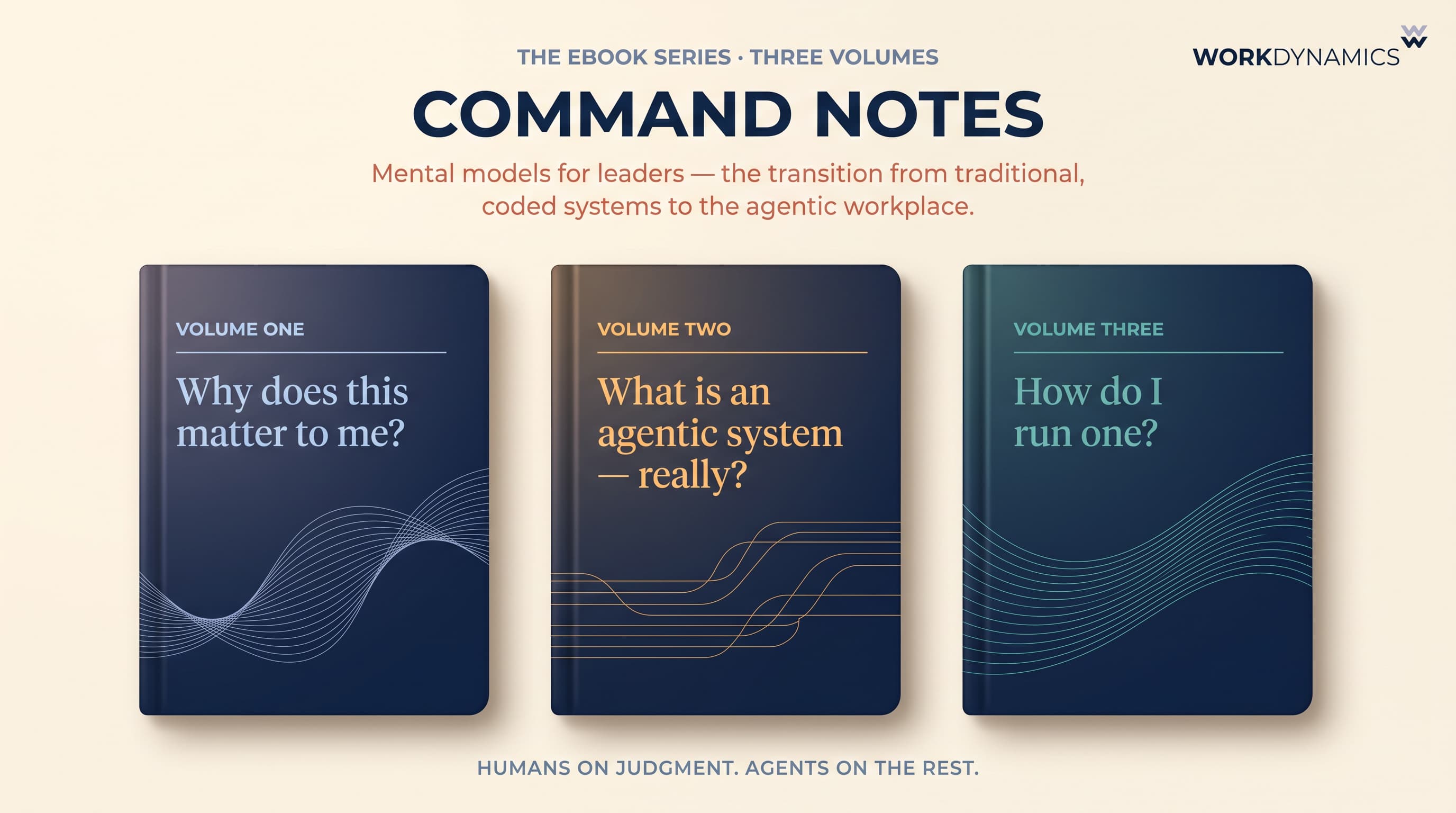
Three volumes
The argument runs in order. Volume One makes the case, Volume Two takes the system apart, Volume Three is about running it. All three are out, and all three are free.
Why → What → How
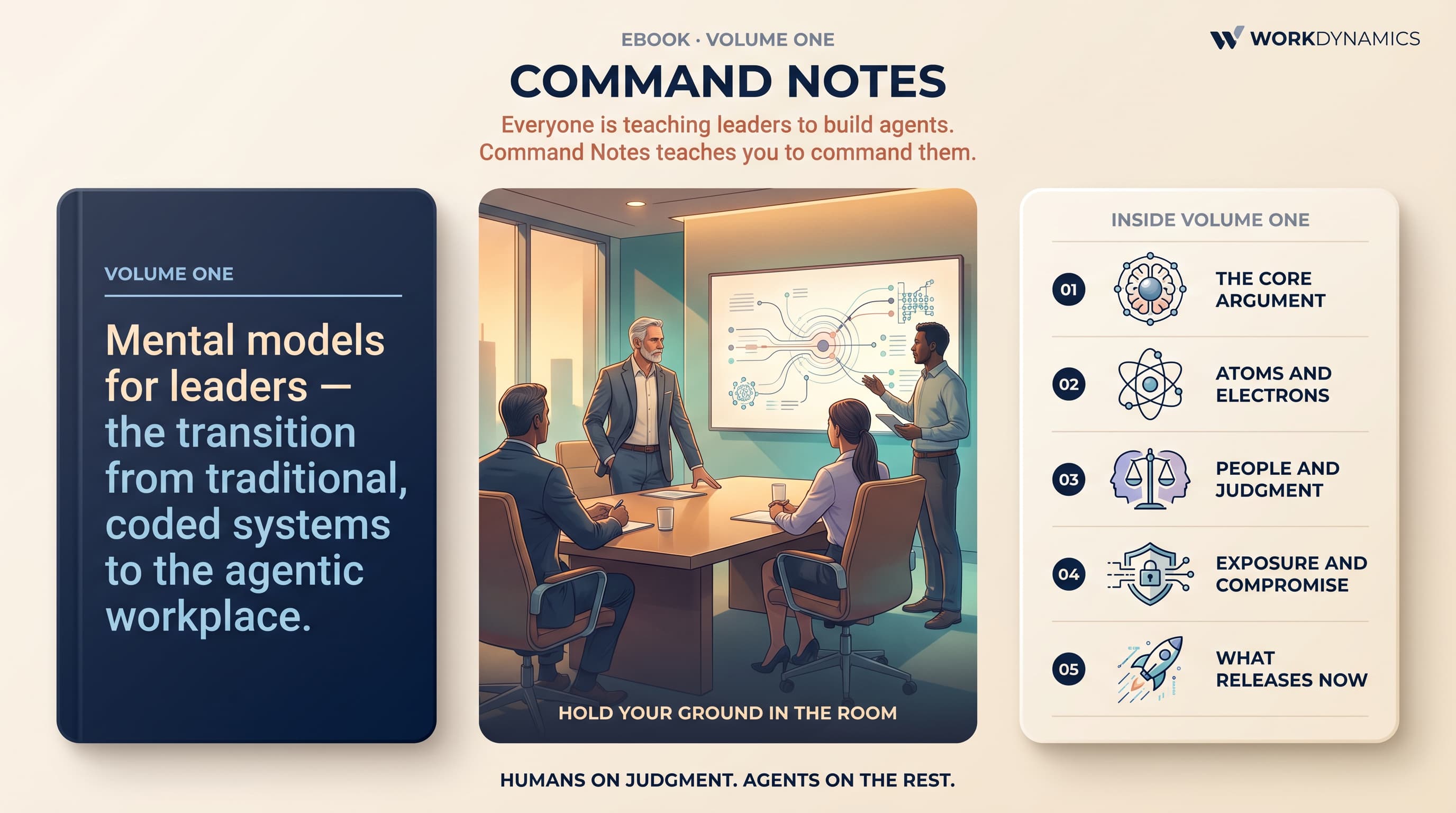
Volume One · Why This Matters
Why does this matter to me?
Why the systems you run were built for scarcity — and what changes now that agentic systems have ended it.
- The Core Argument
- Atoms and Electrons
- People and Judgment
- Exposure and Compromise
- What Releases Now
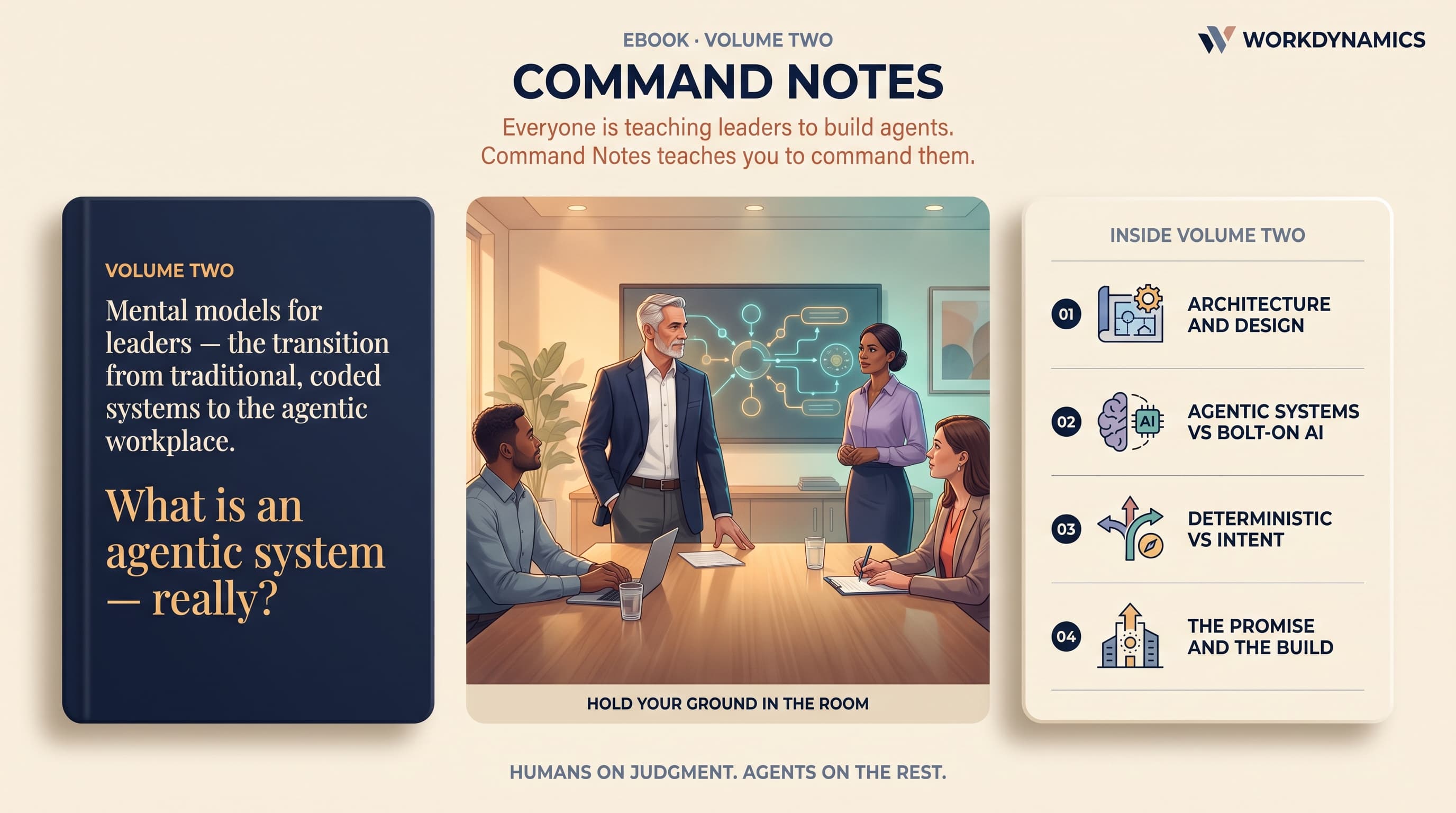
Volume Two · What It Really Is
What is an agentic system — really?
How agentic systems actually differ from traditional coded systems — and how to buy with judgment.
- Architecture and Design
- Agentic Systems vs Bolt-On AI
- Deterministic vs Intent
- The Promise and the Build
Deterministic vs Intent appears here and nowhere else — it is never published in the series.
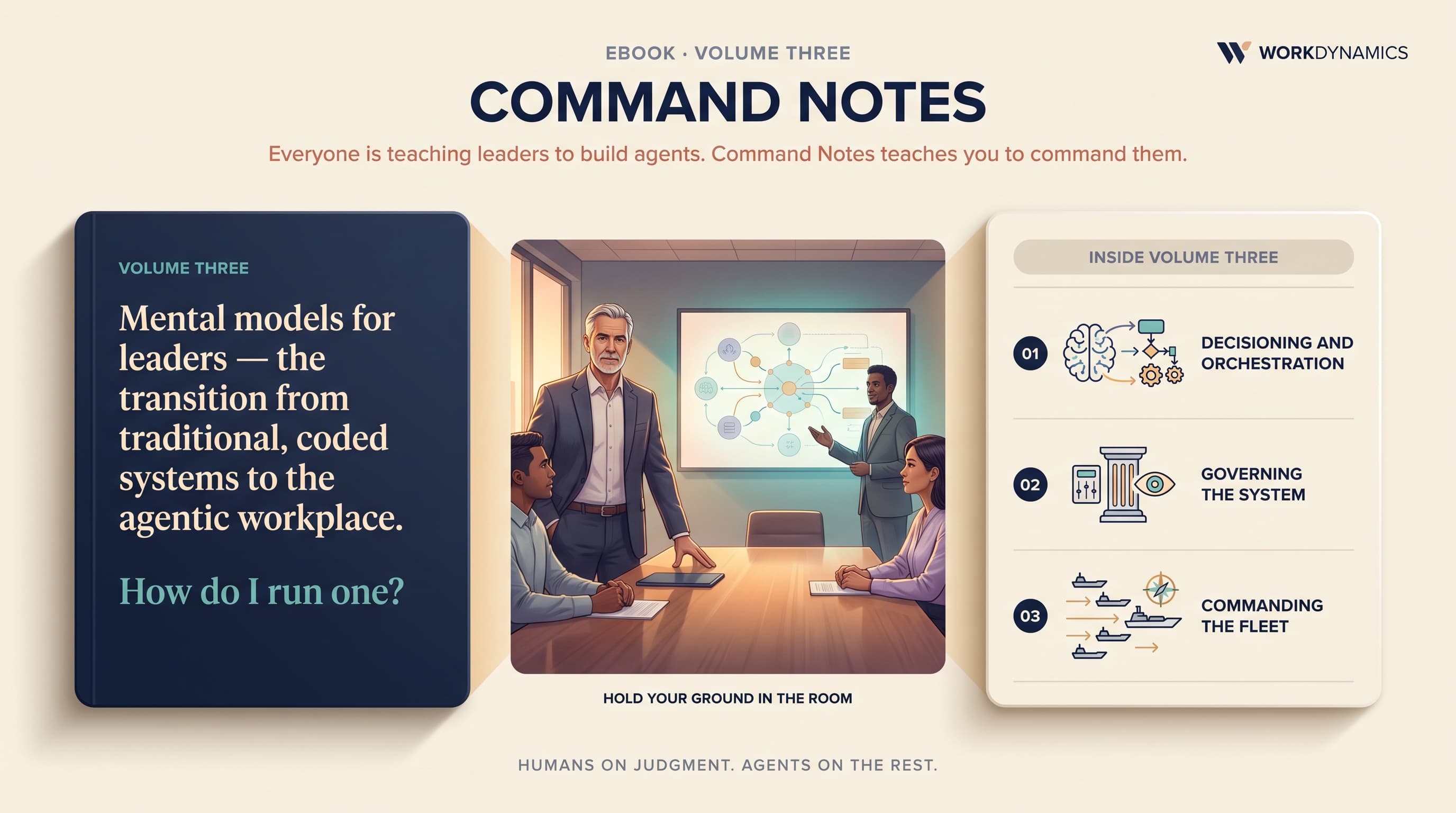
Volume Three · How To Run It
How do I run one?
Running agentic systems as a leader: decisions, governance, and the fleet.
- Decisioning and Orchestration
- Governing the System
- Commanding the Fleet
Every volume is free. Take one, or take all three.
Written by people running production AI
Not commentary. Systems operating today.
These notes come out of production work, not a reading list. WorkDynamics advises commercial, local government and NFP organisations across Australia and New Zealand on the move from individual AI use to structural Digital Labour. The frame handed to you here is one we have already had to stand behind.
Injury Guard AI
Workplace injury management — triage, case management, finalisation.
See the system →Where this thinking starts
Every model in these volumes is drawn from AI Command Foundations. The volumes are the argument in short form; the course is where you work it against your own function until it holds.
Seven modules, self-paced. Leaders get the evaluation frame; their teams get the practice and the architecture literacy. Everyone learns the same vocabulary — which is the point, because it is what stops the decision and the work being two separate conversations.
It is grounded in the stack your organisation already runs — Microsoft 365 Copilot, Copilot Studio and the Power Platform — so you are assessing the tools actually in front of you. You finish holding a measured exposure picture for your own function.
All three volumes come as a single compendium inside the course — one file, the whole argument, without waiting for the releases.
Command of the conversation. Not the system.
AI Command Foundations
- Module 1 free for 90 days
- Full course $297 AUD
- 12 months of included content updates
- The three-volume compendium included
- Team and enterprise pricing on application
Somewhere in your organisation, a decision about your function gets made this year.
By whoever is loudest, or by a vendor, or by default. The people who can read an agentic proposal, test its governance and size its cost will set the terms. The only open question is whether that is you.
All three volumes are there now. They cost you an email address.
Get the three volumes →Humans on judgment. Agents on the rest.