WorkDynamics · Functional Agentic System Transformation
Abundance, scoped to your function.
Not a promise about the economy — an outcome you can point at. Service abundance is what's left once the rationing stops: every file gets the read it deserves, every case the follow-up, every borderline call a second opinion. Not because the team got bigger, but because the grind is carried by something else now. It shows up as a number, not a feeling — no case unreviewed, no signal unactioned.
The thinking unrationed, the grind lifted, the record kept, the unprompted work done.
That's what FAST delivers. Your exposure report names what AI puts at risk in your function. FAST is the path that answers it — from where you stand today, legacy or greenfield, to a function where agents carry the work as Digital Labour and your people hold the judgement.
Humans on judgment. Agents on the rest.
Start free with Module 1 → Want the read on your own function first? Get your free exposure report →Why now
The wave already landed in your function. Are you running it — or reacting to it?
Every week another vendor announcement, another benchmark, another promise that this is the year everything changes. Meanwhile the wave isn't coming — it's already in the building. Copilot's on the desktops. Someone's roadmap has “agents” pencilled in for Q3. And your CFO is asking the question you don't have a clean answer to yet: what are the seats actually producing?
Command over a function doesn't start with a pilot. It starts with knowing exactly where that function stands right now — legacy system or greenfield, atoms or electrons, exposed or protected — and what the path from here to agentic actually looks like. Not the industry's path. Yours.
What the legacy system never told you
“I never knew what we were compromising.”
That's the line leaders say once they see it named. Not because the legacy system was failing loudly — it wasn't. It was just quietly rationing everything: whose file got the careful read, whose case got the follow-up, whose judgement got a second opinion. Nobody signed off on that. It just happened, file by file, for years.
Now the team knows what they're not giving up anymore. Judgement is where their people spend their attention — the calls only a person should make. Everything people-facing runs supported: instant decisioning where a file used to sit in a queue, case orchestration built around the person in front of them instead of a generic process, learning loops that catch what's repeating before someone has to notice it themselves. And over all of it, a leader who can see and direct the whole system — not hoping it's working, knowing it is.
FAST · The definition
FAST is the aggregation, not a new product.
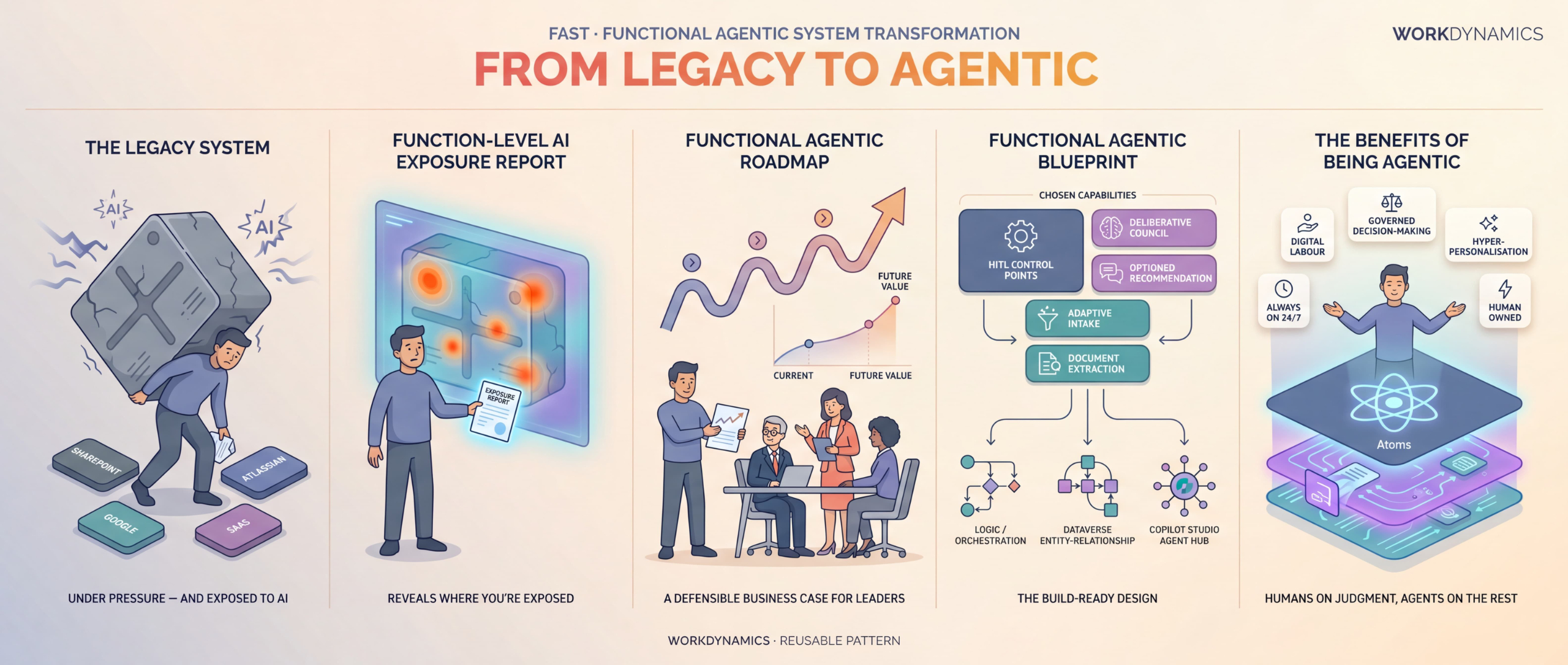
Functional Agentic System Transformation names the connected sequence that takes a function from where it stands today to an agentic one. Four components do the work.
FAIER
Functional AI Exposure Report
Free. Reveals where the function sits today, and where it's exposed.
FAR
Functional Agentic Roadmap
Turns that exposure into a defensible, funded plan.
FAB
Functional Agentic Blueprint
Turns the plan into a build-ready design.
AICF
AI Command Foundations
Builds the human capability alongside the system, so the function can direct it.
Nothing about FAST is a fifth thing to buy. It's the discipline that keeps the other four moving in the right order, toward the same function — so that each one earns the next.
Two starting points
Legacy or greenfield. Same destination.
Every function runs on one of two foundations today, and both are exposed to AI.
Legacy Modernisation
The function already runs — on SharePoint, on Atlassian, on a SaaS tool, on spreadsheets held together by habit. Work moves by hand between systems that don't talk to each other. FAST doesn't rip the legacy out on day one; it reads the function first, then sequences the move. Where a current-system baseline and total-cost-of-ownership read is needed for a clean upgrade-versus-new comparison, the Roadmap carries a legacy-upgrade module.
Greenfield
The function has no system of record yet — it runs on people, process and goodwill. There's no legacy to migrate, which also means there's no default architecture pulling the design back toward the past. FAST designs the agentic system as the first system, not a retrofit.
Same four components either way. What changes is what the Roadmap finds, and what the Blueprint has to design around.
See where your function sits — get your free exposure report →The path
Each step earns the next.
Function today → Exposure report → Roadmap → Blueprint → Agentic outcome
01
The function today
Legacy or greenfield, exposed to AI either way. Every engagement starts with what's actually true about the function.
02 · FAIER
Exposure report
Free. Ten minutes. Where AI can take work off the plate, and where it puts the function at risk.
03 · FAR
The Roadmap
A defensible business case. Sequences the work in phases and prices the return for CFO, board and CIO.
04 · FAB
The Blueprint
The build-ready design. Capabilities mapped to logic, data model and agent hub — governed, on the Microsoft stack.
05
Agentic outcome
Agents carry the work as Digital Labour. The people hold the judgement. Every decision governed and human-owned.
The parallel track
A system without a commander is just automation.
The Blueprint can design the agents. It can't hand a leader the judgement to direct them. That's what AI Command Foundations does — building the capability to read an agentic system, question what it recommends, and hold the calls the design deliberately leaves human.
FAST without AICF ships a system nobody in the function is credentialed to own. FAST with AICF ships the system and the command capability at the same time.
Start Module 1 free →What carries the work
What the function gets, once agents carry the grind.
The abundance above isn’t a mood. It’s what a specific set of capabilities produces when they’re designed into a function properly.
Instant decisioning support
The file that used to wait in a queue for a human read arrives already read, already sorted, with the relevant material surfaced.
Personalised case orchestration
The process shapes itself around the person in front of you, instead of every case walking the same generic path.
Advanced learning loops
Patterns that repeat across cases get surfaced before someone has to notice them — the function improves without waiting for a review cycle.
Agentic command oversight
The leader can see the whole system operating, direct it, and answer for it. Not hoping it’s working. Knowing it is.
Underneath these sit the control points that keep the human core intact: the decisions a person must be in the room for, the options presented rather than the answer imposed, and the record of every act that means trust no longer has to be extended on faith.
See the twenty agentic capabilities →Two functions that made the trip
Not a template. A discipline — proven on real functions.
Same path. Same atoms-and-electrons move. Two completely different functions, two different starting points — and a defensible plan for each.
Customer Contact Centre · external
Agents at the edge, humans where it counts
60-person contact centre, financial services. Atoms just 12% — but that 12% holds the entire commercial value: vulnerable interactions, complex complaints, retention. Agents take the edge at scale; people move to where the revenue lives.
Injury Management · internal
Atoms protected, electrons re-architected
30-person injury team, large employer. Atoms 26% — the case conversations and relationships, not the paperwork. The core is protected and everything around it re-architected. Regulator standing moves from defensive to evidence-led.
The path is not a template — it's a discipline. It produces a function-specific outcome whether the function is internal operations or customer-facing.
Send me the sample report →Where the pricing starts
The entry is free. The first priced rung is fixed.
The exposure report costs nothing. It's the entry point, and it's the only thing you need to start. The Roadmap is the first priced step — and the number is the number.
FAR · Standard function
$7,500 ex GST
A single internal function. Nine components, the complete Roadmap, and one advisor walkthrough.
FAR · Complex function
$10,000 ex GST
High-volume, customer-facing or multi-workflow functions — more surfaces to hold.
Legacy-upgrade module
+$2,500 ex GST
Current-system baseline and TCO, for a clean upgrade-vs-new comparison.
Volume pricing. Assessing more than one function? Per-Roadmap pricing steps down with commitment — $6,500 each at 2–4, $5,500 at 5–9, and $4,500 at 10+. Scoped together or built over time.
Beyond the Roadmap. The Blueprint is scoped from what the Roadmap finds, so it isn't priced here — anyone quoting a build-ready design before the function has been read is guessing. The Roadmap is how the rest gets priced.
Forward credit. If your Roadmap proceeds to a Blueprint for that function, 25% of the Roadmap fee comes off the Blueprint.
Start where the function actually is.
FAST isn't a bigger commitment than any one of its parts. It's the name for what happens when a leader runs the sequence in order instead of stopping at the first piece of it — and it starts with ten minutes and no salesperson.
Get your free exposure report →Humans on judgment. Agents on the rest.