WorkDynamics · AI changes the work. Lead the response.
Copilot's a hit at the desk. The CFO wants the ROI. The CEO wants it locked in across teams.
The excitement is real. People are drafting faster, clearing their inboxes, getting through the day with a bit left in the tank. At the desk, it works.
But the two questions coming down from above don't get answered at the desk. The CFO's — what did we actually get for the spend? — can't be answered by a room full of people who are each individually a little quicker. That's not a return anyone can put in front of a board.
The CEO's is harder still — how do we lock this in across teams, not leave it to a handful of enthusiasts? Desktop AI can't do that either. It lands one person at a time. It never changes how the function actually runs — the handoffs, the bottlenecks, the few people who are the only ones who know how a thing gets done.
That gap has a name.
The gap has a name
It's called AI Exposure. Every function has it.
AI Exposure is the set of compromises your function is making right now that no one ever decided to make.
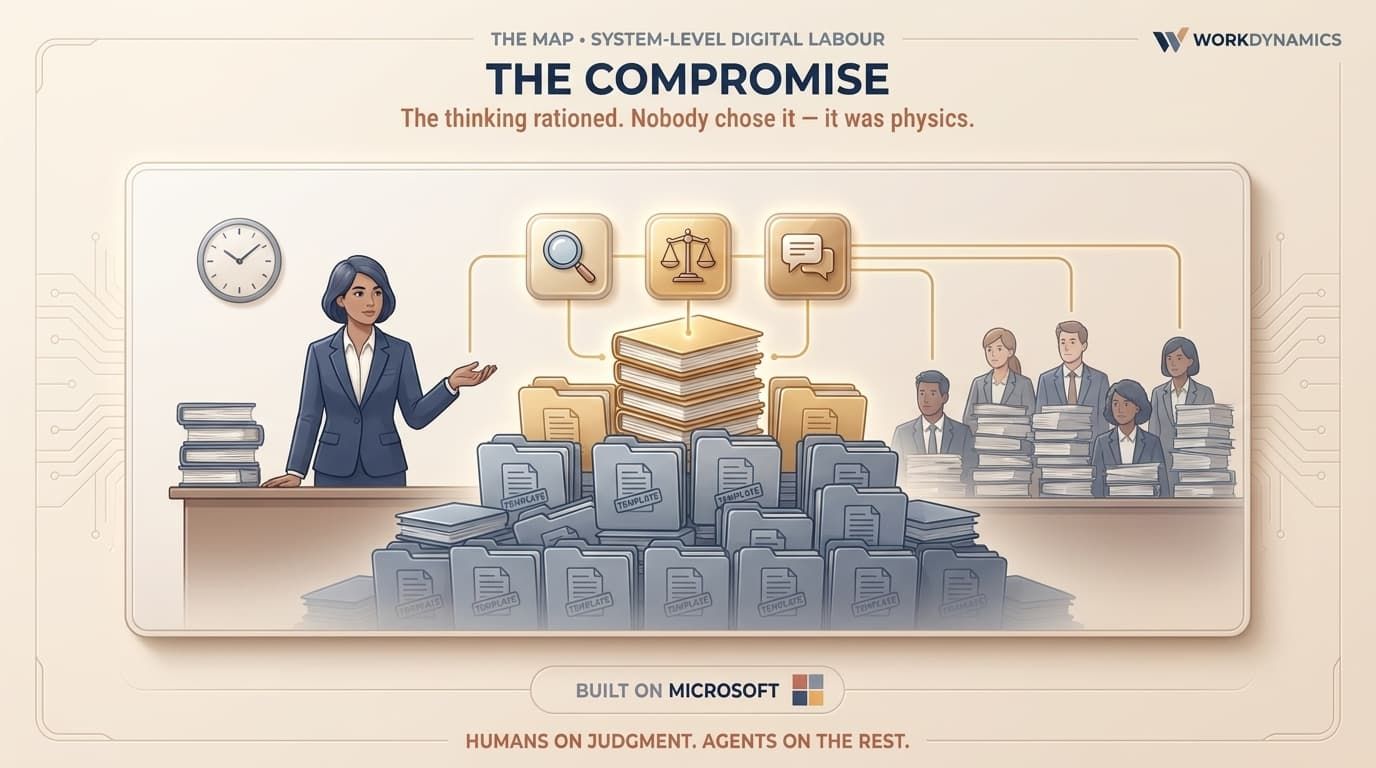
Not mistakes. Not bad people. Compromises — the small, permanent trade-offs a function makes just to get through the volume. The deep thinking that only goes to the cases big enough to justify it. The attention that only reaches the files near the top of the pile. The work that waits to be assigned because no one has the hours to get ahead of it. Every function runs on dozens of these, quietly, all the time.
You don't see them as compromises because they've always just been how it works. They're invisible the way the air is invisible. Nobody chose them. Everybody lives inside them.
That's your exposure: everything your function has quietly given up to keep moving — and has never counted, because it never had to.
Why it matters now
The compromises used to be unavoidable. Now they're a choice.
There were only ever so many hours in the day and so many people to spend them. So the function did what every function does — it triaged. The hard thinking went to the cases that could bear the cost of it. The careful attention went to whatever reached the top of the queue. Everything else got the quick version, because there was no other option. That wasn't a failure of will — it was a limit of physics.
That limit is the thing that just moved. The work that was getting the quick version because there weren't enough hands — assembling the information, keeping the record, chasing the routine follow-up, watching the signals no one had time to watch — no longer needs a person to make it valuable. The hours it used to eat are handed back.
So every compromise your function is still making, it's now making by default — not because it has to, but because no one has stopped to ask whether it still should. The rationing didn't end. It just stopped being forced. The question is no longer can we afford to do this properly? It's why are we still choosing not to?
Once you've seen it, the honest question is where your own function sits. You can find out now — or read on for what to look for.
See where your function sits →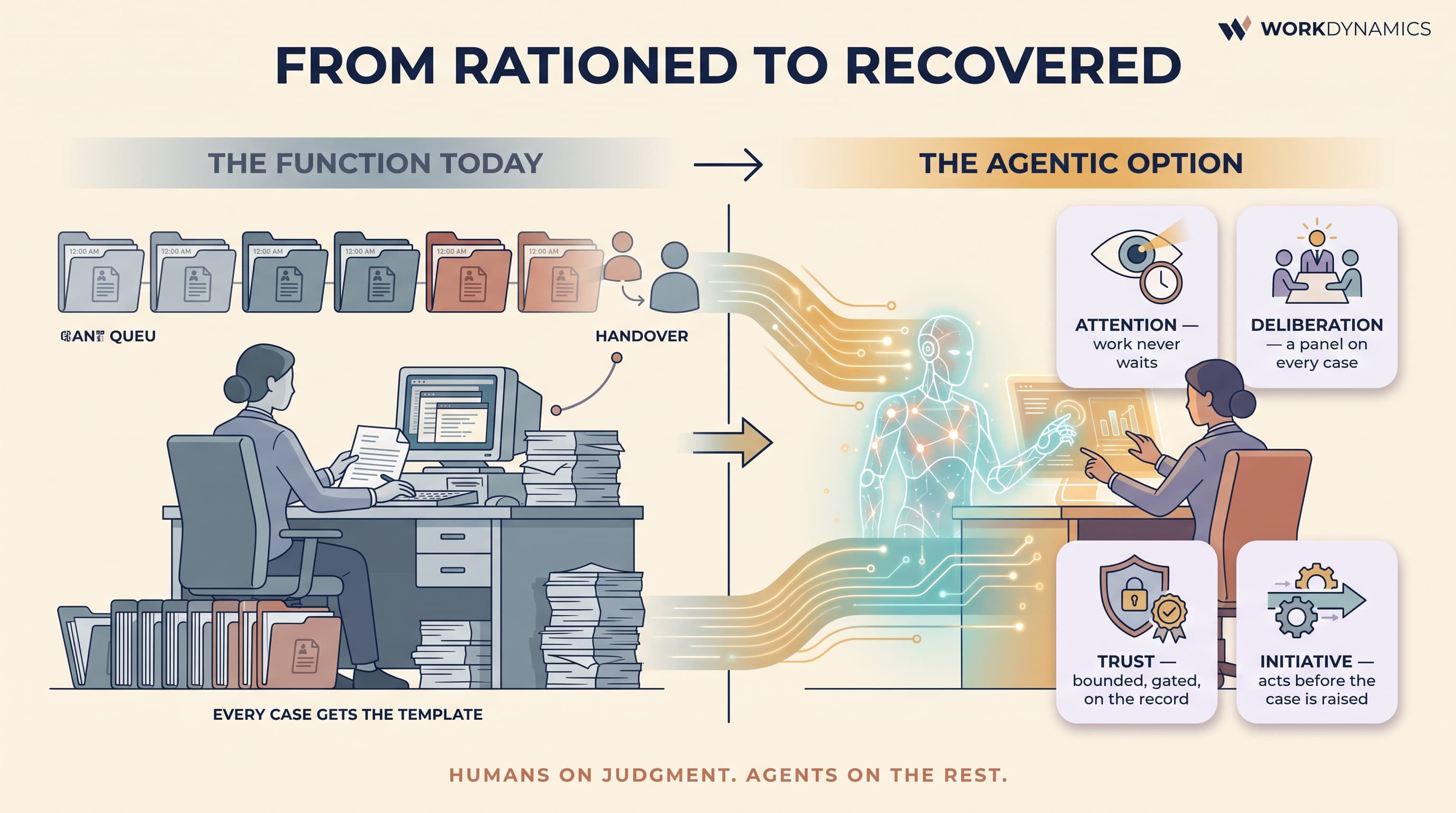
What exposure looks like
Here's what your function is quietly giving up.
Exposure shows up as four compromises. Most functions carry all four — you'll recognise at least one as yours.
The thinking gets rationed
Deliberation only for the big cases
Real thinking goes to the cases big enough to justify the time. Everything else gets a call made too fast — not because it deserved less, but because there weren't the hours to give it more.
The attention runs out
Only the top of the pile gets seen
What reaches the top of the queue gets looked at; what sits below the line gets a glance or nothing. Files slip and signals get missed — through sheer volume, not carelessness.
The record doesn't get kept
You can't show your work
Half of what gets done leaves no trace — decisions, steps, reasons, all in someone's head. So when the regulator asks or the person leaves, there's nothing to point to.
The work waits to be told
The function is permanently reactive
The follow-up, the flag, the chase — it all waits until someone has time to notice and assign it. The function stays reactive because it's never had the hands to be anything else.
Every one of these was forced, once. None of them is forced now.
The other side of exposure
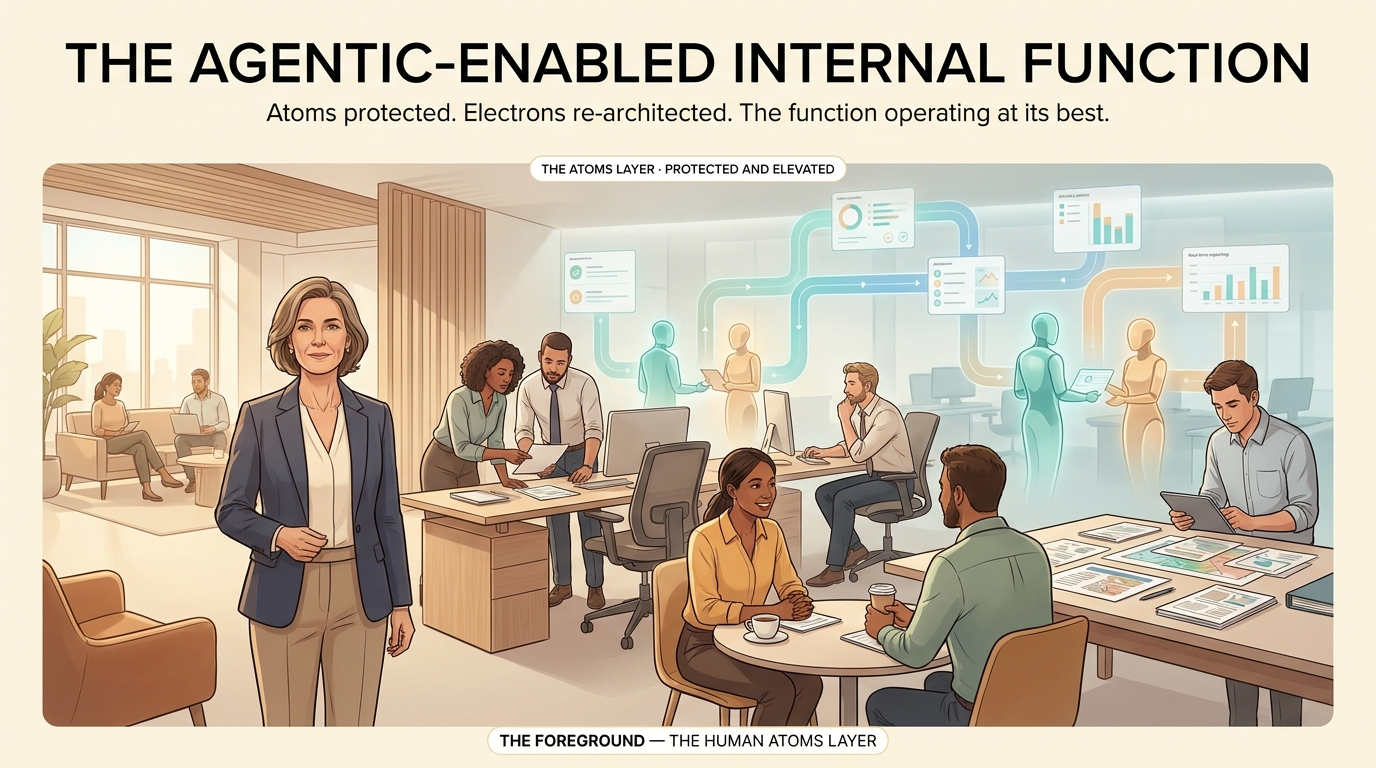
Now picture the same four, paid down.
Not by working people harder — by handing the routine load to something that can carry it, so the humans are freed for the part only they can do.
The thinking, unrationed
Every case gets proper consideration
Not just the ones big enough to earn it. The deliberation stops being a luxury reserved for the top of the pile.
The grind, lifted
Every file gets seen
Nothing slips below the line, because there's no line anymore. The queue stops deciding what gets attention.
The record, kept
Every act leaves a trace
When the regulator asks or the auditor calls, you show your work. Trust stops being something you have to ask for.
The unprompted work, done
The function gets ahead of the work
The follow-up happens and the risk gets flagged before anyone has to assign it — instead of forever chasing it.
Humans on judgment. Agents on the rest — the thinking unrationed, the grind lifted, the record kept, the unprompted work done.
FAIER — Functional AI Exposure
You can't undo a compromise you can't see.
The first move isn't a project or a pilot. It's a clear reading of where your function sits today, and what its exposure is costing you — the raw material for the conversation with the CFO and the CEO, grounded in your function instead of a slide of someone else's.
What it reads
Where your function sits on the Spectrum today, and where its AI exposure is concentrated — across the work your function actually performs.
What you walk away with
An instant result, specific to your function, written for a leadership audience — something you can take into the ROI and the lock-it-in-across-teams conversation.
What it is not
Not a maturity model. Not a tooling inventory. A reading of the work itself — what's happening in your operations today.
Built by people running production AI
Not theory. Systems operating today.
WorkDynamics advises commercial, local government and NFP organisations across Australia and New Zealand on the move from individual AI use to structural Digital Labour. The same framework informs production AI systems in live operation.
Injury Guard AI
Workplace injury management — triage, case management, finalisation.
Safe Havens AI
Safeguarding response — live in regulated environments.
You've seen the excitement at the desk. This is how you find out what it means for the function.
See where your function sits →Humans on judgment. Agents on the rest.