WorkDynamics · AI changes the work. Lead the response.
How exposed are you?
Personal. Professional. Functional.
Not your organisation's exposure. Yours — your standing, your craft, and the function you're accountable for. Ten minutes gives you a position on the AI Work Spectrum and the four forfeits your function is paying for every week.
You can't command what you can't see.
How AI Exposed are you? →Is this you? We work with leaders who own a function — claims, contact centre, lending, employee services — and are accountable for how the work runs. If you don't own a function, this isn't built for you.
The path
Three steps to address your AI exposure.
01
Know your exposure
Personal, professional, functional. Where your function sits on the AI Work Spectrum, what the old scarcity is still costing you every week, and which part of your own expertise just became more valuable rather than less.
Also free. Command Notes · a worked sample Functional Agentic Roadmap · Module 1 of AI Command Foundations · a fortnightly Command Room session.
Free · 10 minutes
Find out — 10 minutes02
Build your fluency
Yours first, then your team's. Enough to read an agentic proposal, test its governance, size its cost, and say what stays human without sounding defensive — because a fluent leader with a function that isn't is still stuck.
What you get. Seven modules, 50+ lessons, 365 days, with Vantis working on your own function. For a team of five: five seats plus four 45-minute coaching sessions on a fixed weekly slot, with recordings.
Starts at $297 for a leader
See AI Command Foundations03
Run a FAST
The roadmap that answers whether and where. The blueprint that answers exactly how. Advisor-led, benchmark-calibrated, and written so a CFO can sign it.
Nine components — atoms and electrons, current-state Spectrum reading, agentic future state, value at stake, prioritised workflows, protected judgment, the return case, the capability case, the Microsoft platform shape. The roadmap we built for a 30-person injury management function modelled 220% three-year ROI and a 16-month payback.
POA for a function plus
See the full pathWhat it's costing you now
You're paying for the old scarcity. Today. On every case.
None of this is anyone failing. Every one is a trade made years ago, sensibly, because expert attention was scarce and the work had to be shaped around the ration.
The queue
The case that waited four days before anyone read it.
The template
The report that repeats the last one, because there was only time to change the dates.
The checklist
The checklist that didn't fit the case but got followed anyway.
The gap
The follow-up that never happened, because the next case had landed.
The scarcity is gone. The trades never stopped — and because each one looks like how work is done, nobody is counting what they cost.
What's in each step
Every element, and where it sits.
| 01 Know your exposure | 02 Build your fluency | 03 Run a FAST | |
|---|---|---|---|
| For | Anyone | A leader, or a leader and team | A function head with a budget |
| Time | 10 minutes | Self-paced, or 4 weeks with a coach | Advisor-led |
| Functional AI Exposure Report | ✓ | ✓ | ✓ |
| Command Notes — three volumes | ✓ | ✓ | ✓ |
| Sample Functional Agentic Roadmap | ✓ | ✓ | Your own |
| Command Room — fortnightly, live | ✓ | ✓ | ✓ |
| AI Command Foundations — Module 1 | ✓ | — | — |
| AI Command Foundations — all 7 modules | — | ✓ | ✓ |
| Vantis — the teaching agent | — | ✓ | ✓ |
| Group coaching — 4 × 45 min | — | Team of five | ✓ |
| Functional Agentic Roadmap — 9 components | — | — | ✓ |
| Functional Agentic Blueprint | — | — | ✓ |
| You end up with | A position and a number | A case you built yourself | A funded plan and a build-ready design |
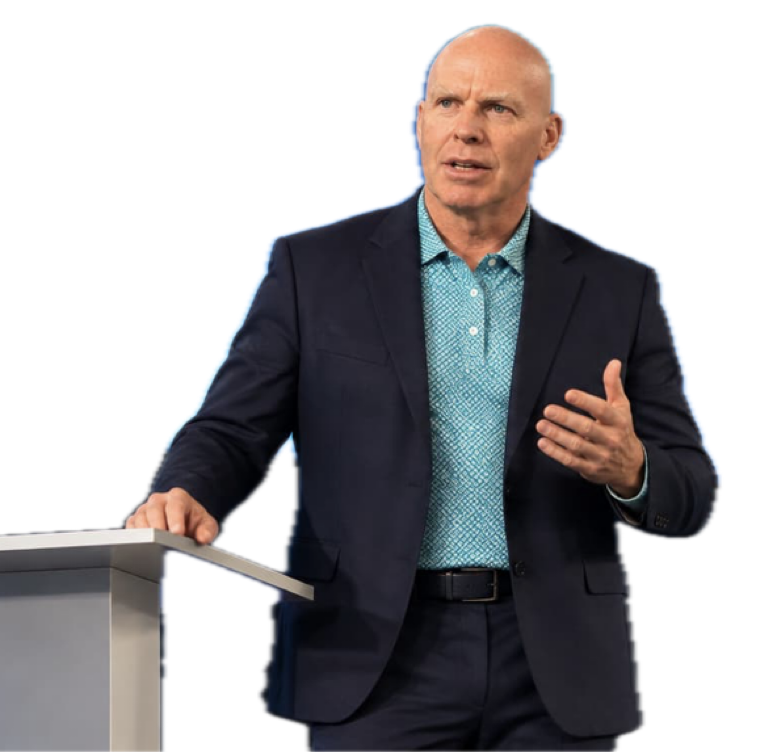
Who is behind this
By someone who's built the systems, not just the slides.
I'm John Ackery. Twenty-five years building systems for the people who run functions — customers from Sydney to London to California, on the traditional platforms of their day.
That's how I know what those systems ration. I built the rationing in, because it was the only thing the code could do.
When agentic systems arrived I put a team on two AI-native applications, Injury Guard AI and Safe Havens AI, and built them end to end: intake agents, triage agents, per-case task generation, case sign-off — authored in Copilot Studio on Dataverse.
Those agents became the capability library the course teaches and the roadmaps are built from. Everything we design runs on the Microsoft AI stack — a partnership of more than twenty years. That's a choice, not a dependency.
You are not hiring a large consultancy with a long engagement and a bigger invoice at the end of it. You are not hiring platform engineers who will explain your own function back to you in jargon.
You are working with a small, pragmatic, results-centred team. We build the leadership capability — yours and your team's — and we work so you see something real in weeks, not months and years.
Not ready for the questions?
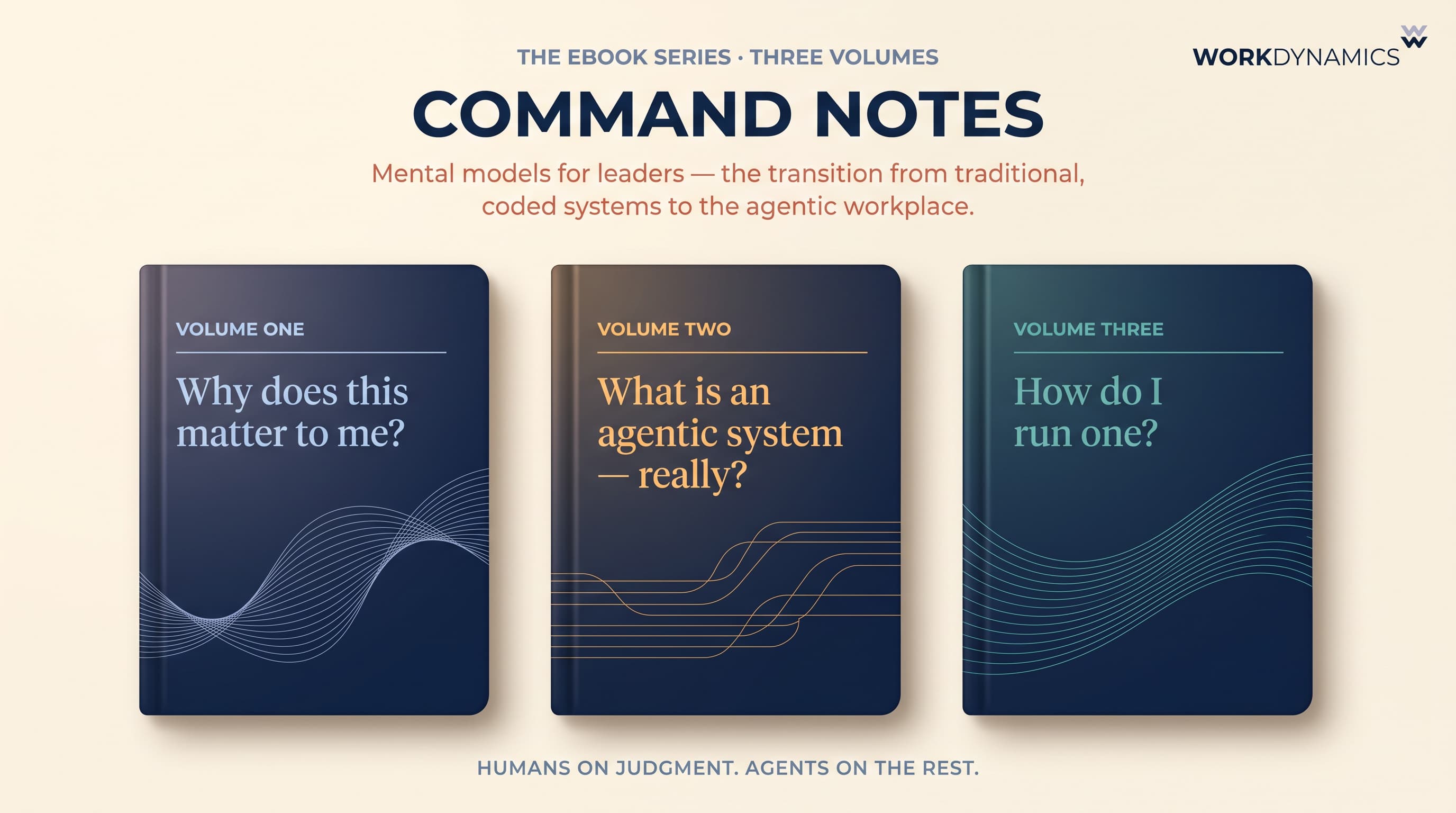
Start with the reading. Three volumes, free.
The literacy ladder in short form — read them tonight, no credit card.
- Volume One — Why does this matter to me?
- Volume Two — What is an agentic system, really?
- Volume Three — How do I run one?
Every system your function runs was built to ration something.
We replace the rationing with agentic systems that work to intent — and your function stops being limited by what its software allows.
Humans on judgment. Agents on the rest.