Functional Agentic Roadmaps to treat Your AI Exposure
Leaders used to wait for technology to catch up. Now the technology is waiting for leaders to catch up.
The Functional Agentic Roadmap is the engagement that closes the gap — function by function and is the first workload before your Agentic Blueprinting and design phase.
A function-altitude blueprint. Not a strategy deck. Not a maturity model. Not a pilot. The artefact your CFO, your CIO, your Microsoft account team, and your board can all read from the same page.
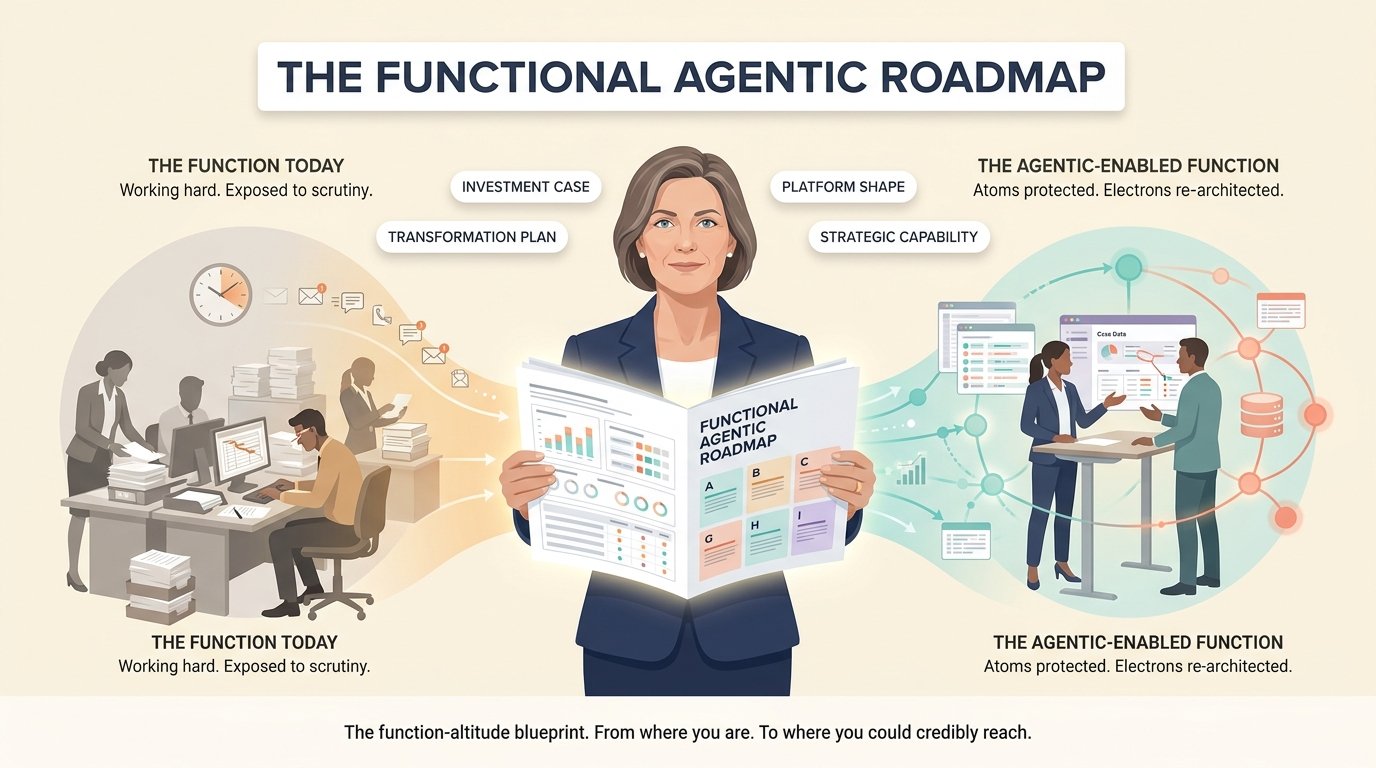
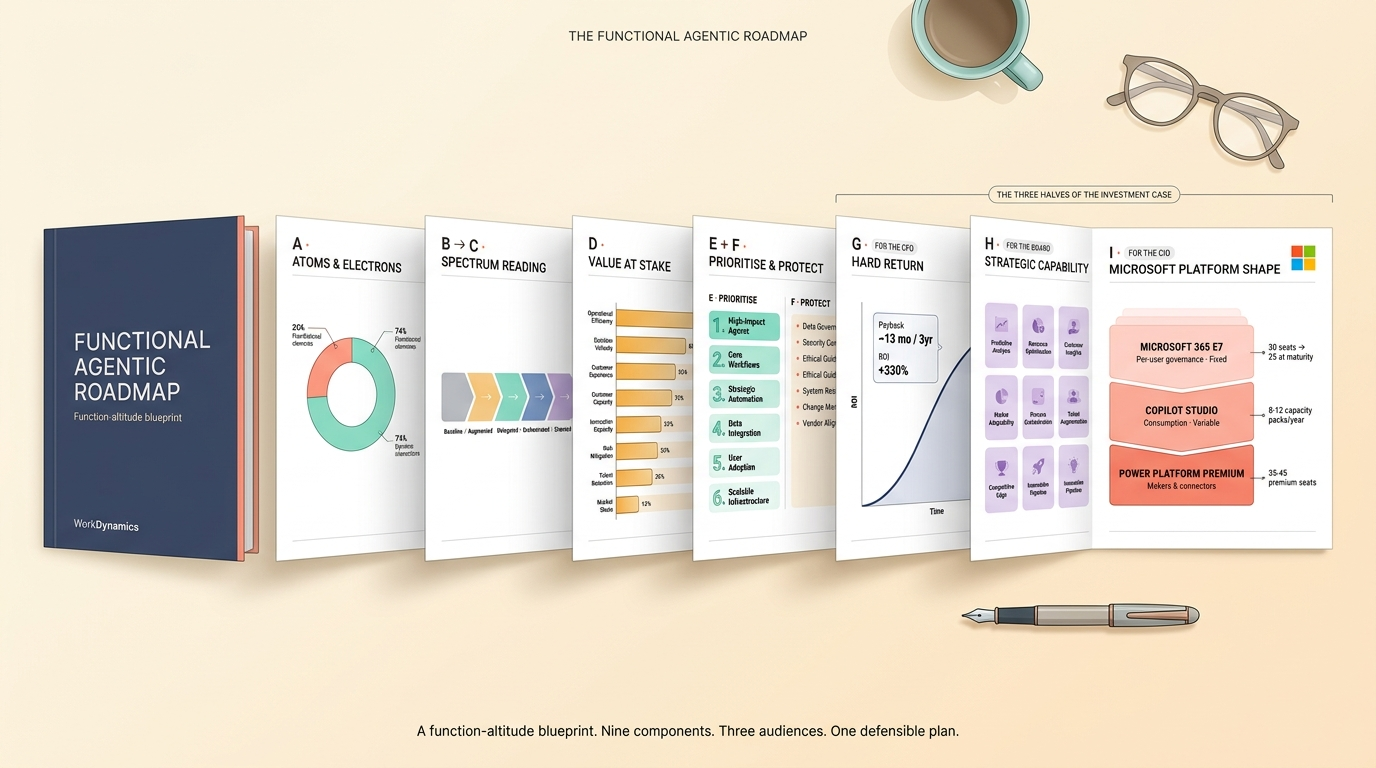
Nine analytical components. Three audiences. One defensible plan.
A Functional Agentic Roadmap is a structured analytical engagement that produces a single document — a function-altitude blueprint. Nine components do the work, from atoms and electrons through to the Microsoft platform shape your CIO can architect against.
The three halves of the investment case — hard return, strategic capability, and platform shape — sit inside. Each one is written for the audience that needs it: the CFO, the board, the CIO.
One artefact. Read by every leader who has to sign off on it.
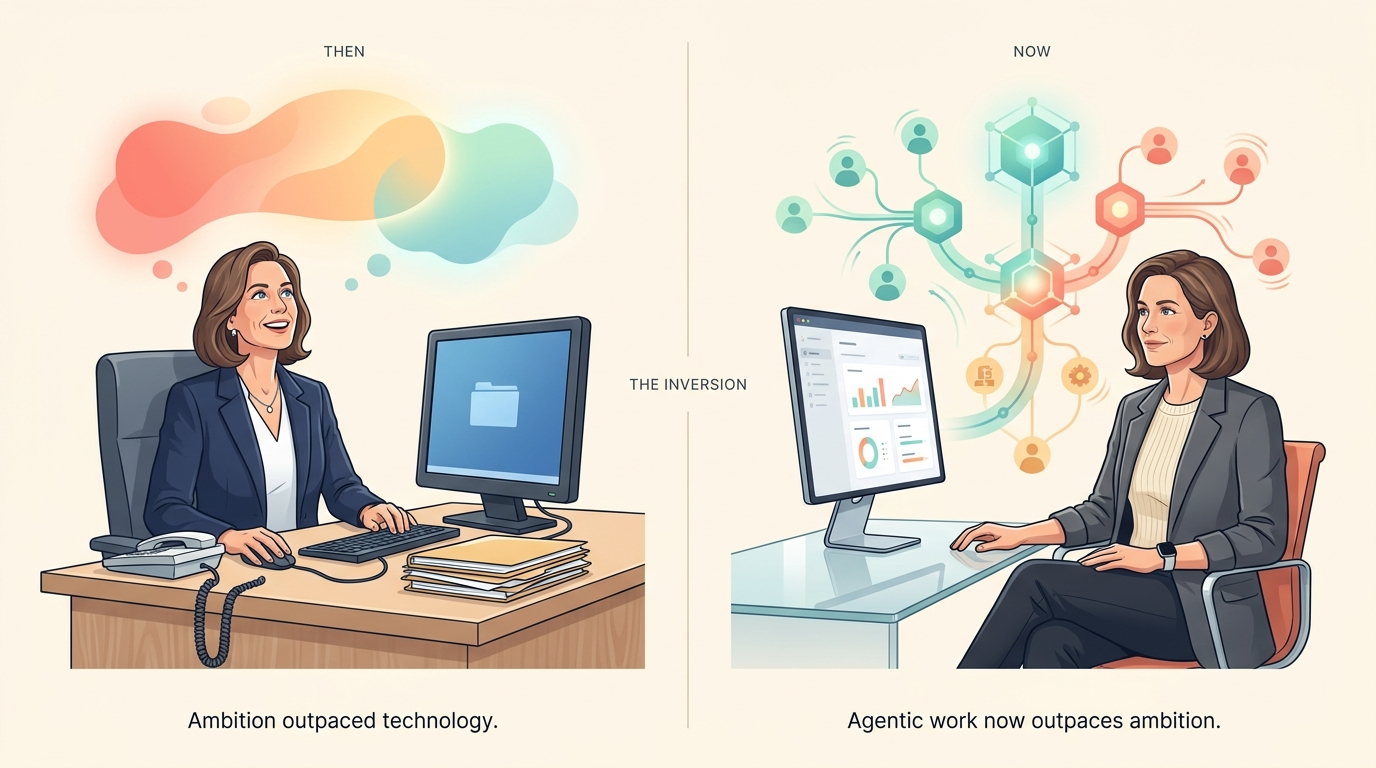
Ambition outpaced technology. Now agentic work outpaces ambition.
For decades, leaders imagined more for their workplaces, systems, and people than the technology could deliver. They waited for the tools to catch up.
That relationship has inverted. GenAI and agents now do more than most leaders have yet defined as their ambition.
Functions that don't define their response will have one defined for them — by competitors moving faster, by regulators setting the boundaries, by the technology reshaping the work itself. And by the people who won't stay in workplaces that haven't kept pace with the modern ones.
A Functional Agentic Roadmap is how a function defines its own response — properly, before someone else defines it instead.
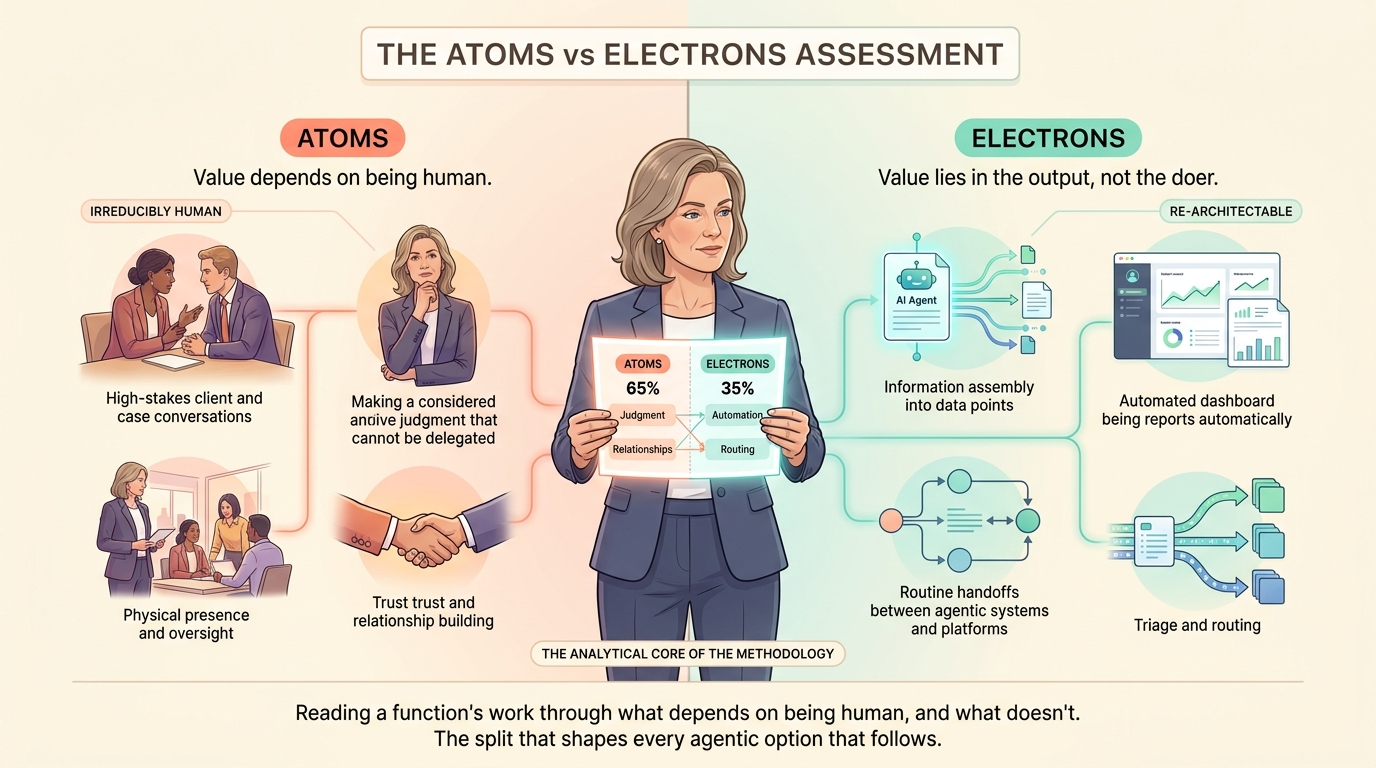
Reading a function's work through what depends on being human — and what doesn't.
At the core of the methodology is one analytical move. Every function's work is divided into two:
Atoms — work whose value depends on being human. High-stakes conversations. Considered judgment that can't be delegated. Physical presence. Trust and relationship building. The work that defines the function and the team.
Electrons — work where the value lies in the output, not the doer. Information assembly. Triage and routing. Automated reporting. Routine handoffs between systems. The work that has to happen, but doesn't need a person to make it valuable.
The split shapes every agentic option that follows.Where it's electrons, Digital Labour takes them. Where it's atoms, the humans stay. Which workflows to redesign first? What stays human? Where agents work end-to-end. Where they assist rather than lead. The investment case, the platform shape, and the 90-day moves all flow from this one reading.
It's the discipline that makes the rest of the methodology defensible.
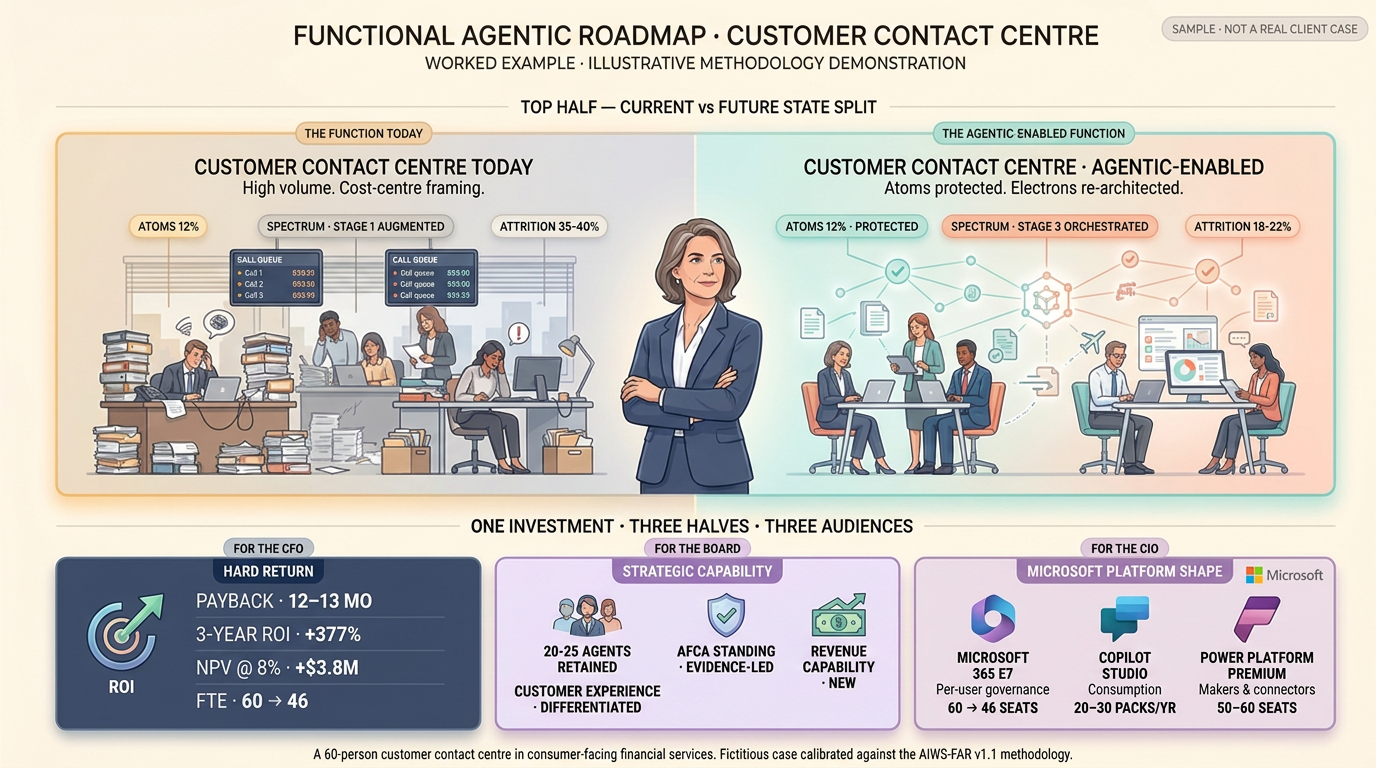
Customer Contact Centre. A customer-facing function.
A 60-person customer contact centre inside a consumer-facing financial services business. The atoms profile comes in at 12% — most contact work is genuinely delegable — but that 12% holds the entire commercial value: vulnerable customer interactions, complex complaints, retention conversations.
The methodology produces a sequenced workflow priority list, an investment case the function head can take to the CFO, and a Microsoft platform shape the CIO can architect against. Payback in 12–13 months. Three-year return around +377%. Twenty to twenty-five experienced agents retained. AFCA standing strengthened.
One worked example. One function. One defensible blueprint.
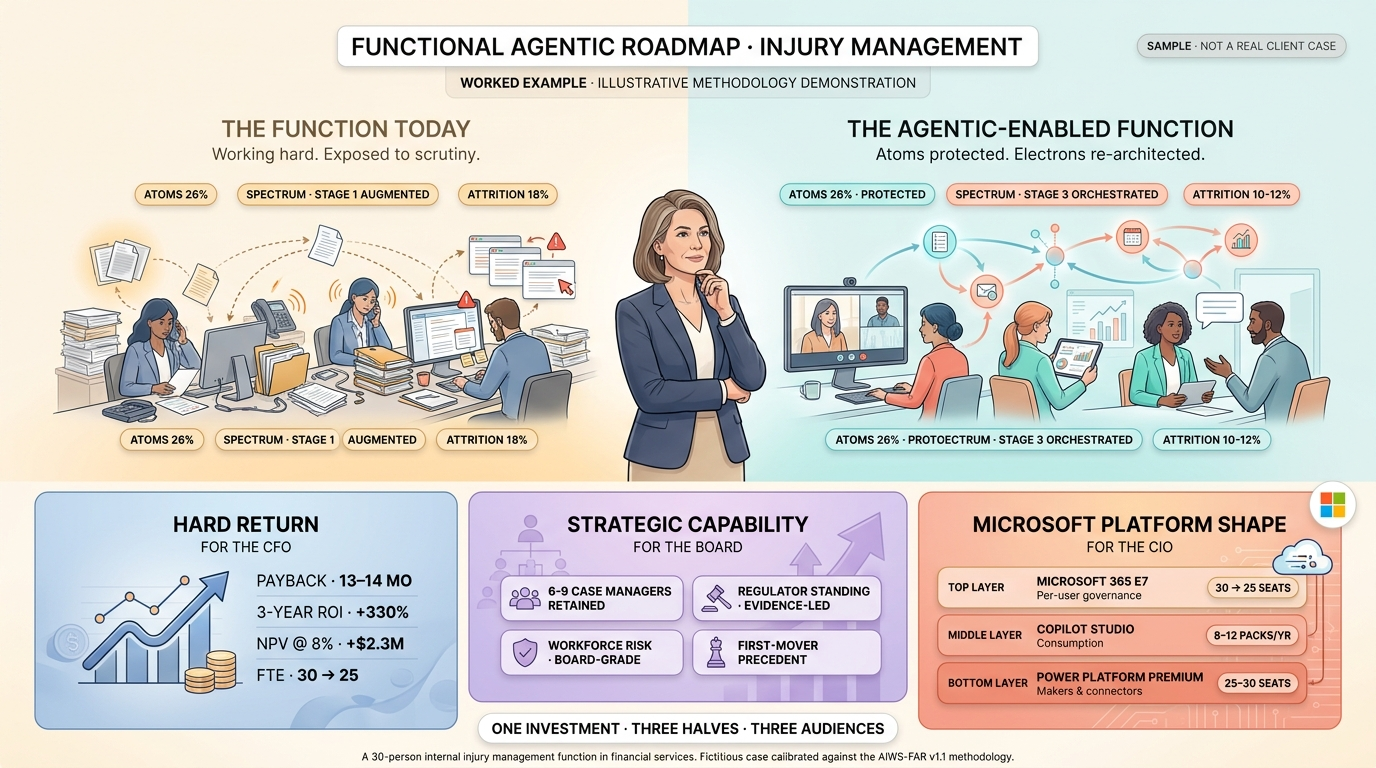
Injury Management. An internal operations function.
A 30-person internal injury management team inside a large employer. The atoms profile comes in higher — 26% of the work is irreducibly human, sitting in the case conversations and relationship work, not the paperwork. The methodology protects that core and re-architects everything around it.
The blueprint produces a sequenced workflow priority list, an investment case the function head can take to the CFO, and a Microsoft platform shape the CIO can architect against. Payback in 13–14 months. Three-year return around +330%. Six to nine experienced case managers retained who would otherwise have left. A regulator standing that moves from defensive to evidence-led.
Same nine components. Same atoms-and-electrons move. A completely different function.
That's the point. The methodology is not a template — it's a discipline. It produces a function-specific blueprint that holds up in front of a CFO regardless of whether the function is internal operations or customer-facing.
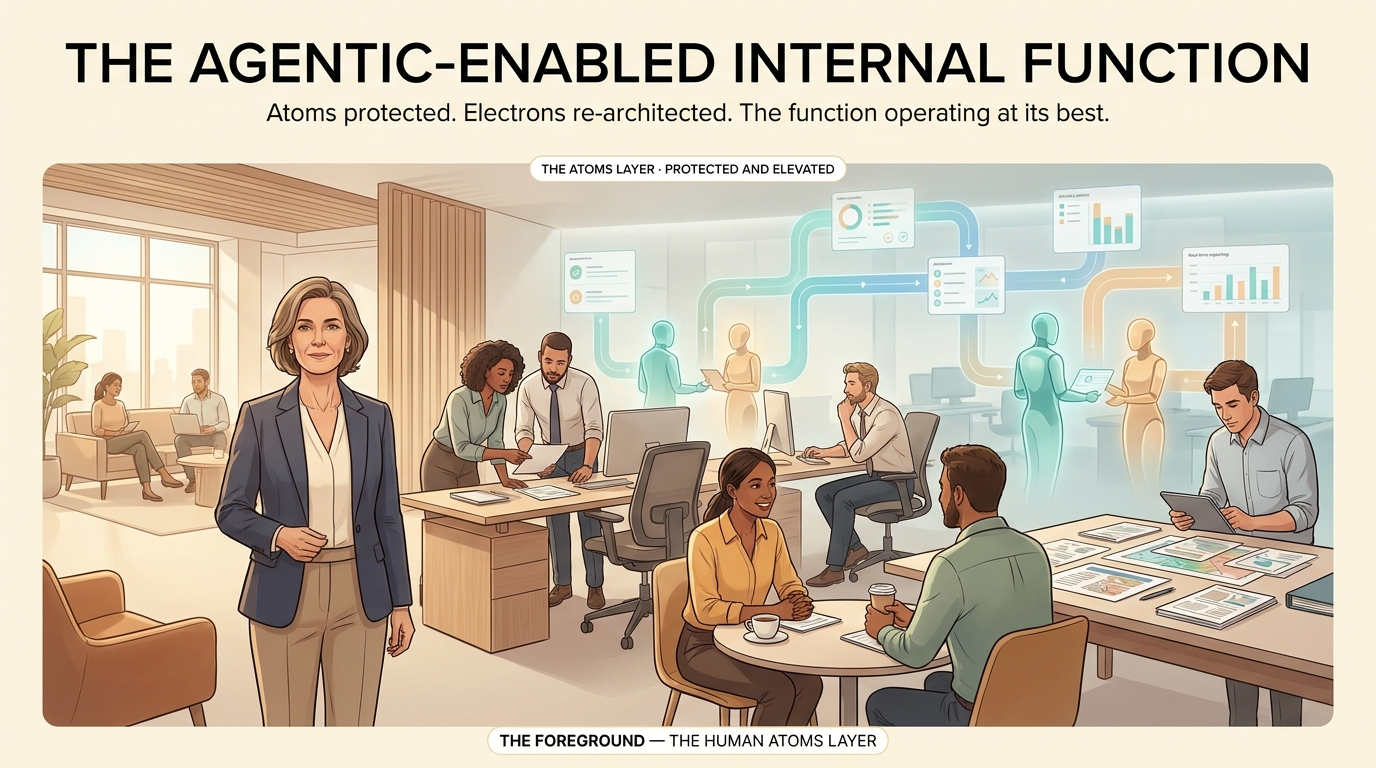
The internal function — atoms protected, electrons re-architected.
The methodology produces more than an investment case. It produces a picture of the function operating at its best.
In an internal services function, the humans hold the foreground. The case conversations. The judgment calls. The relationships. The work that defines the team and earns the standing.
The agentic layer runs underneath. Triage and routing. Information assembly. Workflow handoffs across Microsoft platforms. Automated reporting. The work that has to happen, done without absorbing the team's attention.
The result is a function where the people are doing the work only people can do — and the agents are doing everything else. Service responsive. Cost defensible. Risk audit-ready. Workforce intelligent.
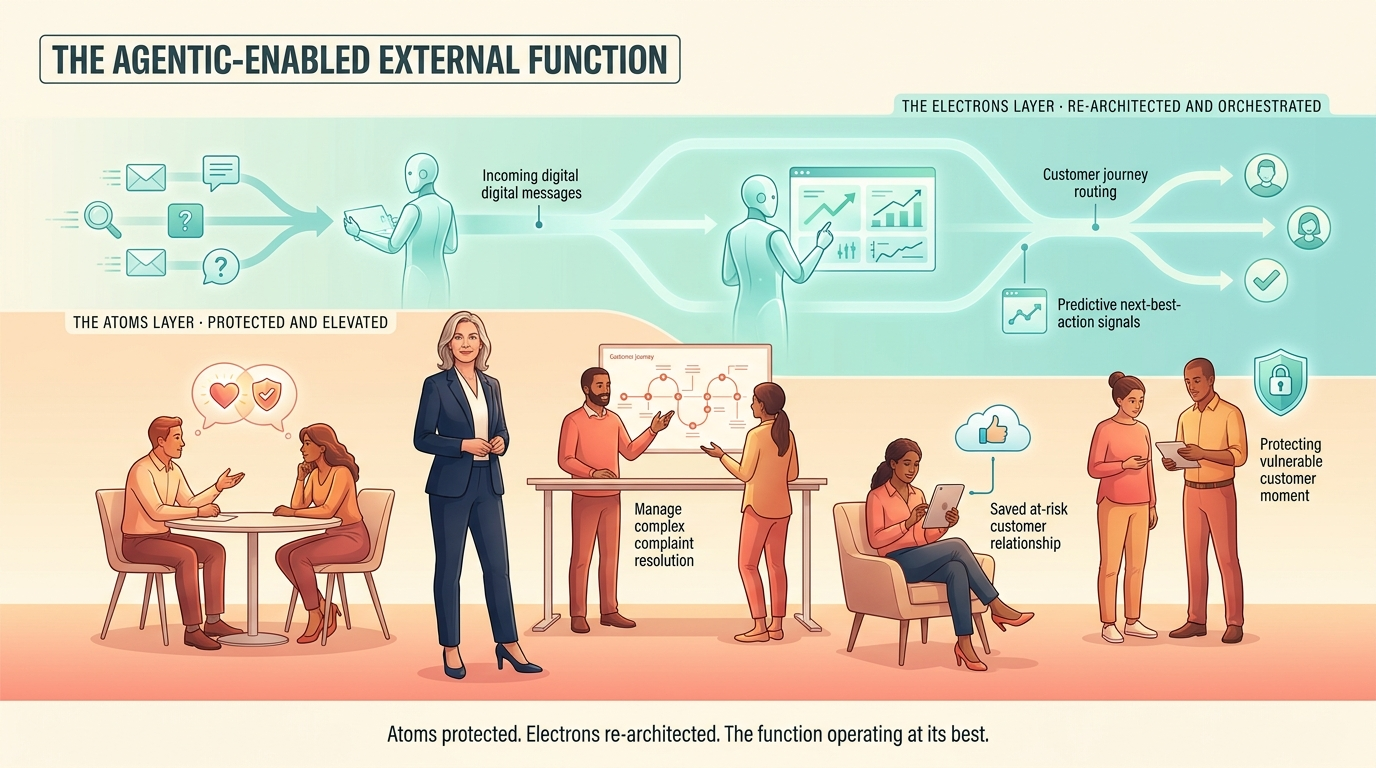
The external function — agents at the edge, humans where it counts.
The shape inverts when the function is customer-facing.
The agentic layer now sits at the edge — handling the routine contact, the triage, the orchestration across systems. The work that has to happen at scale, done without expanding the headcount it would otherwise require.
The humans are where the commercial value lives. The vulnerable customer interaction. The complex complaint. The retention conversation. The judgment call that retains a customer or sets the precedent for thousands more like them.
The result is a function that captures revenue, holds the customer relationship, accelerates offer velocity, and reshapes the cost structure — without losing the human moments that decide whether the business keeps the customer at all.
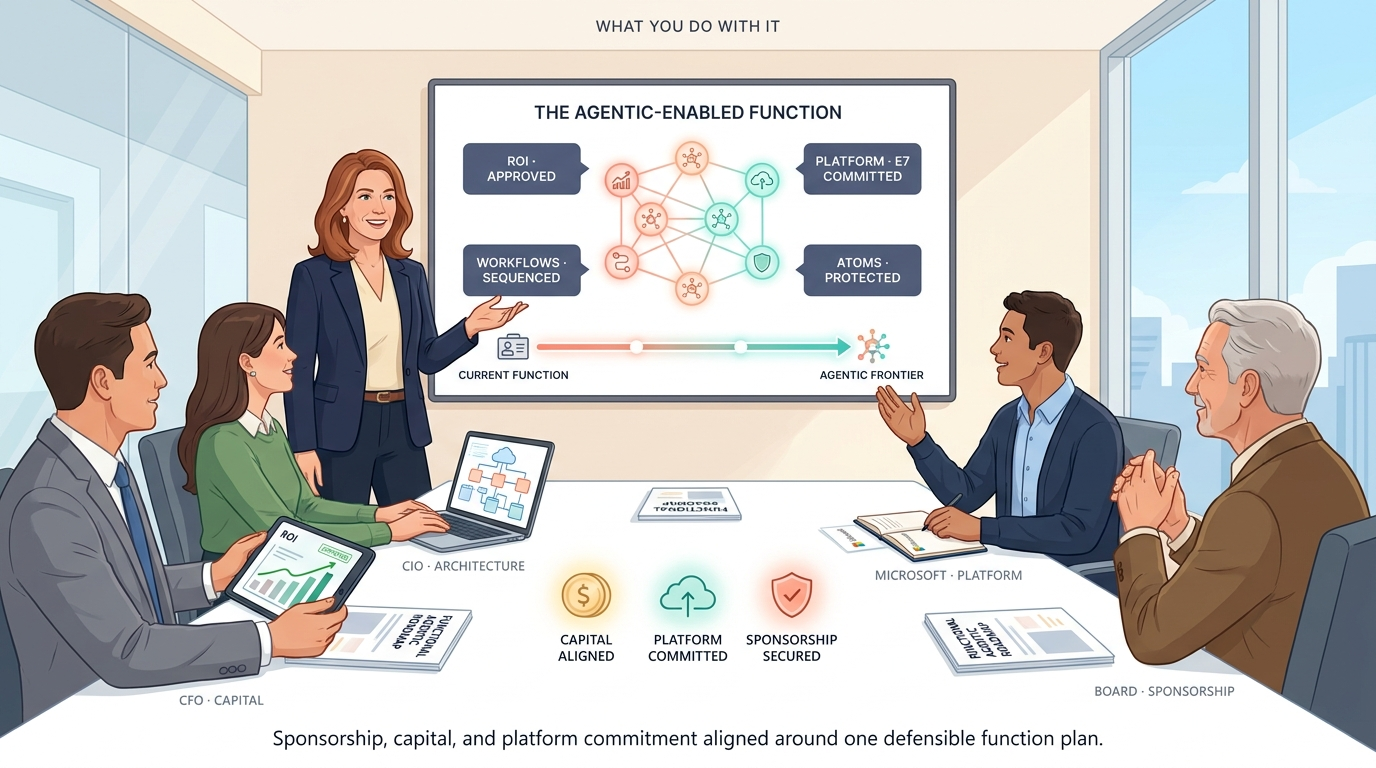
Sponsorship. Capital. Platform. Aligned around one defensible plan.
The Roadmap is built to be taken into the conversations that matter.
Into the CFO conversation, with the hard return signed off and the investment envelope defended.
Into the CIO conversation, with the Microsoft platform shape scoped against function-level value, not generalised assumptions.
Into the Microsoft account team conversation, with the E7 commitment shape and the Copilot Studio capacity already named.
Into the board conversation, with the strategic capability case alongside the hard return — and the function-by-function plan the board has been asking for.
One artefact. Four rooms. The same defensible plan read from the same page.
Or talk to us directly.
If you'd rather start with a conversation, a 30-minute scoping call is the next step. It covers the methodology, the ROI shape, a sample report applied to a function close to yours, the Microsoft investments the activation path implies, and the activation path itself — CAIP and LEEP.
You'll leave with a clear view of what scoping a Functional Agentic Roadmap looks like for your function.
Book a 30-minute scoping conversation →