WorkDynamics · Design Rehearsal · Injury management
Every function is getting an agentic future. The only question is whether its leader designed it or inherited it.
For decades, functions have run on rules-only software. It does exactly what it's configured to do — so careful attention gets rationed to the cases that look complex, and everyone else gets the template. Intent-based agentic systems work out what each case needs, inside hard limits set by rules, and a person still makes the call.
This Design Rehearsal shows the difference in one function: injury management. Watch one claim move through a working design, ready for a build on Copilot Studio and Dataverse — agents read and weigh, rules hold the hard limits, and the triage manager decides.
A working rehearsal of a design — not a built or deployed system.
What you'll see
Not just the agents. The workplace around them.
The rehearsal follows a claim from first report towards closure across three views — the places your people would actually work.
View 1
The triage workbench
Where a new claim is read, weighed by a specialist panel, and decided by the triage manager.
View 2
The team board
Where the work program built from that decision is shared out between agents and people.
View 3
The case manager desk
Where the case is worked and monitored through to closure.
Agents read, weigh, draft and do the routine work. Rules hold the hard limits. People make every decision that matters — and every step shows who did it.
Rules-only software vs an intent-based system
Same function. Two ways to run it.
The difference isn't automation. It's how control works — and how much of your function's attention gets rationed.
Rules-only software
Control through specification. The system does exactly what it was configured to do, case after case. Anything the rules didn't foresee waits for a person — so attention goes to the claims that look complex, and the rest get the template.
Intent-based agentic system
Control through judgment, boundaries and accountability. Agents work out what each claim needs inside hard limits set by rules, and a person decides. Every claim gets the full read, not just the ones that look serious.
| The question | Rules-only today | Intent-based |
|---|---|---|
| What's being missed? | Full review for complex claims; the rest get the standard plan | Every claim triaged in full on day one |
| How good is the call? | One case manager's read | A panel of specialist agents weighs every claim; the triage manager chooses between real options |
| How late do you find out? | Risk surfaces when the claim stalls | Risk signals raised at intake |
| Can you prove it? | Notes spread across email and files | Every view, decision and task on one record |
| What does each case cost? | Long claims drive premium, lost time and case manager hours | Shorter claims through earlier, tailored programs |
The trade-off, stated plainly
An intent-based system won't give the identical answer twice. What it gives instead is the record: every specialist's view, every option and every decision — so you can always see why. And where the law needs the same answer every time, a rule makes the call, not an agent.
Inside the triage workbench
Seven stages. A person decides. Every step shows who did it.
How one claim moves from first report to a work program — and which of the Twenty Agentic Capabilities each stage uses.
Intake
The intake agent captures what happened as a fixed set of facts. Rules then check for immediate danger, crisis or a notifiable incident, and set a starting severity that no later step can lower.
Document extraction
The document agent reads the medical certificate — capacity, restrictions, hours, review date. Anything that doesn't fit is flagged, and a rule recalculates severity. If no certificate arrives, the system chases it.
Convene the panel
Rules size the panel to the claim: four specialists for a minor claim, ten for anything more serious. Everything the panel reads is sealed into one case pack, stored word for word.
The Council reads the case
Each specialist takes one angle — safety, the law, the medical evidence, wellbeing, return to work, the worker's own voice and more. Some can rule an option out; others can insist an issue reaches the decision maker.
The chair
The chair sees only what the panel said, never the case file. It frames two or three genuinely different options with their trade-offs, and what was ruled out. If it drops a disagreement, the system puts it back.
The human gate — the triage manager decides
They can't approve until they've chosen an option and acknowledged every disagreement. Or they send it back with a reason, and the panel sits again. The first attempt stays on the record.
A custom action plan
The decision becomes tasks for agents, people or both, each traced back to the decision. Anything filed with an authority or sent outside waits for a person to approve it.
Then the case passes to a case manager and is monitored through to closure. Every closed case feeds a learning loop, so one claim sharpens how the next is triaged.
Up close
Three moments from the rehearsal.
Stills from the working design. The record on the right fills as the run writes — and no agent writes to it directly.
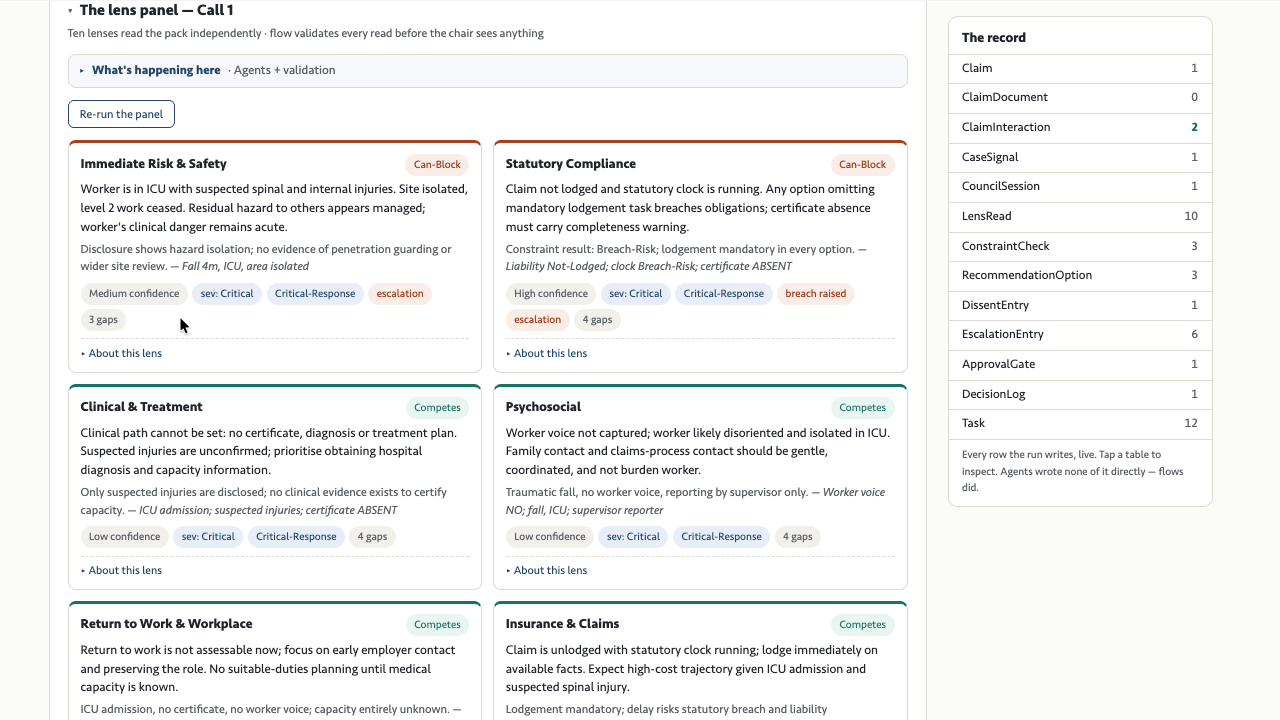
Stage 04 · Deliberative Council
The Council at work
Each specialist reads the case from one angle and gives a short, structured view with its confidence and gaps. Safety and the law can block an option outright. Every view is checked before the chair sees it.
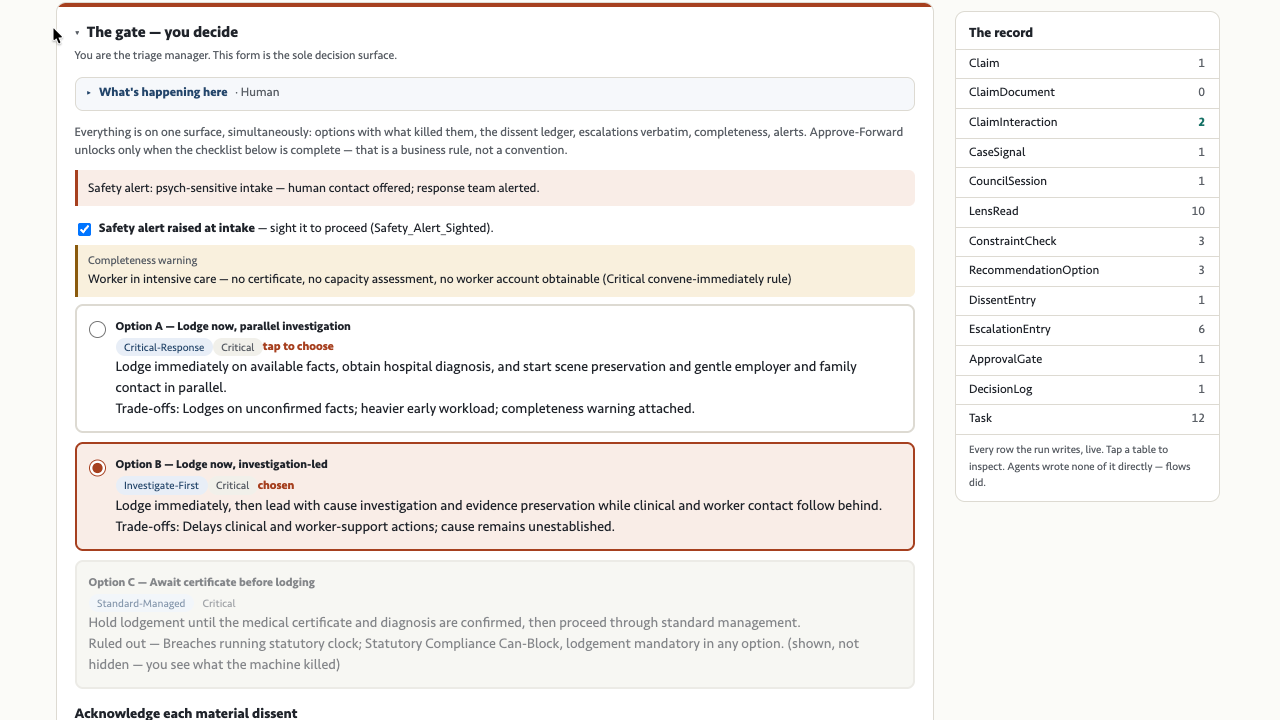
Stage 06 · HITL Control Points
The human gate
Every option on one surface, including the one the system ruled out and why. Approval only unlocks once the safety alert is sighted and every disagreement is acknowledged — a business rule, not a convention.
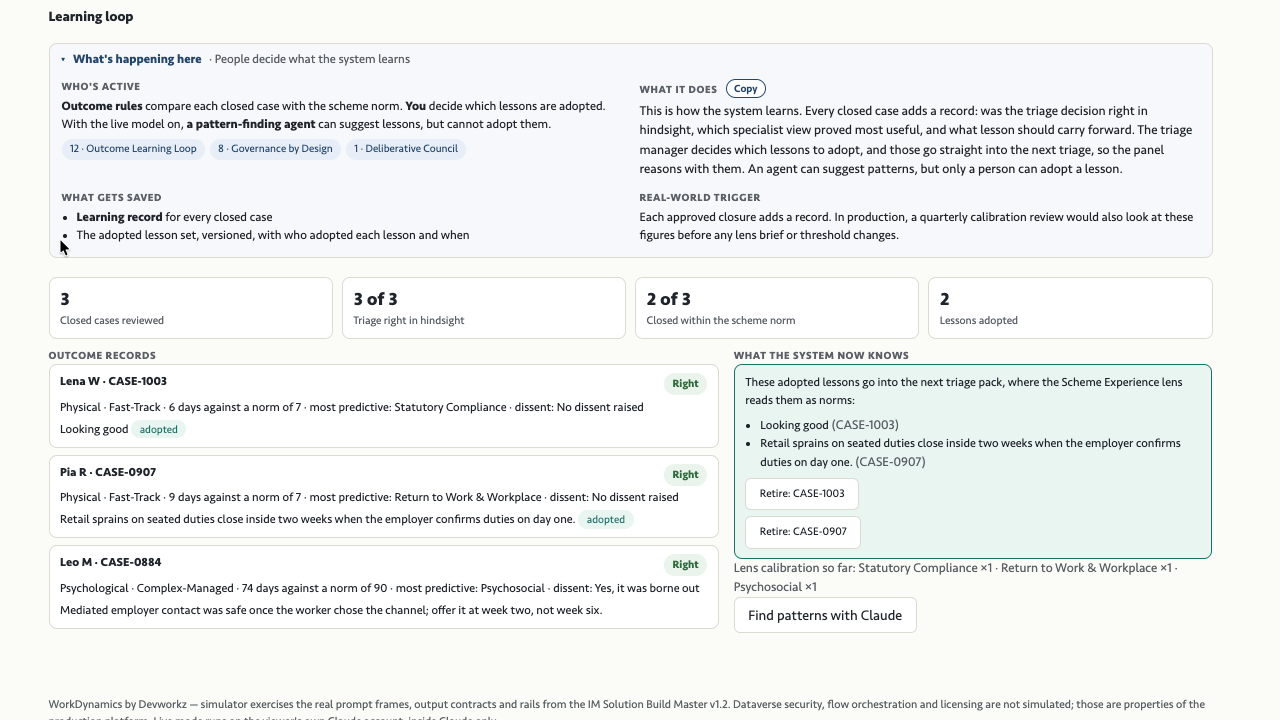
After closure · Outcome Learning Loop
The learning loop
Every closed case records whether triage was right in hindsight and which view proved most useful. An agent can suggest a lesson; only a person can adopt one. Adopted lessons go into the next triage.
How it's designed to run on your Microsoft stack
Agents reason. Rules hold. The record keeps. People decide.
Designed to be built inside your own Microsoft environment on Copilot Studio, Dataverse and the Power Platform. In the design, each part has one job, and none of them does another's.
Copilot Studio
Agents with one job each
Intake, documents, each specialist, the chair, the program builder. They read, weigh and draft. They never write to the record directly.
Governed flows
Rules that never bend
Severity floors, panel size, legal deadlines. The same answer every time, because that's where the law needs it.
Dataverse
A record that can't be rewritten
Fixed classifications, not free text. Every view, option and decision lands in an append-only log.
Your people
Authority at the gate
Every consequential decision, and every change to a threshold, is a person's yes.
Thirteen of the Twenty Agentic Capabilities in one rehearsal. Each is a reusable pattern — what it does never changes; what it's applied to is defined for your function.
More Design Rehearsals
Pick the one your function needs to see.
Injury management is the first. These are next on the build list, grouped by who owns the outcome — and the most-requested are built first.
People & safety
Injury management CHRO
Today: Full case review for complex claims only→Every claim triaged in full on day one
Working With Children Check verification CHRO
Today: Checked at hire, expiries on a spreadsheet→Every worker verified, every expiry watched
Notifiable WHS incidents CEO
Today: Notifiability decided by whoever is on site→Every incident tested against notifiable criteria
Reportable conduct allegations CEO
Today: One person judges what's reportable→Every allegation tested against the scheme
Finance
Supplier bank-detail changes CFO
Today: Callbacks on flagged changes only→Every change verified before payment
Payroll underpayment CFO / CHRO
Today: Sample audits of pay runs→Every pay line checked against award and contract
Refunds and remediation CFO / GC
Today: Affected customers identified by sample→Every customer assessed
Risk, legal & security
Whistleblower and protected disclosures GC
Today: Reports outside the formal channel missed→Every report screened for protection on arrival
Access reviews CISO
Today: Annual review, rubber-stamped→Every account reviewed continuously
Privacy breach assessment CISO / GC
Today: Only obvious incidents assessed→Every incident screened for likely serious harm
Revenue
Deal risk and slippage CRO
Today: Forecast calls on the deals reps mention→Every deal read for slippage signals
Customers at risk of leaving CRO / CCO
Today: Account reviews for the top tier only→Every account watched
Need to see one of these, or something not on the list? Tell us which rehearsal you need →
What is your function rationing today?
This rehearsal shows the pattern in injury management. Your exposure report shows where it applies in yours.
Get your free exposure report → Want it designed for your own function and cases? See the Functional Agentic Blueprint →Humans on judgment. Agents on the rest.